
2026 Engineering Compensation Intelligence Report
ISG Partners Com2026-engineering-compensation-intelligencepensation Intelligence Series
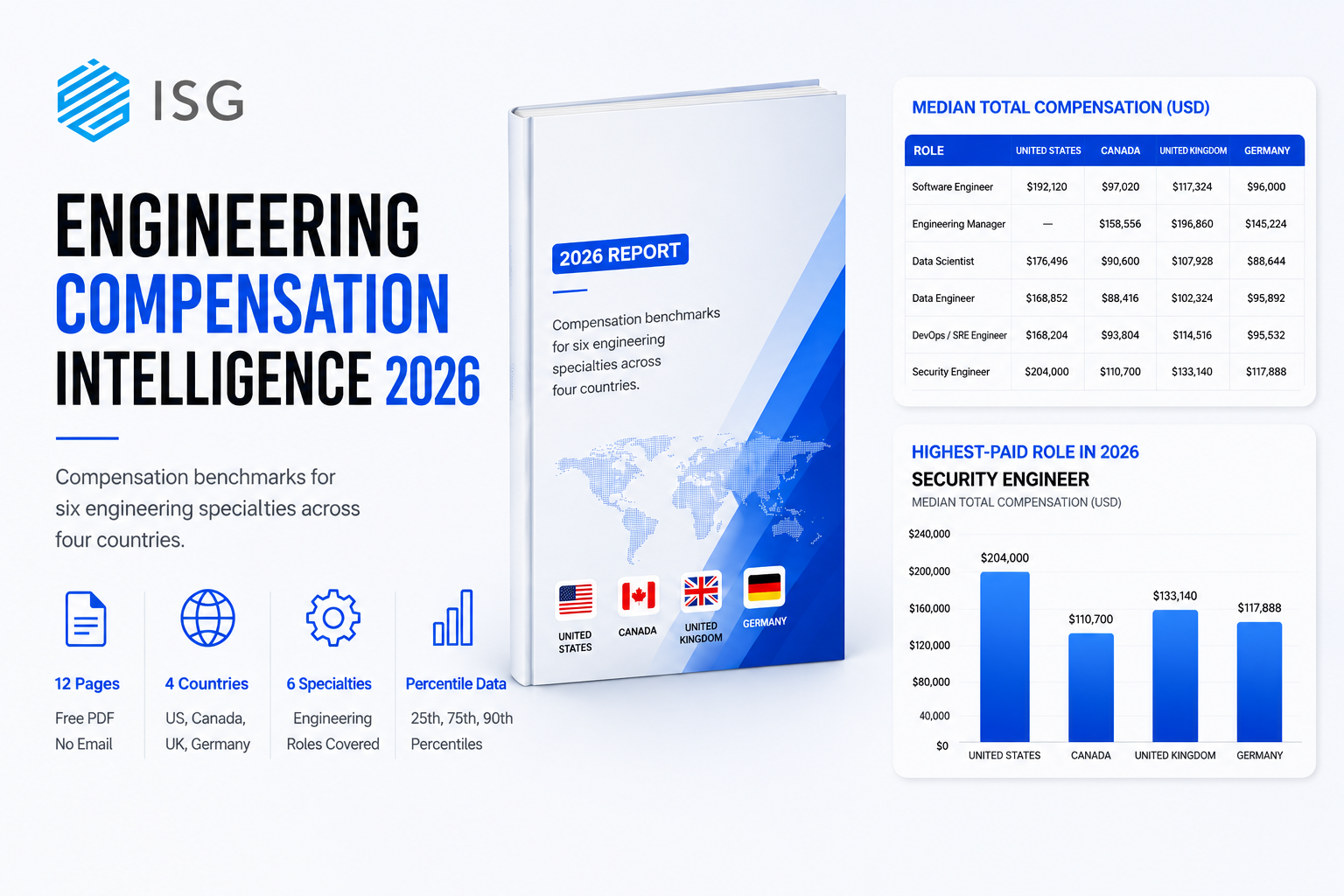
ISG Partners is an embedded recruiting firm. ISG Partners publishes the 2026 Engineering Compensation Intelligence report. The report covers median total compensation for six engineering specialties across four countries: the United States, Canada, the United Kingdom, and Germany.
What is the 2026 Engineering Compensation Intelligence report?
The 2026 Engineering Compensation Intelligence report is a compensation benchmark study published by ISG Partners covering six engineering specialties across four countries. The report contains median, 25th percentile, 75th percentile, and 90th percentile total compensation figures for each role in each market.
The six specialties are software engineering, engineering management, data science, data engineering, DevOps and site reliability engineering, and security engineering. The four markets are the United States, Canada, the United Kingdom, and Germany.
All figures represent annualized total compensation. Total compensation includes base salary, equity annualized over a four-year vest, and bonus. All figures are reported in US dollars.
How much do engineers earn in 2026?
Median engineer total compensation in 2026 ranges from $88,416 to $204,000 depending on specialty and country. The United States pays the highest median in every specialty. Germany pays the lowest median in four of six specialties.
Median annualized total compensation by role and market:
| Role | United States | Canada | United Kingdom | Germany |
|---|---|---|---|---|
| Software Engineer | $192,120 | $97,020 | $117,324 | $96,000 |
| Engineering Manager | — | $158,556 | $196,860 | $145,224 |
| Data Scientist | $176,496 | $90,600 | $107,928 | $88,644 |
| Data Engineer | $168,852 | $88,416 | $102,324 | $95,892 |
| DevOps / SRE Engineer | $168,204 | $93,804 | $114,516 | $95,532 |
| Security Engineer | $204,000 | $110,700 | $133,140 | $117,888 |
US Engineering Manager data was excluded from this edition due to variance across sources. The full report contains 25th, 75th, and 90th percentile figures for every role band.
Which engineering roles pay the most in 2026?
Security engineering is the highest-paid individual contributor engineering specialty in 2026 in every market measured. The ranking below reflects median total compensation in the United States.
Highest-paid engineering specialties in 2026, ranked by US median:
Security Engineer: $204,000. Security engineers earn the highest median in the United States, Canada, the United Kingdom, and Germany.
Software Engineer: $192,120. Software engineering sets the compensation baseline for every other specialty.
Data Scientist: $176,496. The 90th percentile reaches $336,000 in the United States.
Data Engineer: $168,852. Data engineers earn 12 percent less than software engineers at the US median.
DevOps / SRE Engineer: $168,204. The 90th percentile reaches $300,000 in the United States.
Security engineers earn a premium over every other individual contributor specialty. The premium holds in all four countries. The premium reflects candidate scarcity and the consequence cost of security mis-hires.
How does US engineering compensation compare to Europe and Canada?
US engineering compensation runs 1.6 to 2.0 times higher than Canada, the United Kingdom, and Germany at the median. The gap widens at the 90th percentile, where US compensation reaches 2.0 to 2.5 times the US median.
Four cross-market facts from the report:
A US software engineer earns a median of $192,120. A UK software engineer earns a median of $117,324. The difference is 64 percent.
UK engineering compensation runs 18 to 25 percent above Germany across comparable role bands.
Canada medians run 5 to 15 percent below UK medians across most roles.
The UK pays the highest Engineering Manager median in the report at $196,860.
These are factual figures from the report. ISG's interpretation: the cross-market differential is large enough to change headcount allocation, contractor versus full-time decisions, and remote-work compensation policy for companies hiring in more than one market.
How should companies use these compensation benchmarks?
Companies should calibrate compensation bands to the median figures in this report and reach toward the 75th percentile for senior and staff-level offers. Offers below the 25th percentile produce longer time-to-hire and weaker candidate quality.
Three operational applications:
Compensation band calibration. The median is the calibration anchor. The 75th percentile is the senior-offer target. The full operational framework is in why compensation bands are hiring decisions, not HR policy.
Time-to-hire planning. The strongest engineers in every market leave the market within 10 to 14 days of starting an active search. Hiring processes longer than 4 weeks lose candidates at competitive compensation bands. The upstream mechanics are covered in how to reduce time-to-hire.
Hiring capacity planning. The credential range across six specialties exceeds what most internal recruiting teams can source against simultaneously. The capacity patterns are covered in how to hire engineers without burning out the TA team.
What is the methodology behind the report?
ISG Partners compiles the report using a proprietary compensation intelligence framework. The framework combines aggregated engineering labor market data with ISG's internal placement observations from active engineering search engagements.
Four methodology facts:
All figures are annualized total compensation in US dollars.
Total compensation includes base salary, equity annualized over a four-year vest, and bonus where reported.
Non-US figures are converted to US dollars at prevailing exchange rates at compilation.
US Engineering Manager, Director, and VP Engineering data was excluded due to source variance. ISG Partners will publish dedicated leadership compensation benchmarks in a follow-on report.
FAQ
What does the 2026 Engineering Compensation Intelligence report cover?
The report covers median, 25th, 75th, and 90th percentile total compensation for six engineering specialties in the US, Canada, UK, and Germany. The six specialties are software engineering, engineering management, data science, data engineering, DevOps/SRE, and security engineering.
Which engineering role pays the most in 2026?
Security engineering pays the most in 2026, with a US median of $204,000. Security engineers earn the highest individual contributor median in all four countries measured.
What is the median software engineer salary in the US in 2026?
The median US software engineer total compensation in 2026 is $192,120. The 25th percentile is $132,000. The 90th percentile is $384,000.
How much more do US engineers earn than European engineers?
US engineers earn 1.6 to 2.0 times more than UK and German engineers at the median. The gap widens to 2.0 to 2.5 times at the 90th percentile.
Is the report free?Yes. The report is free to download with no email required. It may be cited with attribution to ISG Partners.
Who publishes the report?
ISG Partners publishes the report. ISG Partners is an embedded recruiting firm serving venture-backed, PE-backed, and founder-led companies in the US and EMEA.
About ISG Partners
ISG Partners is an embedded recruiting firm. ISG Partners operates as part of the client's hiring function. ISG Partners handles the full engineering hiring range inside one engagement: single senior searches, scaling pod-level volume, and executive leadership hires.
The market intelligence in this report is the same intelligence our embedded recruiters use inside active engineering search engagements. Learn what embedded recruiting is, how our 8-step process works, or when embedded recruiting capacity makes sense.
[Download the 2026 Engineering Compensation Intelligence report]