
Recruiting Models for Funded Startups: What Fits at Series A, B, and C?
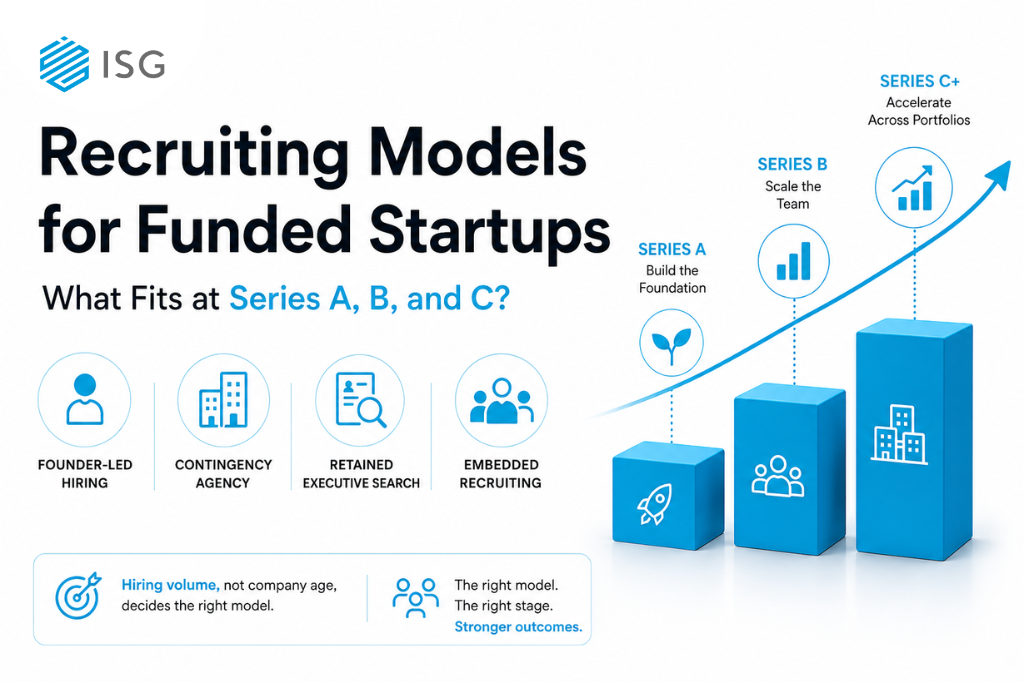
Funded startups choose between four recruiting models: founder-led hiring, contingency agencies, retained executive search, and embedded recruiting. The right model changes at every funding stage. Hiring volume, not company age, decides the fit.
This guide maps each model to each stage. We operate in embedded recruiting. Disclosure given. The frame below covers all four models honestly.
What Are the Recruiting Models Available to Funded Startups?
Four recruiting models cover the needs of funded startups in 2026.
| Recruiting Model | How It Works | Fit Signal |
|---|---|---|
| Founder-led hiring | Founders own sourcing, screening, and closing | Fewer than 5 hires planned in 12 months |
| Contingency agency | External agency charges 15 to 25 percent of first-year salary on placement | One-off senior or hard-to-fill roles |
| Retained executive search | Upfront retainer plus completion fee | C-suite and board-level placements |
| Embedded recruiting | External recruiter integrated inside the startup team on a subscription engagement | 10 or more planned hires across departments |
The table above lists the four dominant recruiting models for venture-backed and PE-backed startups. Each model carries a different cost structure, integration depth, and pipeline ownership. The fit signals decide which model wins at each stage.
When Should a Series A Startup Hire Through Embedded Recruiting?
A Series A startup should consider embedded recruiting when planned hiring reaches 10 or more roles in 12 months. Below that threshold, founder-led hiring still works.
Series A founders face two structural challenges. A hiring round consumes 4 to 6 hours of leadership time per candidate. Across 10 roles at 5 candidates each, the math reaches 200 to 300 hours pulled from product and revenue work. Series A startups also enter the market without an employer brand or talent pipeline. Experienced candidates research company stability before signing.
Embedded recruiting fits at Series A when:
Investor milestones require headcount growth within a fixed window
The first go-to-market or engineering pod must ship as a unit
Leadership time spent on screening delays the product roadmap
Founders should still close the first two or three hires personally. Those hires define the culture every recruiter sells afterward.
Why Does Embedded Recruiting Deliver the Strongest Return at Series B?
Series B companies see the strongest return from embedded recruiting because hiring volume rises faster than an internal team can be built. Headcount targets tie directly to revenue commitments at this stage. Every open role delays the plan behind it.
Building an internal recruiting team during a Series B sprint requires hiring recruiters before any other role. The lead time on that hire usually exceeds the runway the company has to fill the surrounding roles. Embedded recruiting compresses that lead time. Capacity arrives in weeks instead of quarters.
Speed at this stage decides outcomes. Quality of hire still rules. The cost of a bad hire reaches 30 percent of the role's first-year earnings, a figure cited consistently across SHRM and major HR research bodies. Structured screening protects both speed and quality.
How Do Series C and PE-Backed Companies Use Embedded Recruiting Across Multiple Portfolios?
Series C and private-equity-backed companies use embedded recruiting to run hiring across departments and portfolio companies without duplicating recruiting overhead.
The challenge at this stage is parallel demand. Engineering, sales, and operations hire at once. PE investors often need the same recruiting capability across multiple portfolio companies at the same time. Five separate agency relationships at five different fee structures become operationally heavy and financially inefficient.
One embedded recruiting partner replaces those five relationships. The investor gains visibility across portfolio hiring, consistent process, and predictable cost. The portfolio companies gain dedicated recruiters who learn each business individually.
When Should a Startup NOT Use Embedded Recruiting?
Embedded recruiting is the wrong model for four startup situations.
Pre-seed or seed with sporadic hiring. One contingency fee on one role costs less than months of a subscription engagement. Volume must justify the model.
C-suite-only searches. Retained executive search firms specialize in confidential, senior placements. Embedded recruiting is built for volume and velocity, not board-level searches.
One hard-to-fill specialist role. A single agency placement wins on cost when the entire need is one position.
Founders unwilling to close final interviews. No external model fixes absent decision-makers. Recruiters build the pipeline. Founders make the call.
A startup recognizing itself in one of these four cases should pick a different tool. Every other funded startup should weigh the model on total recruiting spend across the hiring year.
What Does Hiring an Internal Recruiter Cost a Startup?
A full-time in-house recruiter costs a startup between $109,000 and $176,000 a year, fully loaded.
Industry cost breakdowns place base salary between $80,000 and $120,000, plus benefits, a LinkedIn Recruiter Lite or Corporate license, and ATS tooling. The cost runs in slow quarters and busy ones alike.
The breakeven point against external recruiting models sits near 15 to 25 hires per year, depending on role complexity and seniority mix. Internal recruiting earns its cost at steady, predictable volume. That volume usually arrives after Series C.
Who Owns the Candidate Pipeline After the Engagement Ends?
In embedded recruiting, the startup retains every candidate record because the recruiter works inside the startup's own applicant tracking system.
Contingency agencies retain candidate data when engagements end. The relationships leave with the agency. Embedded recruiters leave the talent pipeline behind as a company asset. Every sourced candidate, every conversation, every passed lead stays with the company.
The mechanics of how embedded recruiters integrate into startup hiring systems are covered in how we work.
What Should a Startup Ask Before Choosing a Recruiting Model?
Five questions surface the right recruiting model for a funded startup.
How many hires are planned across the next 12 months?
How variable is the hiring forecast across quarters?
Does the internal team have the capacity to run sourcing and screening?
Are the open roles spread across functions or concentrated in one?
Will the candidate pipeline need to remain with the company after the engagement?
The questions above protect founders from picking a model that fits the wrong stage. Companies with answers pointing toward 10 or more hires, variable volume, stretched internal capacity, multiple functions, and pipeline retention typically fit embedded recruiting. Companies with answers pointing toward fewer hires, single-role searches, or executive-only needs fit other models.
Choosing the Right Model for the Stage
The recruiting model that fits a startup is decided by hiring volume, not by company age or revenue. Series A startups planning 5 hires fit founder-led recruiting. Series A startups planning 15 hires fit embedded recruiting. Series B and Series C companies almost always fit embedded recruiting across functions. PE-backed portfolios fit embedded recruiting across multiple companies under one engagement.
The buyer evaluating recruiting models in 2026 wins by matching the model to the volume planned across the actual hiring year.
If your startup has outgrown founder-led recruiting and you want to walk through the fit, reach out to our team.
Frequently Asked Questions
-
Embedded recruiting integrates a dedicated recruiter inside the startup team on a subscription engagement. RPO transfers larger portions of the recruitment function to an external provider under multi-year contracts. The two are separate categories. The detailed comparison sits in embedded recruiting vs RPO.
-
Embedded recruiting fits a startup better than an agency when planned hiring reaches 10 or more roles in 12 months across multiple functions, when pipeline ownership matters, and when the candidate experience needs to reflect the startup's brand rather than the agency's.
-
Series A startups afford embedded recruiting when hiring volume justifies a dedicated recruiter rather than per-placement fees. Below 10 planned hires, contingency or founder-led hiring usually costs less.
-
Embedded recruiting works for technical hiring when the dedicated recruiter has experience in the specific tech stack. Recruiters work inside the startup's applicant tracking system and learn the team's evaluation criteria.
-
A typical embedded recruiting engagement runs three to twelve months for a startup, depending on hiring volume. The model scales up during sprints and scales down between rounds.
-
The candidate pipeline, sourcing data, and process documentation stay inside the startup's systems when the engagement ends. The company retains every relationship the recruiter built.