
How Embedded Recruiting Pricing Works: Models, Structures, and What Determines Cost
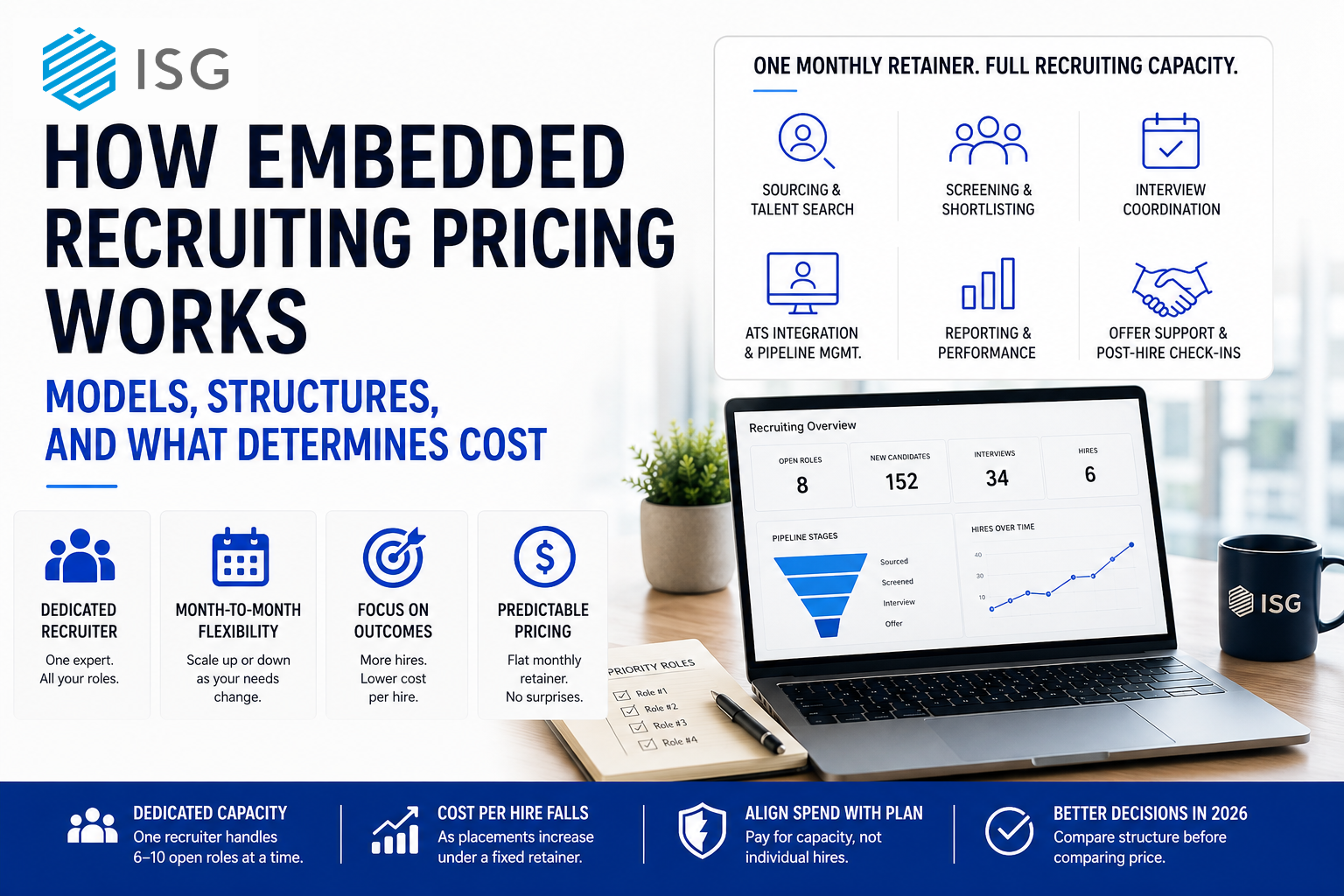
Embedded recruiting pricing runs on a flat monthly retainer that covers a dedicated recruiter and a set capacity of open roles. The wider recruiting market prices external help through five structures: contingency percentages, retained fees, RPO management fees, hourly freelance rates, and flat retainers.
Four factors size an embedded engagement: role count, seniority mix, market difficulty, and timeline. Cost per hire falls as placements accumulate under a fixed retainer, and rises when hiring slows. Buyers who compare fee structure before fee size make better decisions in 2026.
How Does Embedded Recruiting Pricing Work?
Embedded recruiting pricing works on a flat monthly retainer that funds a dedicated recruiter working a set number of open roles. The fee stays the same each month, regardless of how many hires close.
No placement fees, percentages, or per-hire charges sit on top. Engagements run month to month, so hiring capacity turns on and off with demand. Per-hire structures price each placement as a separate transaction. The retainer structure prices recruiting capacity as a continuous function instead.
What Pricing Models Exist Across the Recruiting Market?
The recruiting market prices external help through five structures: contingency, retained, RPO, freelance, and embedded retainers. Each structure places cost and risk in a different position. The five models are compared below:
| Model | Fee structure | When payment happens | Contract shape |
|---|---|---|---|
| Contingency | Percentage of first-year salary, commonly 15 to 25 percent | On successful hire | Per-search, no exclusivity |
| Retained search | Staged fee, released in portions across the search | Start, shortlist, placement | Per-search, exclusive |
| RPO | Management fee plus volume-based elements | Monthly, across the program | Long-term enterprise agreement |
| Freelance recruiter | Hourly rate or short-term arrangement | Weekly or monthly | Short, project-based |
| Embedded recruiting | Flat monthly retainer for dedicated capacity | Monthly | Month-to-month subscription |
Structure shapes incentive. A per-hire fee rewards closing individual searches. A retainer rewards sustained delivery across every open role in the engagement. Risk placement differs as well.
Contingency providers carry the search risk and price that risk into the percentage. Retained structures share risk between the parties through staged payments. A retainer places continuity risk with the buyer, who pays for capacity through slow weeks and fast ones alike.
The embedded recruiting versus RPO model breakdown covers how the two subscription-style structures split on ownership and contract length.
What Does the Flat Monthly Fee Cover in an Embedded Engagement?
The flat monthly fee covers a dedicated recruiter, full-cycle search work, and engagement management across a defined role capacity. Scope, not price, defines the model. In our engagements, one dedicated recruiter carries six to ten open roles at the same time.
The fee funds sourcing, screening, shortlist delivery, interview coordination, ATS integration, and monthly performance reporting. Offer support and post-placement check-ins sit inside the same fee. Nothing bills separately when a hire closes.
Capacity replaces the placement as the unit of purchase. Companies buy a recruiter's full attention for a month, not a single outcome. The embedded recruiting engagement process at ISG Partners shows how that capacity gets deployed from day one.
What Sits Outside a Recruiting Fee?
Line items outside the service fee vary by provider and belong in every scoping conversation. Job advertising spend, assessment platforms, background checks, and relocation support bill separately under many structures across the market.
ATS and sourcing tool subscriptions stay on the buyer side in most engagements. A complete quote names what the fee funds and what falls outside. Clean scoping now prevents invoice surprises later. The question costs one line in an email and settles half the comparison.
What Determines the Cost of an Embedded Recruiting Engagement?
Four factors determine embedded engagement cost: role count, seniority mix, market difficulty, and timeline. Providers size the retainer on these inputs, which explains why two companies receive two different quotes for the same model.
Role Count and Capacity
Role count sets how many recruiter seats an engagement needs. One recruiter covers a defined band of simultaneous searches. Hiring plans beyond that band add recruiter capacity, and the retainer scales in steps rather than per hire.
Capacity bands also explain quote jumps: crossing the band adds a full seat, not a marginal fee. The embedded recruiting model definition and mechanics explain the capacity band in detail.
Seniority Mix
Seniority mix changes the depth of work each role demands. A director search consumes more sourcing hours, longer interview loops, and heavier offer negotiation than an entry-level search. A slate weighted toward senior and executive roles sizes higher than a slate of similar individual-contributor roles.
Market Difficulty
Market difficulty prices the scarcity of the talent involved. Competitive technical markets, thin regional pools, and confidential searches demand more outreach per hire. Passive-candidate work raises the effort behind every shortlist.
Timeline and Ramp
Timeline compresses or spreads the same work across different windows. A 90-day sprint across many roles concentrates recruiter load. A steady hiring rhythm spreads the load and holds the engagement at a smaller size.
How Does Cost per Hire Behave Under a Flat Monthly Retainer?
Cost per hire equals total recruiting spend divided by hires made in the period, and a fixed retainer pushes that number down as placements accumulate. Per-hire pricing scales in a straight line: ten hires cost ten fees. Retainer pricing holds flat while hires stack inside the window, so each additional placement lowers the effective cost per hire.
The mathematics runs both directions, and honesty requires saying so. A single slow hire inside a monthly retainer carries the full month of cost. Companies filling one role with no further hiring planned sometimes price better under a per-hire structure. Continuous hiring across multiple roles is where retainer economics reward the buyer. The flat fee and contingency recruiting cost comparison walks through how per-hire pricing behaves as volume grows.
Picture two identical hiring plans across the same quarter. The per-hire plan produces a spend line that climbs with every accepted offer. The retainer plan produces a flat spend line, stepped only when recruiter capacity gets added. Finance teams read the second line as a forecastable budget item. Hiring teams read the first line as a reason to slow down late in the quarter.
A related metric appears in finance reviews. Recruiting cost ratio divides total recruiting costs by the total first-year compensation of the people hired, expressed as a percentage. Both metrics reward structures that hold spend flat while hiring continues.
How Do You Compare Quotes Across Different Pricing Models?
Quotes across pricing models compare on one line: projected total spend divided by projected hires over the same window. A percentage fee, a staged retained fee, and a monthly retainer all reduce to that number once the hiring plan is fixed.
Four questions complete the comparison.
What does the fee include, and what bills separately?
How many roles does the capacity cover?
What contract term binds the spend?
What does exiting the agreement require?
Structure answers those questions before any quote makes sense. Window alignment matters most. A quote scoped to a quarter and a quote scoped to a year describe different commitments, and dividing each by the same hiring plan restores the comparison.
How Do Contract Terms Shape Recruiting Cost?
Contract term decides how fast recruiting spend adjusts when the hiring plan changes. Month-to-month structures let companies scale capacity up for a sprint and release capacity once the plan lands.
Long-term agreements hold spend in place across the full term, regardless of hiring pace. Exit terms belong in every evaluation for that reason. A structure priced attractively on paper turns expensive once the plan shifts and the spend stays locked.
Recruiting pricing strategy starts with matching contract length to hiring visibility: commit long only where the hiring plan holds long.
What Do Buyers Get Wrong About Recruiting Pricing?
Buyers misjudge recruiting pricing when they compare fee size instead of fee structure. A large-looking retainer and a small-looking percentage reverse positions once hiring volume enters the math. Three other mistakes repeat across evaluations.
Buyers count the external fee and skip internal costs such as hiring manager hours and vacancy drag. Buyers fold recruiting software pricing into service fees, though ATS subscriptions are a separate budget line.
Buyers compare quotes across different hiring windows, which breaks the math. The full cost of recruiting breakdown for 2026 covers the internal cost side in depth.
Frequently Asked Questions
How much do recruiters charge per hire?
Contingency recruiters charge a percentage of first-year salary, commonly 15 to 25 percent, paid on a successful hire. Retained searches stage a fee across the search instead.
How do freelance recruiters get paid?
Freelance recruiters get paid through hourly rates or short-term monthly arrangements. Some work per-hire structures. Scope and dedication vary far more than in embedded engagements.
How is the recruiting cost ratio calculated?
Recruiting cost ratio equals total recruiting costs divided by total first-year compensation of hires, as a percentage. Cost per hire divides total spend by hires made.
Does embedded recruiting have per-hire fees?
Embedded recruiting has no per-hire fees. A flat monthly retainer covers the dedicated recruiter, the role capacity, and every placement made inside the engagement.
Why do embedded recruiting quotes differ between companies?
Quotes differ because providers size the retainer on role count, seniority mix, market difficulty, and timeline. Two hiring plans rarely produce the same engagement scope.
Reading Embedded Recruiting Pricing Correctly
Structure decides more than sticker: the flat monthly retainer prices recruiting capacity, and the four cost drivers size that capacity to the plan. Per-hire models price transactions. The embedded model prices a dedicated recruiter working your roles, month to month, with nothing added when hires close.
We publish no fixed rates at ISG Partners, because every engagement is sized on the roles, seniority, markets, and timeline involved. The scoping conversation takes 30 minutes, and most companies receive a proposal within 24 hours.
One structure covers single senior searches, scaling teams, and executive search alike. Book a discovery call, bring your 12-month hiring plan, and the sizing becomes clear on the first pass.