
Embedded Recruiting for Private Equity Portfolio Companies
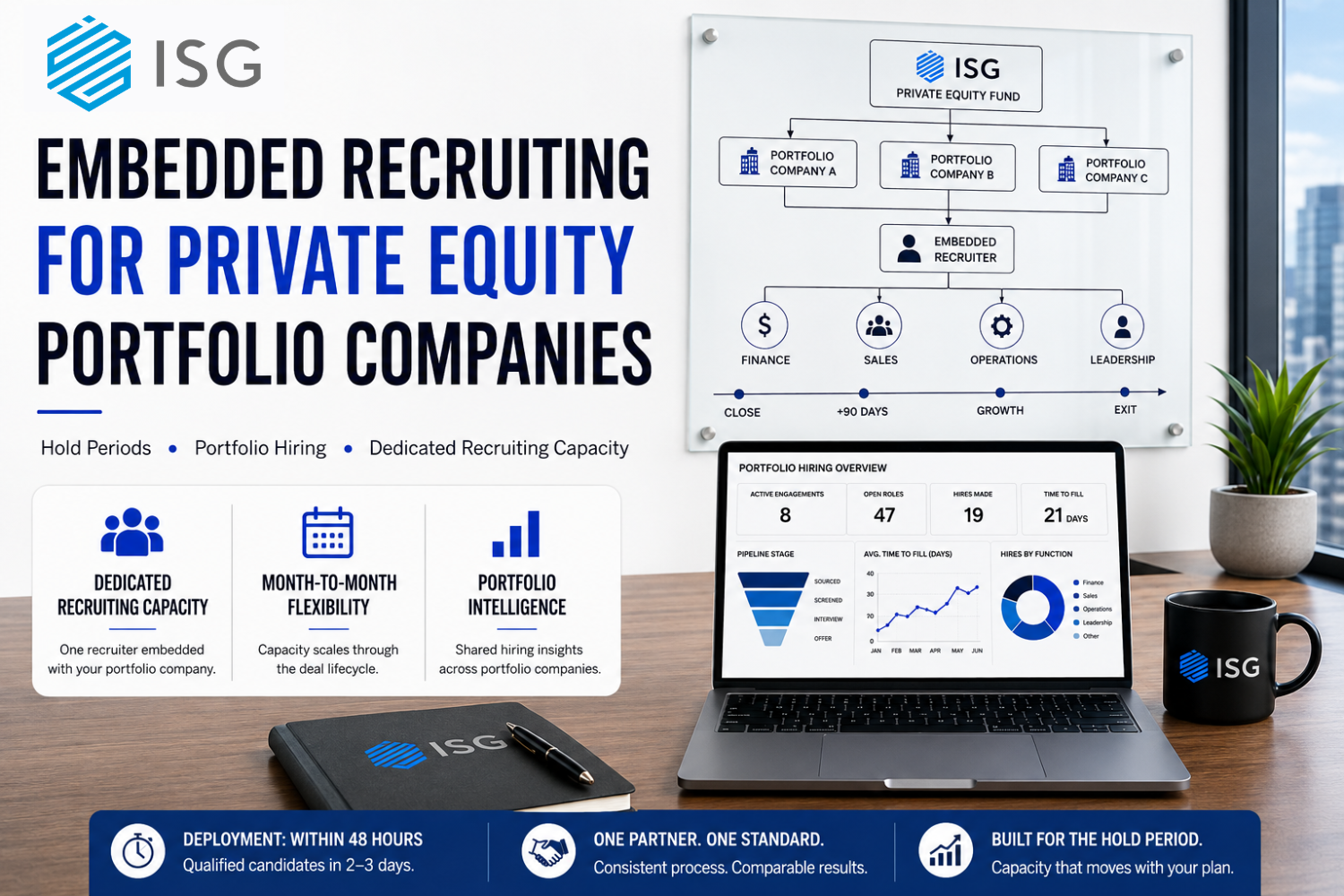
Embedded recruiting gives private equity portfolio companies a dedicated recruiter inside their own hiring process, sized to the value-creation plan. Hold periods compress years of team building into a fixed window, which makes hiring speed a direct input to plan runway.
Portfolio hiring repeats the same finance, sales, and operations searches across companies, and repeatable hiring rewards a partner that carries learning between portcos. One embedded engagement covers the full range, from team builds to leadership search, on month-to-month terms that move with the deal cycle.
Fund talent partners in 2026 treat recruiting capacity as portfolio infrastructure, not a per-company purchase.
Why Does Private Equity Hiring Need a Different Recruiting Model?
Private equity hiring runs against a clock: the hold period fixes the window, and every unfilled role spends part of the plan inside a search. A value-creation plan assigns work to seats that exist mostly on paper at close.
Finance upgrades, commercial builds, and operational hires all carry start dates the plan depends on. Recruiting models built for open-ended corporate hiring treat time as available. Portfolio hiring treats time as the scarcest asset in the deal.
Hiring plans now form before close. Diligence teams map the leadership gaps and the first-year org chart, and the recruiting engine starts the day the deal signs.
Deal cadence adds a second pressure. Acquisitions, add-ons, and carve-outs each trigger hiring surges with quiet periods between them. A recruiting model that fits portfolio work turns capacity on for the surge and releases capacity when the build completes.
How Does Embedded Recruiting Work for a Portfolio Company?
Embedded recruiting places a dedicated recruiter inside the portfolio company's team, running searches through the company's own process and tools. The recruiter works inside the portco ATS, joins hiring meetings, and reports into the leadership driving the plan.
Hiring managers keep every decision. We deploy a dedicated recruiter within 48 hours of kickoff, and most clients see qualified candidates inside the first two to three days. One recruiter carries six to ten open roles at once, and the engagement runs month to month.
Month-to-month structure maps cleanly onto deal phases. Capacity ramps at close, holds through the build, and steps down once the team stands. No long-term contract outlives the hiring plan behind the engagement.
The structure also survives exits cleanly, since nothing binds the portfolio past the deal. The full mechanics sit in how the embedded recruiting model works.
What Happens in the First 100 Days After Acquisition?
The first 100 days concentrate the heaviest hiring of the hold period: leadership upgrades, key backfills, and carve-out function builds. New ownership commonly resets the finance seat first, then the commercial leadership, then the layer beneath both.
Carve-outs add a second track, standing up finance, HR, and IT functions the former parent used to provide. Departures after close add a third.
Running those tracks through separate per-search engagements multiplies vendors at the exact moment the plan needs one accountable process.
Why Is Portfolio Hiring Repeatable Hiring?
Portfolio hiring repeats the same searches across companies: similar finance, sales, and operations roles recur at every portco in a similar stage. A fund holding several companies runs the controller search, the sales team build, and the operations hire again and again under different logos. Repetition is the structural fact that decides the right recruiting model.
Per-company agency engagements restart the learning every time. Each new search rebuilds market knowledge, compensation expectations, messaging, and candidate pools from zero, and each placement bills as a separate transaction.
An embedded partner working across the portfolio carries that learning forward. The second controller search starts where the first one finished. Sourcing maps, comp intelligence, and pitch language compound instead of resetting.
The fee mechanics repeat the pattern: per-hire structures bill the same search at full price every time, while capacity structures price the repetition.
How Does Search Intelligence Compound Across Portfolio Companies?
Search intelligence compounds when comp data, sourcing maps, and interview calibration carry from one portco search to the next. The first sales build in a market prices the second one accurately.
Candidate pools mapped for one company shorten sourcing for the sibling company a state away. Interview scorecards refined at one portco raise signal quality at the next. Offer benchmarks from closed searches replace guesswork in new ones.
Fund-level comp intelligence also feeds board conversations, because the data comes from real searches inside the portfolio rather than generic surveys. Every search adds to a portfolio asset that per-search vendors never build, because their engagement ends at the placement.
What Does One Partner Across the Portfolio Change?
One recruiting partner across the portfolio produces consistent process, comparable reporting, and capacity that redeploys between companies. Every portco reports the same metrics the same way: time-to-fill, cost per hire, offer acceptance, and 90-day retention.
Fund-level reviews compare companies on one scorecard instead of translating five vendor formats. Capacity moves too.
A recruiter seat finishing one company's build phase redeploys to the next acquisition without a new vendor search. The recruiting partner due diligence checklist covers how to test any provider against that portfolio standard.
Which Roles Do Portfolio Companies Hire Through the Embedded Model?
One embedded engagement covers the portfolio hiring range, from finance and operations teams to sales builds to leadership search. The finance layer runs from controllers and FP&A through the CFO seat.
The commercial layer runs from the first professional sellers through sales leadership, the classic move from founder-led revenue to a managed motion. Building sales teams with embedded recruiting covers that transition in depth.
Operations, engineering, and HR hires fill the execution layer beneath the plan. Leadership searches run inside the same engagement, through the same recruiter, with the same reporting. No hiring tier requires a separate vendor or a separate fee structure.
How Do Add-On Acquisitions Change Hiring Load?
Add-on acquisitions create integration hiring: duplicated functions get resolved, key operators get retained, and new seats get created for the combined company. Two finance teams become one, and the survivor structure needs hiring decisions within weeks.
Integration leads, systems roles, and combined-territory sales seats appear on no pre-close org chart. Retention conversations run parallel to recruitment, and one embedded team holds both threads.
The hiring surge lands mid-hold, on top of the original plan, and capacity that flexes month to month absorbs the surge without a new vendor cycle.
How Do Fund-Level Talent Partners Use Embedded Recruiting?
Fund talent partners deploy embedded recruiting as shared portfolio infrastructure: one accountable partner, one reporting standard, and capacity that follows the deal calendar.
The talent function at the fund coordinates hiring across companies that rarely share systems or process maturity. A single embedded partner gives that function reach: one relationship covers many companies, and every engagement reports into the same dashboard.
Talent partners also gain a pattern library. Wins and misses at one portco inform the search strategy at the next, because the same team carries both. Quarterly portfolio reviews sharpen as well.
One reporting standard turns talent from anecdote into a line the operating committee reads like any other metric. Vendor consolidation cuts the administrative surface too: one agreement, one security review, one invoice rhythm across the fund.
When Does the Embedded Model Not Fit a Portfolio Situation?
A single, isolated executive replacement with no surrounding hiring sometimes fits a dedicated per-search engagement better than an embedded one. Interim executive placements sit outside the model as well, since interim work is a staffing product rather than a team build.
Honesty belongs in vendor selection. The embedded structure earns adoption where hiring is plural, repeatable, and tied to a plan, which describes most of a hold period and not all of one.
How Does Vacancy Time Behave Inside a Hold Period?
Vacancy time inside a hold period costs twice: the unfilled work, and the shortened runway for the plan the hire exists to execute. An open commercial seat delays the revenue line the model already assumes.
An open controller seat delays the reporting the board already expects. Compressing search time returns weeks to the plan, and reducing time to hire across open roles covers the levers that produce that compression. Speed is a plan input at every portfolio company, not a recruiting vanity metric.
Portfolio Hiring as Repeatable Infrastructure
Portfolio hiring rewards the model built for repetition: one embedded partner, learning that compounds across portcos, and capacity that moves with the deal calendar. Per-search engagements price every hire as a fresh transaction and restart the knowledge each time.
The embedded structure prices capacity, carries the pattern library, and reports every company on one standard.
We work with venture-backed, private-equity-backed, and founder-led companies at ISG Partners, and portfolio work is where the embedded model shows structural advantage. One engagement covers finance builds, sales teams, and leadership searches, month to month, sized to the plan.
The range holds from a portco's first five hires through the leadership search that caps the build. Portfolio hiring is a system problem, and systems reward one accountable partner. Walk through the day-one embedded engagement process, then bring the portfolio hiring map to a discovery call.
Frequently Asked Questions
What is embedded recruiting for private equity?
Embedded recruiting for private equity places a dedicated recruiter inside a portfolio company's hiring process on a month-to-month engagement. Capacity scales with the value-creation plan instead of per-hire transactions.
What is an embedded talent partner?
An embedded talent partner is a dedicated recruiter integrated into a company's team, tools, and process. The partner runs full-cycle searches inside the client structure rather than from an external pipeline.
Do portfolio companies share one recruiter?
Each portfolio company engagement runs on dedicated recruiter capacity sized to that company's roles. Learning and reporting standards carry across the portfolio, and capacity redeploys between companies as build phases complete.
How fast does an embedded recruiter start at a portfolio company?
A dedicated recruiter deploys within 48 hours of kickoff. Most portfolio companies see qualified candidates inside the first two to three days of the engagement.
Does embedded recruiting cover executive search at portfolio companies?
Executive and leadership searches run inside the same embedded engagement. One structure covers team builds, senior hires, and leadership search without separate vendors or fee models.