
How to Recruit Machine Learning Engineers in 2026
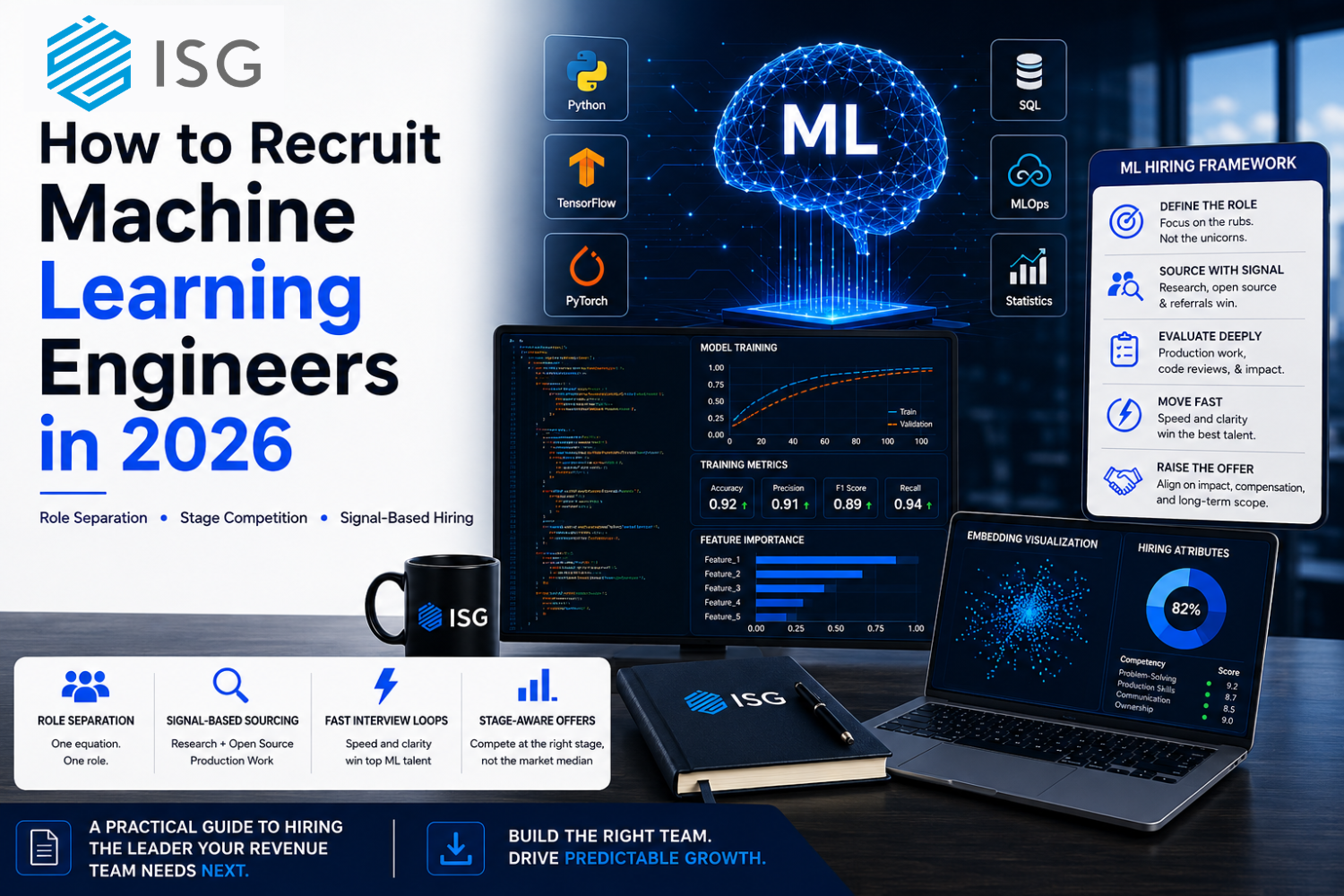
Recruiting machine learning engineers in 2026 starts with role separation, because one job title now covers four different jobs. Stage competition shapes every search: a Series A company competes against frontier-lab offers, not the market median.
Machine learning compensation carries a 12 to 38 percent premium over the software engineering baseline, and the spread widens sharply at the top. Sourcing runs on signal, screening runs on production evidence, and offers close on speed and positioning rather than median-matched numbers.
Companies that separate the roles, price the stage, and move fast win searches the market says they lose.
Why Is Recruiting Machine Learning Engineers Different in 2026?
Machine learning recruiting differs because the market moves faster than any benchmark cycle and the ceiling is set by frontier labs. Demand for machine learning engineers keeps rising across every funding stage and every vertical we serve.
Compensation follows the demand. Our 2026 data places the AI and ML premium at 12 to 38 percent above the US software engineering baseline of $192,120. Annual survey data ages out inside the same year, which leaves offer conversations anchored to numbers candidates stopped accepting months earlier.
A standard engineering search process, pointed at ML talent, misprices the market on day one. Velocity also changes candidate behavior. Strong ML candidates field inbound weekly, hold parallel processes by default, and drop slow companies without a decline email.
Which Machine Learning Role Does the Work Require?
Most machine learning searches fail at the requisition stage, because one posted title covers four different jobs. Companies write "machine learning engineer" and interview candidates from four separate talent pools with four separate expectations.
Role separation happens before sourcing, or the funnel fills with mismatches. The four roles and their screening signals are separated below:
| Role | Core work | Signal to screen for |
|---|---|---|
| ML Engineer | Ships models into production systems | Production deployments, latency, and scale decisions |
| Applied Scientist | Adapts published research to business problems | Applied work bridging papers to product outcomes |
| Research Scientist | Produces novel research | Publications, novel methods, research citations |
| MLOps Engineer | Builds training and serving infrastructure | Pipeline, orchestration, and reliability ownership |
One requisition, one role. A posting that asks for publications, production systems, and platform infrastructure in the same bullet list signals a company that has not decided what the work is. Strong candidates read that signal and pass. AI and ML company hiring with the embedded model covers how the role decision anchors the whole search.
What Does Stage Competition Change About the Search?
A Series A company hiring machine learning talent competes against frontier-lab offers, not the market median. Stage sets the real comparison. Our 2026 data shows the same ML role spanning $165,000 at seed-stage companies to $290,000 at frontier labs.
The candidate worth hiring either holds a frontier-range offer or believes one is reachable, which makes median-anchored offers dead before the first call.
Stage competition changes the pitch, not only the number. Frontier labs sell compute and prestige. Growth-stage companies sell ownership, shipping speed, and equity with room to move.
The winning position names the trade honestly: a real number inside the stage-adjusted band, plus scope no lab offers. Companies that pretend the spread does not exist lose the candidate at the compensation conversation, days before any offer letter forms.
Recruiters see the spread arrive as silence: strong candidates rarely argue with a low band, and the process reads the silence too late.
How Do You Source Machine Learning Engineers in 2026?
Machine learning sourcing runs on signal, not keywords, because the strongest candidates publish their work before they publish their resumes. Papers, open-source contributions, model releases, and conference output map the talent pool more accurately than any job-title search.
Keyword sourcing surfaces people who describe ML work. Signal sourcing surfaces people who ship ML work, and the two lists overlap less than hiring teams expect.
The community is small and referral-dense. One strong hire opens a lab cohort, a research group, or an open-source project full of peers. Passive outreach carries the load, since the candidates worth pursuing rarely sit on job boards.
Outreach quality decides response rates: a message that names the candidate's specific work outperforms any template, in any market. Response data feeds the search itself, since message-level signal shows which pitch version the market believes.
Where Do ML Candidates Concentrate?
ML candidates concentrate around visible work: research trails, open-source repositories, model hubs, and the alumni networks of known labs and teams. Conference workshops and reading groups map the applied community.
Maintainer lists and contributor graphs map the production community. Alumni cohorts from respected teams travel together, which turns one warm relationship into a mapped pool.
Sourcing plans built around these surfaces reach candidates months before any resume update, and the first message lands while the inbox is still quiet.
How Do You Screen and Evaluate ML Candidates?
Screening works when the evaluation instrument matches the role: production evidence for engineers, applied judgment for scientists, and infrastructure ownership for MLOps.
Puzzle-style coding screens misfire on research candidates, and paper walkthroughs misfire on production engineers. Work samples drawn from the company's real stack beat abstract exercises in both signal and candidate experience.
Panel calibration decides how the signal gets read. Interviewers aligned on criteria before the first candidate produce debriefs about evidence instead of taste. The hiring scorecard calibration framework covers how to lock those criteria at intake.
Speed completes the screen. ML candidates run parallel processes, and a loop that stretches across weeks hands the hire to whichever competitor moved first.
How Fast Does an ML Interview Loop Need to Run?
The loop runs at the speed of the candidate's fastest parallel process, which means compression gets designed before sourcing starts. Panels get scheduled in blocks instead of sequential weeks.
Debriefs happen the same day, with decision authority sitting inside the panel rather than above the panel. Offer approval gets pre-cleared at intake, so the yes travels in hours.
None of the compression lowers the bar. Compression removes the waiting between signals, and waiting is where parallel offers win.
How Do You Structure Offers for ML Talent in 2026?
Offers close on stage-adjusted bands, honest structure, and speed, not on median matching. Our 2026 AI/ML Engineer Compensation Intelligence report places the US Research Scientist median at $265,000, reaching $560,000 at the 90th percentile, the widest top-decile spread of any specialty we measured.
The spread is the message: top-of-market ML talent prices far above the middle, and offer strategy has to decide which part of the distribution the company is shopping in.
Bands come first. A band-first compensation strategy sets the stage-adjusted range before the first conversation, which keeps offers fast and parity defensible. Geography enters the plan for distributed teams: the United Kingdom runs the strongest EMEA market, 22 to 27 percent above Germany for comparable roles.
Equity carries the difference where cash meets its ceiling, and the equity story lands only when the cash number is already credible.
How Does Equity Positioning Work Against Lab Offers?
Equity closes ML offers when the cash number is credible and the ownership story is concrete. Percentage ownership, vesting mechanics, and refresh expectations get stated plainly, in numbers the candidate verifies.
Vague equity language reads as weakness against a lab offer built entirely on cash certainty. Candidates comparing a lab package against startup options deserve the math, and giving the math builds the trust that closes.
The honest frame wins more often than the inflated one: real risk, real upside, real scope, priced against a stage-adjusted base the candidate already respects.
What Breaks Machine Learning Hiring Processes?
ML hiring breaks on four repeatable mistakes: blended roles, median-anchored offers, slow loops, and hiring ahead of the data foundation. One title covering four jobs fills the funnel with mismatches.
Offers built on national medians die against stage competition. Interview loops that run long lose candidates holding parallel offers. The fourth mistake costs the most. Companies without data infrastructure hire ML talent into a role with nothing to model, and the hire leaves within the year.
Honesty belongs in the plan: some companies need a data engineer before any machine learning hire, and saying so early saves two searches. The fix for the first mistake costs one meeting: rewrite the requisition around one role before any sourcing begins.
Winning ML Searches in 2026
Machine learning recruiting rewards precision: separate the four roles, price the stage instead of the median, source on signal, and move faster than the parallel process. The market punishes blended requisitions and median-anchored offers, and the punishment arrives silently, as declined conversations rather than declined offers.
We run AI and ML searches at ISG Partners with the same market intelligence published in our compensation research, applied live at intake, in sourcing, and at the offer table. One embedded engagement covers the ML engineer pair, the MLOps build, and the eventual research leadership search.
Walk through our embedded search process from kickoff to offer, then bring the ML hiring plan to a discovery call.
Frequently Asked Questions
Are machine learning engineers in demand in 2026?
Machine learning engineers remain in high demand across every funding stage in 2026. Compensation reflects the demand, carrying a 12 to 38 percent premium over the software engineering baseline.
What does a machine learning engineer earn in 2026?
ML compensation runs 12 to 38 percent above the $192,120 US software engineering median. Research Scientists reach $265,000 at the median and $560,000 at the 90th percentile.
What is the difference between an ML engineer and a research scientist?
ML engineers ship models into production systems, while research scientists produce novel research. The two roles come from different talent pools and answer to different evaluation instruments.
Do startups compete with big labs for ML talent?
Startups compete directly with frontier-lab offers for the same candidates. The 2026 stage spread runs from $165,000 at seed to $290,000 at frontier labs for comparable roles.
Does every company need a research scientist?
Most companies need ML engineers, not research scientists. Production work fills the majority of ML hiring plans, and research roles fit companies advancing novel methods.