
How to Hire Your First VP of Sales: Profile, Process, and Compensation
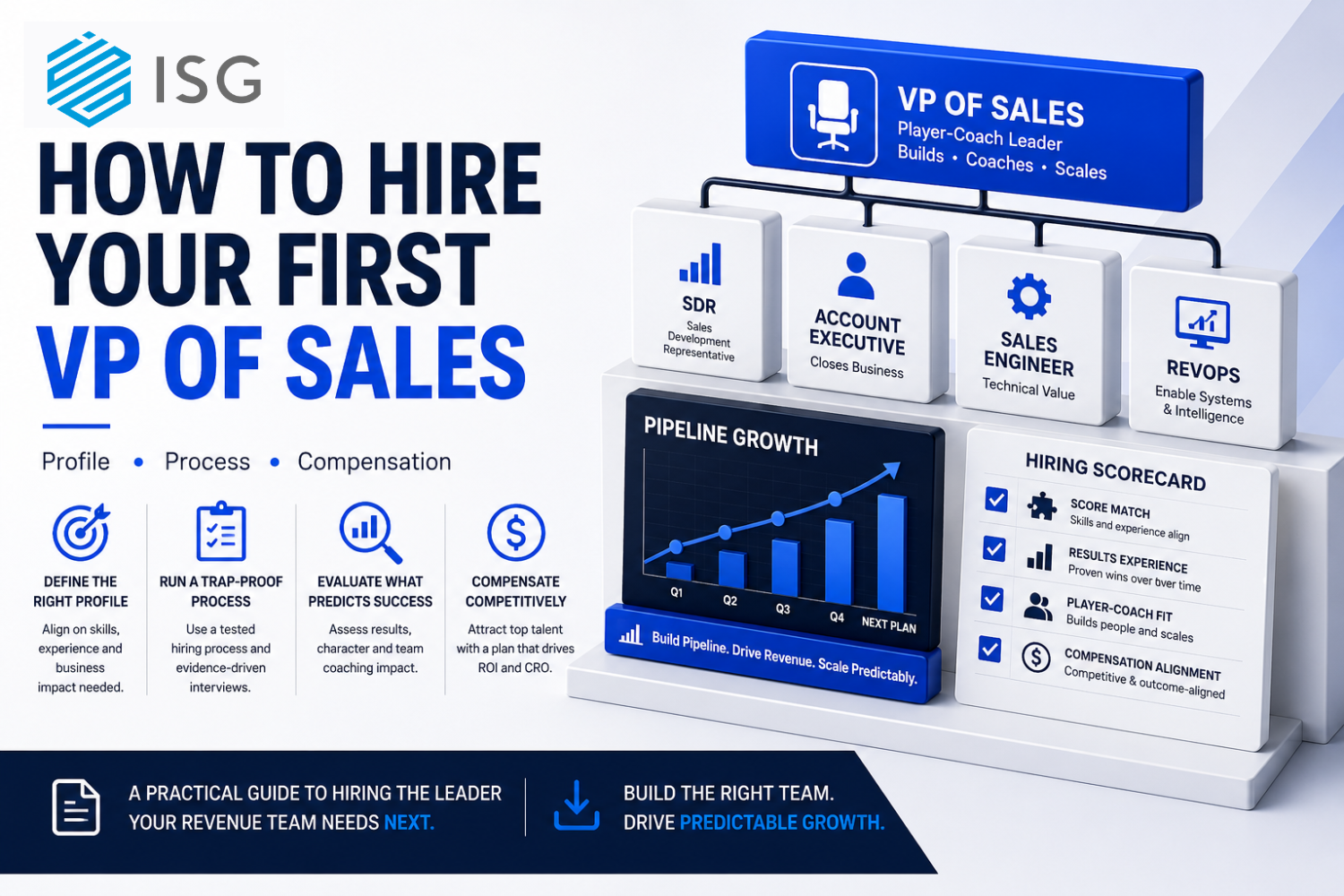
Hiring a first VP of Sales succeeds on profile fit before process quality: the right hire built a team at your next stage, sold recently, and runs as a player-coach. Evaluation traps sink more of these searches than weak candidate pools, and logo-shopping leads the trap list.
The process holds when criteria lock at intake, the panel calibrates before interviews, and evidence outweighs charisma in every debrief.
Compensation follows a near 50/50 base-to-OTE structure, positioned between team-level closer pay and the chief revenue officer ceiling. Companies that define the stage before the search win the hire the org chart needed.
What Does a First VP of Sales Do?
A first VP of Sales scales a proven revenue motion: coaching reps, running the pipeline math, and turning close-rate data into a forecast the board trusts. The role manages the motion, not the mystery.
Founder-led selling and the first closer pair already produced the segment, the message, and the close rate. The first sales leader takes those proofs and multiplies them through hiring, coaching, and process.
The role differs from a chief revenue officer, who owns the full revenue engine across sales, marketing alignment, and customer expansion at a later stage. Companies hiring a first sales leader buy scaling capacity, not an executive layer.
What Profile Fits a First VP of Sales?
The right first VP of Sales profile combines stage match, recent selling, builder evidence, and player-coach capacity. Resumes rarely surface these four traits in order, which puts the burden on the search, not the applicant pool.
The Stage-Match Test
Stage match means the candidate built a sales team one stage ahead of yours, not three. A leader who scaled a team from three reps to fifteen at a similar deal size knows your next two years.
A leader who ran two hundred reps at an enterprise giant knows a machine your company does not own yet. Motion match travels with stage match: deal size, sales cycle, and buyer type at the candidate's last build predict fit better than any industry label.
Signals That Predict Success
Builder evidence separates leaders who created a motion from leaders who inherited one. The signals below predict a working first VP of Sales hire:
Grew a team through hiring, not through org-chart absorption
Sold personally within the last two years, and closes alongside reps early in the tenure
Ran pipeline reviews on data, with a forecast record the candidate explains in numbers
Hired, ramped, and exited reps, with a clear account of each decision
Names the playbook artifacts personally written: comp plans, stage definitions, scorecards
Candidates strong on all five carry the search. Candidates strong on charisma alone carry the interview. Internal candidates deserve the same test. The strongest rep in the building earns the seat through the identical scorecard, or resentment prices into the team either way.
How Do You Write the VP of Sales Job Description?
A first VP of Sales job description sells the proof and states the outcomes, because strong leaders evaluate the motion before the title. Open with what exists: the segment, the close rate story, the team in place, and the founder's role today.
State the first-year outcomes in numbers the business already tracks: reps hired and ramped, forecast cadence installed, pipeline coverage built. Close with the stage and the structure, plainly.
Blended wishlists break leadership postings the same way blended titles break technical searches. A description asking for enterprise logos, startup scrappiness, channel expertise, and international expansion in one list signals indecision, and the leaders worth hiring read the signal.
One stage, one motion, one mandate per posting. Posting the compensation band filters honestly in both directions and shortens every later conversation.
What Does the First VP of Sales Hiring Process Look Like?
The process holds when criteria lock before the first conversation and every interview produces evidence against those criteria. Leadership searches drift without structure, because senior candidates interview well by profession.
The intake meeting structure for leadership searches sets the profile, the deal-breakers, and the trade-offs before sourcing begins, and everything downstream traces back to that meeting.
Panel design carries the middle of the process. The founder tests motion understanding. A board member or investor calibrates stage judgment. A top rep tests coaching credibility in a live deal review.
The deepest interview walks the candidate's last build number by number: team size over time, quota attainment by cohort, and the decisions behind both. Reference work closes the process, run deep and with candidate awareness, reaching the reps who worked under the leader rather than the peers who worked beside one.
How Does a Confidential Leadership Search Change the Process?
Confidential first-leader searches trade reach for discretion, and the trade gets designed rather than improvised. Some companies run the search quietly, around a player-coach stepping back or a founder handing off revenue.
Outreach narrows to direct, named approaches instead of open postings. The panel shrinks to the people already inside the decision. Reference work moves late in the process and runs with explicit candidate coordination.
Discretion slows nothing when the profile is sharp, because a precise target list replaces the volume an open search relies on.
What Are the Evaluation Traps in a First Sales Leader Search?
Four evaluation traps sink first VP of Sales searches: logo-shopping, stage mismatch, charisma weighting, and escape hiring. Logo-shopping leads the list. A famous-company VP who inherited a running machine presents beautifully and has never built one.
The interview question that exposes the difference costs one sentence: what existed on day one, and what existed when you left. Stage mismatch follows, importing enterprise structure into a company that needs selling, not strategy decks.
Charisma weighting lets the best interviewer beat the best builder in debrief. Escape hiring, covered in the first GTM team sequencing guide, hands an unproven motion to a leader hired to relieve the founder, and both fail together.
Calibrated criteria beat all four traps at once. A leadership hiring scorecard built from intake keeps the debrief on evidence, where builders win and performers do not.
How Do You Structure First VP of Sales Compensation?
First VP of Sales compensation follows a near 50/50 base-to-OTE structure, positioned between team-level closer pay and the chief revenue officer ceiling. The 50/50 ratio holds from account executives through chief revenue officers across every market we measure, and the leadership seat inherits the structure.
Position sets the number. The package sits above the managed team, with US account executive on-target earnings at $230,000 at the median, and well below the executive layer the company is not buying yet, with chief revenue officers at $730,000 median and $1.05 million at the 90th percentile.
The GTM compensation benchmarks for 2026 carry the full percentile bands behind the structure.
Ramp mechanics complete the offer. A quota guarantee through the ramp window buys the leader time to build without punishing the build itself.
Equity weights heavier at the first-leader stage, priced against the scope the role owns. Band discipline protects the second leadership hire, because leadership comp leaks faster than any other tier.
How Does the First Leader's Quota Get Set?
The first VP of Sales quota rolls up from the team's proven math, not down from a board-model wish. Rep-level quota, ramp schedules, and pipeline coverage produce a team number the leader signs with credibility.
A top-down number disconnected from the close-rate history reads as a trap, and strong candidates decline the seat quietly. Quota ownership starts in the offer conversation: a leader who helps build the first-year number defends the number all year.
When Is the First VP of Sales Hire a Mistake?
The first VP of Sales hire fails when the motion is unproven or the founder is a blocker no hire removes. A leader hired before three reps need management inherits nothing to scale. A leader hired under a founder who keeps every deal decision manages a title, not a team.
Board pressure creates the third failure pattern: a leadership hire made to signal maturity rather than to manage reps. Signals fade, quotas stay.
Honesty saves the search: fix the motion or the founder pattern first, and the leadership hire lands on ground that holds. Some companies discover in intake that the right next hire is another closer, and hearing so early costs one meeting instead of one year.
Hiring the Sales Leader the Build Deserves
The first VP of Sales hire rewards discipline: match the stage, demand builder evidence, lock criteria at intake, and pay the structure between the team and the ceiling. Logo-shopping and charisma weighting lose to calibrated process every time the process exists.
We run first sales leader searches at ISG Partners inside the same embedded engagement that builds the team beneath the seat, from confidential outreach through offer close. One structure covers the closer pair, the leadership search, and every hire between.
Sales team and leadership hiring through the embedded model shows the engagement in motion, and a discovery call with the current team map starts the search.
Frequently Asked Questions
What does a VP of Sales do?
A VP of Sales scales a proven revenue motion through hiring, coaching, and pipeline management. The first holder of the seat runs as a player-coach, selling alongside the team early.
What goes in a VP of Sales job description?
A working description states the proof, the first-year outcomes, and the stage in plain numbers. Blended wishlists signal indecision, and strong leaders pass on the signal.
How much does a first VP of Sales cost?
Compensation follows a near 50/50 base-to-OTE structure, above team-level closer pay and below the CRO ceiling. US chief revenue officers reach $730,000 at the median for scale context.
When does a company hire its first VP of Sales?
The hire lands when three or more reps need management and the motion is proven. Earlier hires inherit nothing to scale and spend quarters discovering so.
What is the difference between a VP of Sales and a CRO?
A VP of Sales scales the sales motion, while a CRO owns the full revenue engine across functions. Most companies earn the CRO seat stages after the first sales leader.