
How to Build a 12-Month Hiring Plan (Roles, Sequence, and Budget)
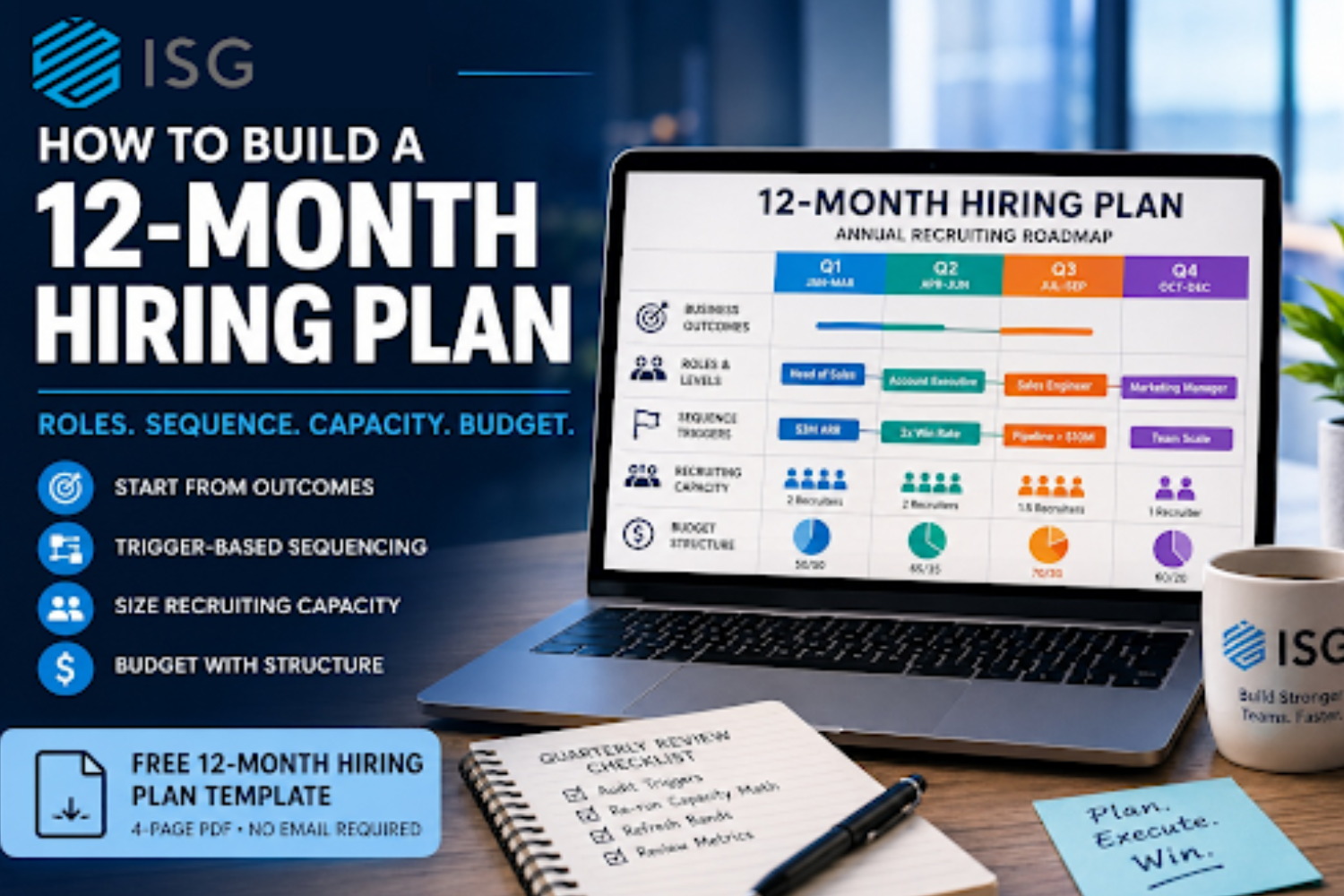
A 12-month hiring plan puts roles, sequence, capacity, and budget structure on one working document. The plan starts from business outcomes and works backward to seats. Triggers decide the sequence, so each hire opens on proof instead of a calendar date.
Capacity math sizes the recruiting effort, with one dedicated recruiter carrying six to ten open roles. Budget structure comes before totals, built on current compensation bands. The free 12-month hiring plan template below turns the framework into a fillable PDF. No email required.
Download: the ISG Partners 12-Month Hiring Plan Template (free PDF). Four pages: plan overview, quarterly role and trigger worksheets, capacity math, and the budget and metrics dashboard.
What Is a 12-Month Hiring Plan?
A 12-month hiring plan is one document that states which roles get hired, in what order, with what recruiting capacity, and under what budget structure. The plan is the shared artifact between founders, finance, and recruiting. Boards read the plan as headcount strategy. Finance reads the plan as a spend line. Recruiters read the plan as a workload map.
One page serves all three when the structure holds. Companies without the document plan hiring one emergency at a time. Ownership makes the document real.
One name owns the plan. Everyone else contributes to the plan. The planning window runs twelve months because budgets run twelve months. The review rhythm runs quarterly because markets move faster than budgets.
What Goes Into the Hiring Plan?
Five components make the hiring plan work: outcomes, roles, sequence triggers, capacity, and budget structure. The components are defined below:
| COMPONENT | WHAT THE COMPONENT CAPTURES |
|---|---|
| Business outcomes | The three results the next twelve months must produce |
| Roles and levels | Every seat, one role per requisition, traced to an outcome |
| Sequence triggers | The proof that opens each seat |
| Recruiting capacity | Recruiter seats needed per quarter, from the capacity math |
| Budget structure | Pay mix per role family, set from current bands |
Each component earns a section in the template. A plan missing any one of the five breaks in a predictable place. Missing triggers produce calendar hiring. Missing capacity produces stalled searches. Missing structure produces offer chaos.
How Do You Choose the Roles?
Roles come from outcomes, not from org charts. Start with the three results the year must produce. Revenue targets, product milestones, and operational commitments each demand work.
Map the work to seats. A seat with no outcome behind the seat leaves the plan. The discipline runs in both directions. An outcome with no seat behind the outcome exposes a gap the plan surfaced early.
One role per requisition holds at the planning stage. A blended seat asking for three jobs signals indecision to every strong candidate who reads the posting later. Level mix belongs in the plan too.
Senior seats consume more search effort and more budget per hire. A plan loaded with senior hires in one quarter needs the capacity math to say so.
How Do Backfills and Attrition Fit the Plan?
Backfills belong in the plan as named rows, not as surprises absorbed mid-quarter. Teams lose people in a normal year. Plan an attrition allowance per function and hold open rows for the backfills. Each departure also opens a decision.
Replace the seat as designed, or upgrade the seat the business outgrew. The plan is the place to make that call calmly. A backfill decided in a panic copies the old job description and repeats the old gaps.
How Do You Sequence the Hires?
Triggers sequence the plan: each seat opens when the proof behind the hire exists. Calendar sequencing hires ahead of evidence. Trigger sequencing hires behind proof. A second closer opens when the first one holds a documented motion.
A pipeline role opens when the close rate is known. A leadership seat opens when the team needs managing. The trigger-based GTM hiring sequence shows the pattern applied to a full go-to-market build.
Dependencies complete the sequence. Some hires need another hire ramped first. A sales engineer without deals in evaluation has nothing to support. An operations hire without volume has nothing to run. The template's trigger column forces the dependency conversation at planning time. Cheap on paper. Expensive in a live search.
How Do You Load the Quarters?
Quarter loading balances trigger timing against search lead time, because senior seats start long before the start date. A leadership search opened in the quarter the leader is needed arrives a quarter late. Work the lead times backward.
Long searches start early. Fast roles fill near the need. Offer-to-start lag adds weeks on top for employed candidates. The template's target start column carries the real date. The trigger column carries the proof. The gap between the two is the search window.
How Do You Plan Recruiting Capacity?
Capacity math sizes the plan: peak simultaneous open roles divided by roles per recruiter seat equals seats needed. One dedicated recruiter carries six to ten open roles at the same time. A quarter with fourteen open seats needs two recruiter seats.
A quarter with four needs a fraction of one. The math takes one line per quarter and prevents the most common plan failure. Plans assume searches run themselves. Searches run on capacity. Seats round up. A plan needing one and a half seats staffs two or accepts the slower quarter knowingly.
Capacity source is the second decision. Internal recruiters, added embedded capacity, or a mix. The honest test is duration. Permanent hiring volume justifies permanent capacity.
Sprint-shaped volume fits capacity that scales up and releases. The embedded recruiting capacity and pricing structure explains how capacity gets bought in seats rather than transactions.
How Do You Budget the Plan?
Budget structure comes before budget totals: set the pay mix per role family, then price each seat from a current band. Closing sales roles sit near a 50/50 base-to-variable split. Pipeline roles sit near 65/35.
Engineering and operations run base-weighted. Structure first keeps offers consistent when the hiring starts. Setting compensation bands before the search covers why band-first offers close faster and survive the second hire.
Bands come from current market data. Specialty markets move inside a single year. A band set from last cycle's survey prices the plan against candidates who left that market months ago.
Our 2026 Compensation Intelligence reports carry current benchmarks across GTM, engineering, AI and machine learning, and data center roles.
The recruiting cost line completes the budget as a structure choice. Per-hire fees scale with every hire. Capacity-based structure holds flat while the plan executes.
What Does Finance Need From the Plan?
Finance needs the plan phased by start dates, structured by pay mix, and owned by one name. Spend begins at the start date, not the offer date. Variable compensation follows quota timing rather than hire timing.
The role family structure in the template gives finance the mix without a debate per offer. One document signed by talent and finance ends the monthly renegotiation. The plan becomes the budget conversation instead of preceding one.
How Do You Keep the Plan Alive?
A hiring plan survives on quarterly review: audit the triggers, re-run the capacity math, refresh the bands, and read the metrics. Four metrics run the dashboard. Time-to-fill, cost per hire, offer acceptance rate, and 90-day retention. The same four we report inside every engagement. Targets go in at planning time. Actuals go in every quarter. Planning around time to hire covers the levers when the first metric drifts.
Re-sequencing is normal. Triggers move because businesses move. A plan that survives contact with the year is a plan that got reviewed. Trigger events force an early review.
A funding round, a key departure, or a missed quarter each reopen the sequence. The template's quarterly checklist takes fifteen minutes per quarter. The alternative takes a re-planning offsite in month seven.
What Breaks Hiring Plans?
Hiring plans break on five repeatable failures: calendar loading, headcount-first budgeting, static bands, ignored capacity, and no owner.
Calendar loading schedules hires by month and ignores proof. Headcount-first budgeting counts seats before outcomes and funds work nobody defined. Static bands price the year against a dead market.
Ignored capacity assumes searches run themselves. No owner means no quarterly review, and an unreviewed plan expires by spring. Every failure has a line in the template built to catch the failure early. The five failures share one root. The plan stopped being a working document and became a slide.
Frequently Asked Questions
What is a hiring plan template?
A hiring plan template is a structured document for planning roles, sequence, capacity, and budget across a set window. Ours covers twelve months on four pages.
What goes in a 12-month hiring plan?
Five components: business outcomes, roles and levels, sequence triggers, recruiting capacity, and budget structure. Metrics targets complete the working document.
How do you calculate recruiter capacity?
Divide peak simultaneous open roles by six to ten roles per dedicated recruiter seat. The result is recruiter seats needed for the quarter.
How often does the hiring plan get reviewed?
The plan gets reviewed quarterly, plus any time a trigger moves. The review audits triggers, capacity, bands, and the four metrics.
Is the hiring plan template free?
The template is a free PDF with no email required. Four pages: overview, quarterly worksheets, capacity math, and the budget and metrics dashboard.
The Plan Behind Every Good Hiring Year
A working 12-month hiring plan traces every seat to an outcome, opens every seat on a trigger, sizes the recruiting capacity, and prices from current bands. The document costs an afternoon to build and a quarter-hour to maintain. Hiring without one costs the year.
We ask every company the same question at ISG Partners: what does the next twelve months of hiring look like? The completed plan is the best possible answer.
One embedded engagement built around your hiring plan covers the full range, from the first five hires through executive search, with capacity sized to the document you now hold. Download the template, build the plan, and bring both to a discovery call.