
How to Reduce Cost per Hire in 2026 (Without Hiring Less)
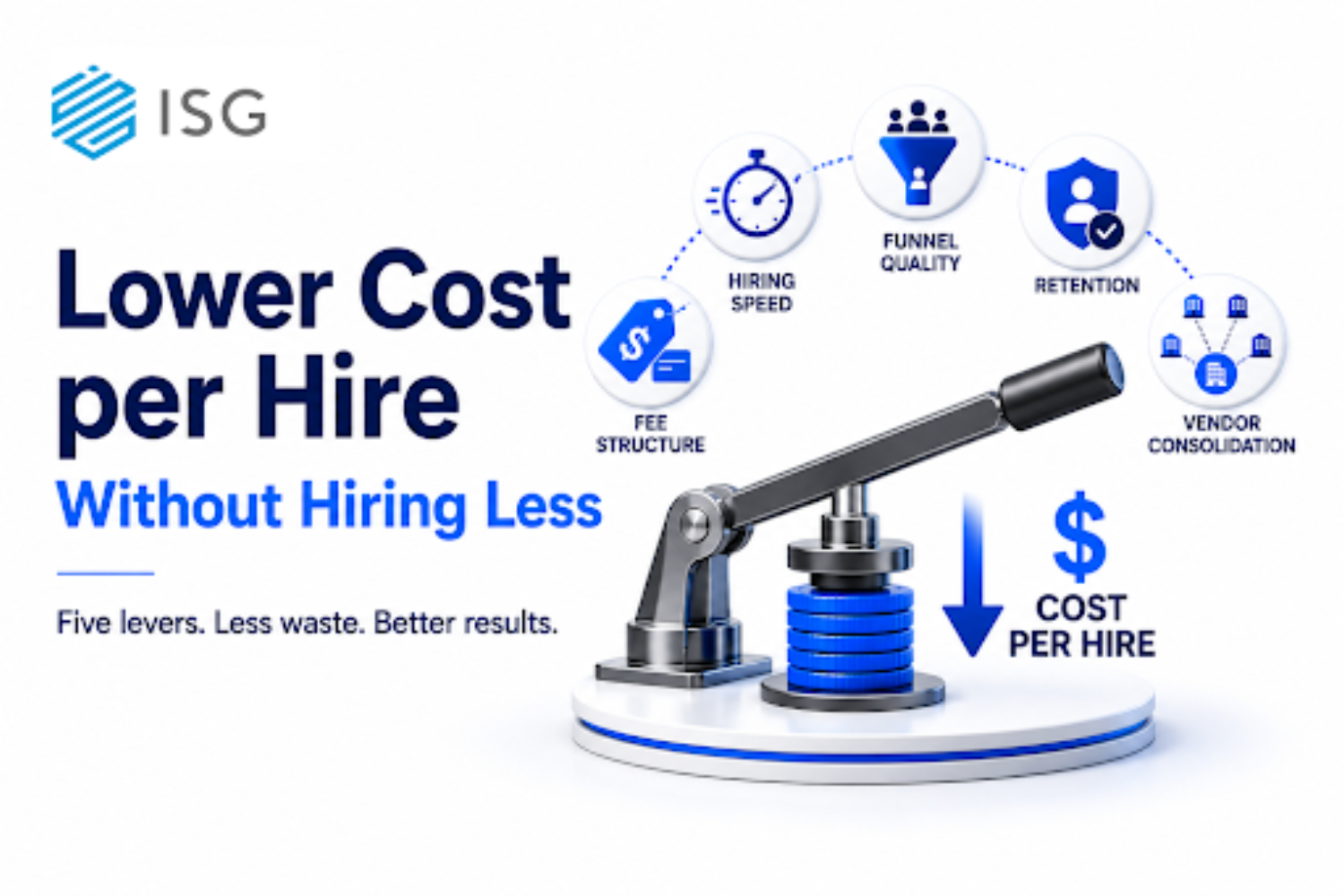
Cost per hire falls two ways: cut the hiring or cut the waste, and only one of those is a strategy. Five levers reduce recruiting spend without touching hiring volume: fee structure, speed, funnel quality, retention, and vendor consolidation.
Most of the waste hides in lines nobody tracks, from repeated interviewer hours to declined offers that re-run the funnel. A failed hire attaches the full search cost twice, which makes retention the most underrated cost lever in recruiting. We report cost per hire inside every ISG Partners engagement, and the levers below are the ones that move the number.
What Drives Cost per Hire Up?
Cost per hire rises through waste, not through hiring volume, and the waste hides in five places most budgets never itemize. The formula stays simple: total recruiting spend divided by hires made in the period. The spend side is where the leaks live.
Per-hire fees stack with every placement. Interviewer hours repeat across bloated loops. Declined offers send the funnel back to the start. Failed hires re-open finished searches.
Vacancy weeks tax the team doing the missing work. The full cost of recruiting breakdown diagnoses the complete number. The levers below reduce the number.
Volume is not the villain. Companies read a high cost per hire and slow their hiring, which shrinks the denominator and makes the number worse. Waste is the villain. Cut the waste and the metric falls while hiring continues.
Which Five Levers Reduce Cost per Hire Without Reducing Hiring?
Five levers lower recruiting spend while hiring volume holds: fee structure, hiring speed, funnel quality, retention, and vendor consolidation. Each lever attacks a different waste line. The full set is mapped below:
| Lever | What changes | Where the saving comes from |
|---|---|---|
| Fee structure | Per-hire fees become fixed capacity | Spend stops scaling with every placement |
| Hiring speed | Vacancy weeks shrink | Less unfilled work, fewer repeated interviews |
| Funnel quality | Fewer interviews per hire | Interviewer hours and declined offers drop |
| Retention | Failed hires stop re-opening searches | The same search never gets paid for twice |
| Vendor consolidation | One partner replaces several | Duplicated fees and duplicated learning end |
One lever helps. The five together compound, because every lever protects the others. Faster hiring means less vacancy drag. Better funnels mean fewer declines. Stronger retention means the speed gains stay banked.
How Does Fee Structure Lower Cost per Hire?
Fee structure decides how recruiting spend behaves as hiring grows: per-hire fees scale in a straight line, and capacity structures hold flat. Ten hires under a percentage model cost ten separate fees. Ten hires inside a fixed-capacity engagement cost the same as three, because the structure prices recruiter capacity instead of individual placements.
Cost per hire falls with every additional hire the capacity absorbs. Per-hire structures also shape behavior: spend that climbs with every offer gives teams a quiet reason to slow hiring late in the quarter. Capacity structures remove the tension.
How Capacity Pricing Behaves as Hires Accumulate
Capacity pricing turns hiring volume from a cost driver into a cost divisor. The spend line stays level while placements stack, so the arithmetic improves each month the team keeps hiring.
The flat fee and contingency recruiting comparison walks the math in both directions, including the honest reverse: a single slow month carries the full capacity cost. Continuous hiring is where the structure pays. One dedicated recruiter carrying six to ten open roles is the capacity unit that makes the divisor work.
How Does Hiring Speed Cut Recruiting Costs?
Hiring speed cuts recruiting costs because vacancy time is a cost line, paid weekly, that never appears on an invoice. An open seat taxes the team covering the work, delays the output the role exists to produce, and keeps interview loops running longer than planned. Slow searches also lose candidates to faster processes, which restarts sourcing and repeats every hour already spent.
Speed converts directly into spend: how faster hiring timelines lower spend covers the compression levers, from parallel scheduling to pre-cleared offer approval.
Weeks removed from a search are dollars removed from the metric, on both the vendor line and the vacancy line. Vacancy drag compounds on senior seats, where the missing work is decisions rather than tasks.
How Does Funnel Quality Reduce Hiring Costs?
Funnel quality reduces hiring costs by cutting the interviews, declines, and restarts hiding between application and acceptance. Two conversion points carry most of the waste.
Screening Precision and Interviewer Hours
Interviewer hours are the largest unbilled line in recruiting spend. A loose screen sends weak candidates into expensive rooms. Six interviews per hire instead of ten saves dozens of senior hours per search, and the saving repeats on every requisition.
Sharp intake criteria, calibrated scorecards, and honest phone screens buy the precision. Screening depth is an investment that pays at the panel stage, every single time.
Offer Acceptance and the Double Funnel
Every declined offer runs the funnel twice and books the cost once, which hides the most expensive failure in the metric. A decline sends the search back through sourcing, screening, and interviews, doubling the effort behind one seat.
Acceptance rate is a cost lever wearing a quality costume. Counteroffer preparation, early compensation conversations, and fast offer approval protect the funnel from paying for the same hire twice.
How Does Retention Protect Cost per Hire?
Retention protects cost per hire because a failed hire re-opens a finished search and attaches the full cost a second time. The 90-day exit is the most expensive event in recruiting economics.
Everything spent on the search repeats, the team absorbs a second vacancy, and the metric quietly doubles for that seat. Structured 30, 60, and 90-day check-ins catch the failures while the fixes stay cheap.
We run those check-ins on every placement, with the company and the new hire, because protecting the placement protects the spend behind the placement. Cost per hire and 90-day retention are the same conversation read from two directions.
How Does Vendor Consolidation Lower Recruiting Spend?
Vendor consolidation lowers recruiting spend by ending duplicated fees, duplicated learning, and duplicated management overhead. Three agencies on one company each bill their own structure, rebuild the same market knowledge, and demand separate oversight. Every new vendor restarts the learning a previous vendor already charged for.
One accountable partner carries the compensation data, the sourcing maps, and the process knowledge forward across every search, so the second search starts where the first one finished.
Consolidation also cleans the reporting: one scorecard, one cadence, one relationship to manage instead of a vendor portfolio. Companies running many searches a year feel the compounding most, because carried learning prices the tenth search lower than the first.
How Do You Measure Cost per Hire Reduction?
Measure cost per hire fully loaded, per role family, as a trend, or the number lies in every direction. Fully loaded means the internal lines count: interviewer hours, tooling, and vacancy cost, not vendor invoices alone.
Per role family means an executive search and an SDR batch never share one blended number. Trend means quarter over quarter, because a single month proves nothing.
The metric belongs on monthly reporting against the partner scorecard, next to time-to-fill, offer acceptance, and 90-day retention, where the four numbers explain each other.
A falling cost per hire beside falling retention is not a saving. A falling cost per hire beside steady retention is the real thing. Reason codes from declined offers and exit notes from failed hires turn the trend into a diagnosis.
What Cost Cuts Backfire?
Four cost cuts raise cost per hire while looking like savings: cheap vendors, thin screening, stretched loops, and silent processes. The cheapest agency resurfaces as mis-hires and re-runs.
Screening cuts push the waste downstream into interviewer hours and failed placements. Loops stretched to avoid decisions lose candidates and restart searches.
Ghosted candidates damage the brand that future funnels depend on, and the damage prices into every later search. Each cut moves cost from a visible line to an invisible one.
The metric catches the trick eventually, and the catch always costs more than the cut saved. The honest test for any cut: name the line the cost moves to. No answer means the cut is a transfer.
Frequently Asked Questions
What is cost per hire?
Cost per hire equals total recruiting spend divided by hires made in the period. Fully loaded versions include internal costs such as interviewer hours and vacancy time.
How is cost per hire calculated?
Divide all recruiting costs, external and internal, by the number of hires in the same window. Segment the number per role family for an honest read.
What is a good cost per hire?
A good cost per hire is a falling trend beside steady retention, measured per role family. Universal benchmarks blend roles and markets into a number that guides nothing.
Does reducing cost per hire hurt quality?
Cutting waste protects quality, and cutting corners destroys quality. The five levers reduce spend on fees, delays, and re-runs, never on screening depth or evaluation rigor.
What lowers cost per hire fastest?
Fee structure moves the number fastest, because per-hire fees stop scaling the moment capacity replaces transactions. Retention protects the gain from quietly reversing.
Key Takeaways: Cut the Waste, Keep the Hiring
Cost per hire falls when the five levers work together: capacity-based structure, faster searches, tighter funnels, protected placements, and one accountable partner. None of the five touches hiring volume. All five attack the waste that made the number high.
We built the ISG Partners model around the same arithmetic. One dedicated recruiter, a flat monthly structure with zero per-hire fees, searches that move in days, and 30, 60, and 90-day check-ins protecting every placement.
Cost per hire goes in the monthly report where everyone reads the number, next to the three metrics that keep the number honest. Inside our embedded recruiting engagement, the levers run as one system, from a single senior search through executive search. Bring last quarter's recruiting spend to a discovery call, and we find the waste together.