
Embedded Recruiting for SaaS Companies
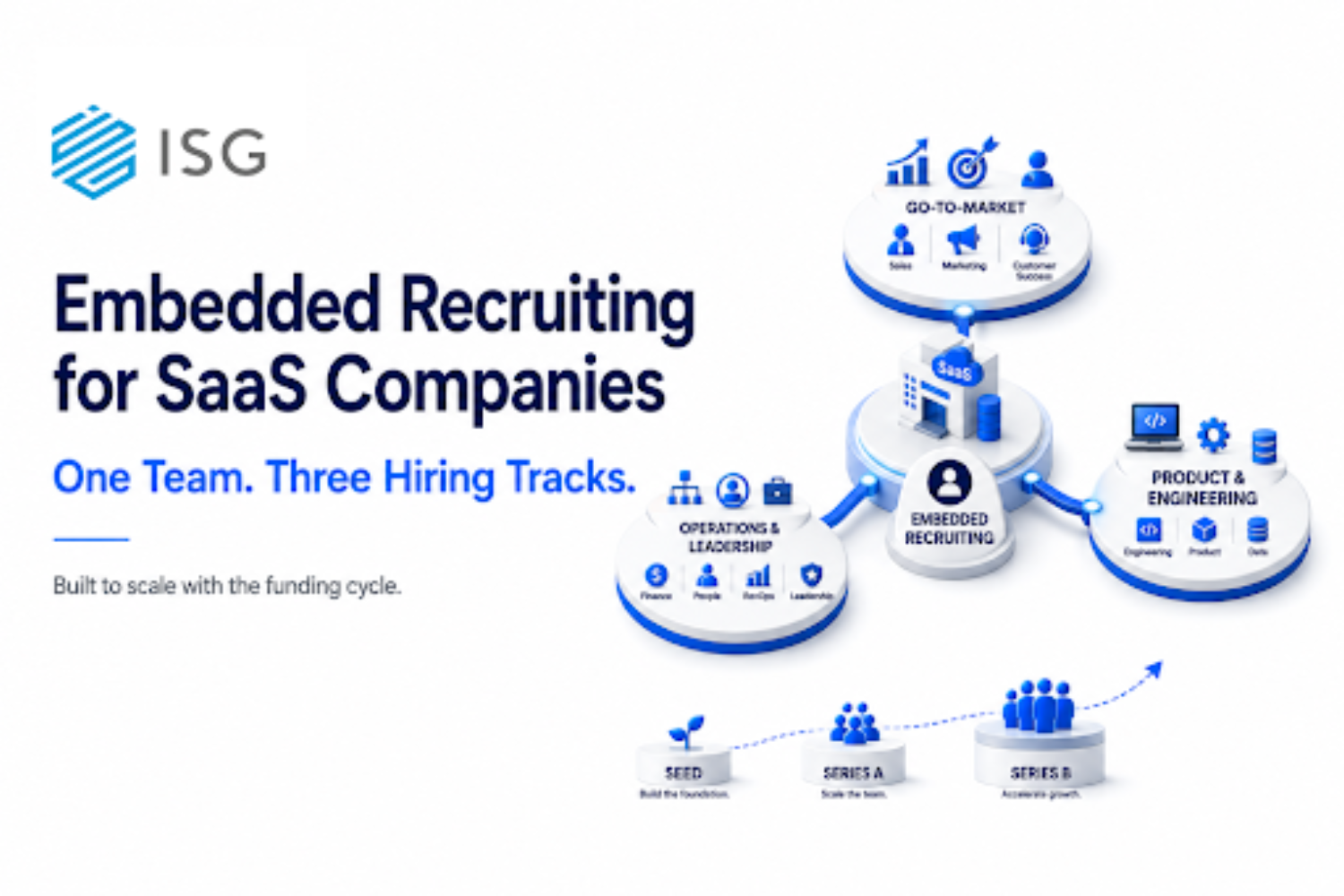
Embedded recruiting fits SaaS companies because SaaS hiring moves in waves, runs across three tracks at once, and competes in the tightest talent markets in tech. A dedicated recruiter works inside the company's own ATS and Slack, carrying six to ten roles across go-to-market, engineering, and operations in one engagement.
Capacity ramps after a funding round, holds through the build, and steps down when the wave completes, on month-to-month terms shaped like the funding cycle itself. Approximately 80 percent of our clients at ISG Partners are SaaS and technology companies, and the model below is why.
Why Does SaaS Hiring Break Traditional Recruiting Models?
SaaS hiring breaks traditional recruiting models because the volume arrives in waves, spans three functions at once, and competes for the most contested candidates in tech. A funding round converts a hiring plan into twenty open requisitions overnight.
The roles spread across sales, engineering, and operations, three separate talent markets with three separate evaluation standards. Per-hire fee structures stack a separate charge on every one of those placements, at the exact moment the company needs spend predictability most.
Per-search agencies cover one function well and the other two badly. The mismatch is structural, and structural mismatches never get fixed by working harder inside the wrong model. Talent competition sharpens every edge of the problem, because every funded SaaS company fishes the same candidate pools in the same quarter. Our foundational embedded recruiting guide covers the model itself. The sections below cover why SaaS is the vertical the model fits best.
How Does Embedded Recruiting Work for a SaaS Company?
Embedded recruiting places a dedicated recruiter inside the SaaS company's team, running every search through the company's own tools and process. The recruiter joins your Slack, works inside your ATS, and sits in your hiring meetings.
We deploy within 48 hours of kickoff, and most clients see qualified candidates inside the first two to three days. One recruiter carries six to ten open roles at the same time, across functions, and the engagement runs month to month.
Hiring managers keep every decision. The recruiter carries your brand into every candidate conversation, as a true internal talent team rather than an external voice juggling a dozen clients.
What Happens After a Funding Round Closes?
A closed round starts the hiring wave, and the first two weeks decide how the whole wave runs. The announcement brings inbound noise while the real targets stay passive. The plan converts into sequenced searches, the priority roles open first, and parallel execution replaces one-at-a-time hiring.
A recruiter deployed inside 48 hours runs the sequencing from day one instead of joining mid-scramble. Band-setting belongs in those first two weeks too, because every parallel search prices against the same market at once. Waves rewarded planning last quarter. Waves punish improvisation now.
Which Teams Does One Embedded Engagement Cover?
One embedded engagement covers the full SaaS build: the go-to-market track, the product and engineering track, and the operations and leadership track. The three tracks and their demands are mapped below:
| Track | Typical roles | What the search demands |
|---|---|---|
| Go-to-market | AEs, SDRs, sales engineers, marketing, CS | Motion match, stage match, comp structure discipline |
| Product and engineering | Engineers, product managers, design, data | Technical evaluation, signal-based sourcing, speed |
| Operations and leadership | Finance, people, RevOps, VP and executive seats | Confidentiality, calibration, leadership assessment |
Most SaaS companies hire across all three tracks in the same quarter, and most recruiting vendors specialize in exactly one. The single-engagement structure removes the vendor patchwork.
Building the first GTM team after Series A covers the commercial track's sequencing, and our sales team recruiting breakdown goes deep on the revenue org. The same recruiter who closes the founding AE runs the staff engineer search the following month, with the context carried, not rebuilt.
Why Does Cross-Track Context Compound?
Cross-track context compounds because one recruiter learns the company once and applies the learning to every search. The product story, the compensation philosophy, the interview culture, and the founder's bar get absorbed in week one and carried into every conversation after.
A vendor patchwork re-teaches the same context three times and still gets three different versions of the pitch. Candidates hear the difference. A recruiter who explains the product roadmap fluently closes candidates a script reader loses. Context is the quiet advantage of the single-engagement structure, and context only compounds when the seat stays constant.
How Does the Funding Cycle Shape SaaS Hiring?
The funding cycle shapes SaaS hiring into a rhythm of waves: seed builds the core, Series A builds the motion, and Series B scales what the motion proved. Seed-stage hiring stays small and senior, founding engineers and the first commercial hire.
Series A opens the GTM build and deepens the engineering core. Series B multiplies the teams the proofs justified and adds the leadership layer. Triggers govern healthy waves at every stage: each seat opens when the proof behind the hire exists, never on a calendar date.
What Does the Series B Wave Demand?
The Series B wave multiplies proven teams and adds the leadership layer, which doubles the search load and raises the stakes per seat. Pod replication runs many similar searches in parallel: second and third AE cohorts, engineering squads, the CS team behind the renewal base.
Leadership searches open above the pods, from sales leadership through the first VP Engineering. Fourteen simultaneous open seats need two recruiter seats by the capacity math, and the math surfacing at planning time beats the math surfacing as a stalled quarter.
Capacity follows the rhythm. The engagement ramps when the round closes, holds through the build, and steps down when the wave completes, without exit penalties or renegotiation.
The capacity structure behind embedded engagements explains how seats scale in steps rather than per hire. A structure shaped like the funding cycle beats a structure shaped like a contract, in every uncertain year SaaS keeps having.
What Do SaaS Compensation Benchmarks Say in 2026?
SaaS compensation in 2026 follows structure first: closers near a 50/50 base-to-OTE split, SDRs near 65/35, and engineering base-weighted against a $192,120 US software median. Our GTM compensation research for 2026 places US account executive on-target earnings at $230,000 at the median, with sales engineers carrying the highest individual contributor base at $148,000.
Bands set from current data close offers, and bands set from last cycle's survey lose candidates silently at the compensation conversation. SaaS talent markets move inside a single year. Offers built on band discipline, structured plainly, and delivered fast win against bigger numbers explained vaguely.
The data layer is part of the engagement: the same benchmarks published in our research calibrate every offer we help structure. SaaS companies adding AI features meet a second market on top of the first.
AI and ML compensation carries a 12 to 38 percent premium above the software baseline, and offers priced on the general engineering band lose those candidates without a conversation.
Why Does Candidate Experience Matter More in SaaS?
Candidate experience carries revenue weight in SaaS, because the people a software company interviews are the people its category sells to. The rejected AE surfaces later inside a prospect account. The sales engineer from the final round runs a future technical evaluation. Practitioner markets stay small, and verdicts travel.
A dedicated embedded recruiter carries one brand into every conversation, which protects the pipeline wearing a candidate badge. Every search leaves dozens of impressions in the exact market the company sells into, and the model decides what those impressions say. Software categories reward the companies practitioners speak well of, in reviews, referrals, and renewal rooms alike.
When Does the Embedded Model Not Fit a SaaS Company?
The embedded model does not fit a SaaS company with one isolated search, no near-term hiring plan, or a pre-plan product stage. A single senior search with nothing behind the search sometimes prices better per-search. A company still finding product-market fit sometimes needs a plan before a recruiter.
Standardized thousand-seat volume programs belong with process-rebuild providers. Honest fit runs our whole model: the engagement earns adoption where hiring is plural, multi-track, and tied to a funded plan, which describes most SaaS companies after a round and not every company before one. Saying so early costs one call and saves one bad engagement.
Frequently Asked Questions
What is embedded recruiting for SaaS companies?
Embedded recruiting places a dedicated recruiter inside a SaaS company's team and tools on a month-to-month engagement. One engagement covers GTM, engineering, and operations hiring together.
How fast can a SaaS company add recruiting capacity?
A dedicated recruiter deploys within 48 hours of kickoff. Most SaaS clients see qualified candidates inside the first two to three days of the engagement.
What does a SaaS embedded engagement cover?
The engagement covers the full build: sales and marketing, product and engineering, and operations through leadership search. One recruiter carries six to ten open roles across the tracks.
How do SaaS companies pay for embedded recruiting?
The engagement runs on a flat monthly structure with zero per-hire fees. Capacity scales in seats with the hiring plan, month to month, without long-term contracts.
Does embedded recruiting work for early-stage SaaS?
The model works from the first funded hiring wave onward. Seed-stage companies with a plan and several open roles fit, and companies with one isolated search sometimes fit per-search firms better.
Key Takeaways: The Vertical the Model Was Shaped For
SaaS hiring runs in funded waves across three tracks, and embedded recruiting is the one structure shaped like that pattern. Capacity that ramps with the round, one recruiter across every track, offers calibrated on current data, and a candidate experience that protects the market the company sells into.
Approximately 80 percent of ISG Partners clients are SaaS and technology companies, from seed-stage teams making their first five hires through growth companies running executive searches.
One engagement, month to month, sized to the wave. The wave is coming either way. The structure decides how the wave runs. Bring the post-round hiring plan to a discovery call, and we size the capacity to the build.