
How Is RevOps Compensation Structured?
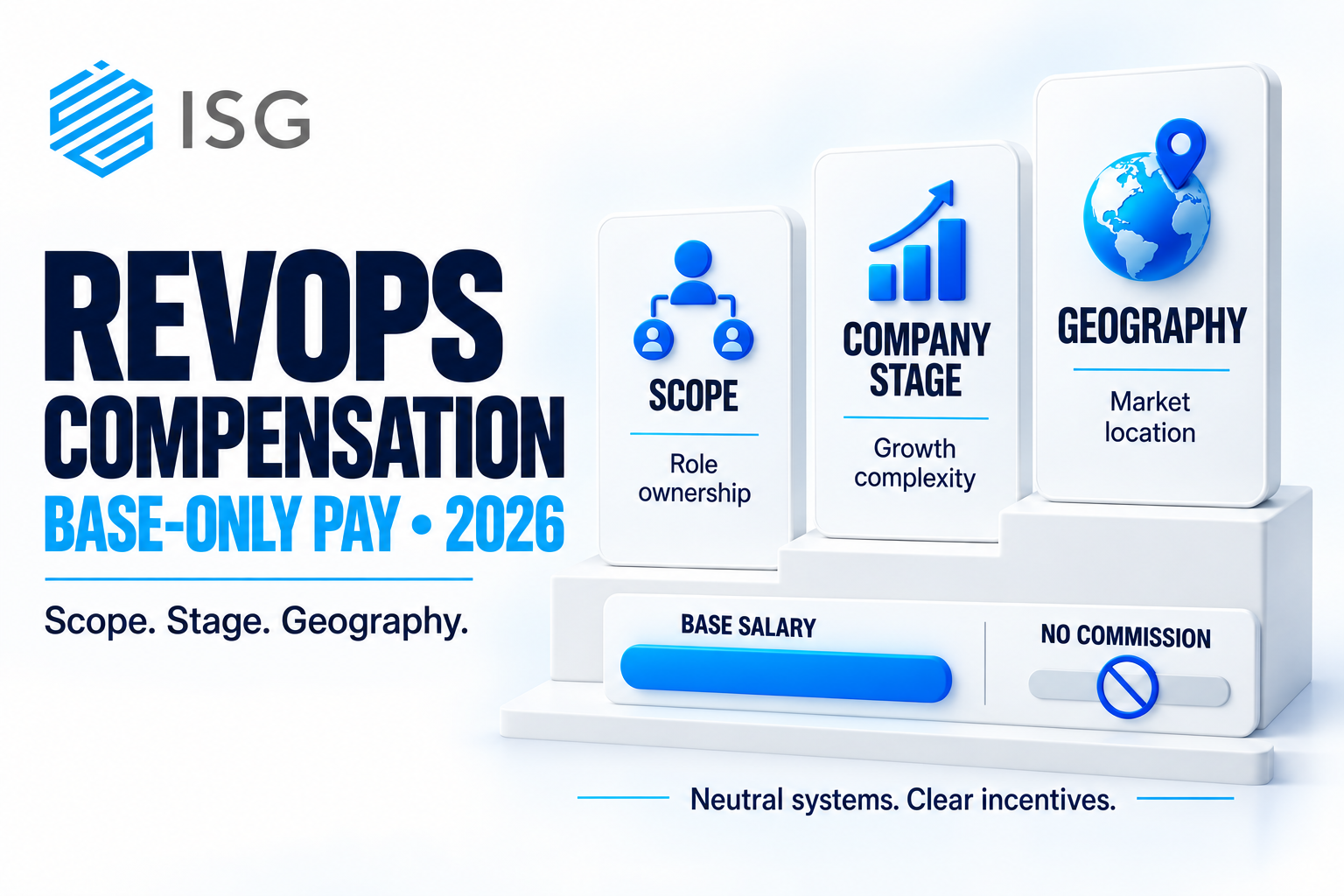
RevOps compensation is a base-only salary structure for the people who own the revenue systems, with no commission and no quota-linked bonus. RevOps compensation runs base-only because the role sets, measures, or calculates every number a variable plan pays on.
A RevOps base band is set on three inputs: scope, company stage, and geography, read against current market data. A RevOps compensation plan contains a base band, a level, an equity grant, and a review trigger, with no commission line.
We recruit RevOps roles on a scorecard that tests systems ownership, forecasting, and compensation administration. The full structure is below.
What Is RevOps Compensation?
RevOps compensation is the pay structure for revenue operations roles, and the structure runs on base salary alone. Revenue operations owns the systems and the numbers that sales, marketing, and customer success run on. The role carries no quota. The role carries no commission.
The RevOps function covers four levels, given below:
RevOps analyst, who builds reports and maintains data hygiene.
RevOps manager, who owns the CRM, the pipeline stages, and the forecast model.
RevOps director, who owns territory design, quota setting, and compensation administration across the revenue team.
VP of RevOps, who owns the revenue operating model across sales, marketing, and customer success.
Every level pays on base. Scope moves the band between levels. Variable pay never enters the structure, and the next section covers the reason in 2026 terms.
What Does the RevOps Role Own?
The RevOps role owns seven numbers that every other revenue plan depends on. The seven are given below:
Pipeline stage definitions, which decide when a deal counts.
Forecast categories and the forecast model.
Territory design and account assignment.
Quota setting for every quota-carrying seat.
Commission calculation and payout timing.
Win rate, cycle length, and conversion reporting.
CRM configuration in Salesforce or HubSpot, plus the tools attached to the CRM.
Each number feeds a variable plan somewhere else in the company. The person who owns the number holds the pen on the pay of every other revenue seat. Pay structure has to respect that position.
Why Does RevOps Compensation Run Base-Only?
RevOps compensation runs base-only because the role sets, measures, or calculates every number a variable plan pays on, and paying the owner of the number on the number distorts the number. A commission on bookings rewards loose stage definitions. A bonus on forecast accuracy rewards a sandbagged forecast. A bonus on pipeline coverage rewards inflated early stages.
Base-only pay removes the conflict at the source. The RevOps manager who sets quotas gains nothing from a low quota. The RevOps director who calculates commissions gains nothing from a generous rule. The number stays clean because the owner of the number has no stake in the direction the number moves.
The pay-mix findings in our 2026 GTM compensation report carry the full base-only finding beside the quota-carrying bands.
What Goes Wrong When RevOps Pays on a Number?
Three distortions appear when RevOps pays on a revenue number, and each one shows up inside two quarters. The three are given below:
Stage drift. Deals advance earlier so pipeline and bookings numbers rise. Forecast accuracy falls the following quarter.
Quota compression. Quotas get set low enough to protect attainment, because attainment feeds the RevOps bonus. The board sees high attainment and flat revenue.
Rule generosity. Commission rules get interpreted in favor of the rep, because disputes with reps cost RevOps time and goodwill. Payout costs rise without a plan change.
Each distortion is invisible on the dashboard, because RevOps owns the dashboard. Base-only pay is cheaper than the audit that finds the distortion.
Where Does Variable Pay Belong Instead?
Variable pay belongs on the seats that close, source, or retain revenue, and the mix differs by role. The revenue team pay mixes are mapped below:
| Role | Base-to-variable mix | What the variable rewards | Who owns the number |
|---|---|---|---|
| Account executive | 50/50 | Closed bookings against quota | RevOps sets the quota |
| SDR | 65/35 | Qualified meetings and pipeline created | RevOps defines qualification |
| Customer success manager |
Base-weighted with retention variable | Net retention and renewal | RevOps reports retention |
| Sales engineer | Base-weighted | Technical win contribution | RevOps attributes the win |
| RevOps | Base-only | Nothing, by design | RevOps owns every number above |
The table shows the dependency in one column. Every variable plan on the table runs through a number RevOps controls. The on-target earnings structure behind each quota-carrying mix explains the closer and SDR splits in full.
How Is a RevOps Base Band Set?
A RevOps base band is set on three inputs read against current market data: scope, company stage, and geography. Scope sets the level. Stage sets the width. Geography sets the market multiplier. No input involves a quota.
Band width stays narrower than a quota-carrying band, because no variable component absorbs performance differences. Performance moves a RevOps hire between levels, not between the bottom and top of one level. Compensation bands read as hiring decisions covers the band-setting method the RevOps band follows.
How Does Scope Move the Band?
Scope moves a RevOps band through three measures: reps supported, systems owned, and functions covered. The three measures are given below:
Reps supported: a RevOps manager for a ten-rep team sits below a manager for a sixty-rep team.
Systems owned: CRM alone sits below CRM plus enablement, forecasting, and commission tools.
Functions covered: sales-only operations sits below operations across sales, marketing, and customer success.
Scope changes faster than title. A RevOps manager who inherits marketing operations has moved up a level in scope without a title change. The band has to move with the scope, or the market moves the person.
How Does Company Stage Move the Band?
Company stage moves a RevOps band through the breadth of the role: early-stage RevOps is one generalist, and growth-stage RevOps is a team of specialists. The first RevOps hire at a Series A company owns everything on the seven-number list. A RevOps director at a late-stage company owns a team that splits the list.
The generalist band sits wide, because the hire covers director-level scope at manager-level headcount. The specialist band sits narrow, because each role covers one slice. Stage decides which shape the company is buying.
How Does Geography Move the Band?
Geography moves a RevOps band through the market multiplier of the hiring location. Remote RevOps hires get paid on the market of the company, not the market of the candidate. A RevOps manager in Atlanta, Austin, or Raleigh reads against the local market. A remote hire reads against the market where the company sets its bands.
One rule holds across locations. The band follows the scope and the company market, and the location adjusts the number inside that band. Location never changes the structure. Base-only pay applies in every market.
What Does a First RevOps Hire Get Paid On?
A first RevOps hire gets paid on base, with equity carrying the long-term alignment the role needs. The first hire builds the pipeline stages, the forecast model, and the commission rules from nothing. A variable plan on any of those three pays the builder on the thing being built.
Equity rewards the company outcome instead. The first RevOps hire owns the measurement layer the whole revenue team runs on, and the pay structure keeps the layer neutral.
What Does a RevOps Compensation Plan Contain?
A RevOps compensation plan contains five elements, and none of the five is a commission line. The five elements are given below:
Base band by level, set against current market data for the geography.
Level definition with the scope measures that move a hire between levels.
Equity grant sized to level and stage, vesting on the company schedule.
Review trigger: an annual market check plus a re-read at any scope change or funding event.
Company bonus eligibility where one exists, tied to company performance rather than a revenue number RevOps calculates.
The fifth element draws the line precisely. A company-wide profit share is compatible with base-only RevOps pay. A bonus on bookings, pipeline, forecast accuracy, or attainment is not, because RevOps produces those numbers.
How Do We Recruit RevOps Roles at ISG Partners?
We recruit RevOps roles at ISG Partners on a scorecard that tests four competencies: systems ownership, forecasting, compensation administration, and cross-functional authority. RevOps candidates come from three pools: sales operations, finance and FP&A, and revenue consulting. Each pool carries one strength and one gap.
The pool reading is given below:
Sales operations candidates know the CRM and the reps. The gap is forecasting rigor.
Finance candidates know the model and the forecast. The gap is CRM depth and rep credibility.
Consulting candidates know the operating model. The gap is ownership of one system over years.
The scorecard weights the gap against the current need of the company. A company with a broken forecast hires from finance. A company with a broken CRM hires from sales operations. Embedded recruiting across the revenue team covers how the RevOps seat gets filled beside the quota-carrying seats.
What Does a RevOps Scorecard Test?
A RevOps scorecard tests four competencies with one work sample each. The four samples are given below:
Systems ownership: the candidate walks through a CRM they rebuilt, stage by stage, with the reasons each stage definition changed.
Forecasting: the candidate explains a quarter where the forecast missed and the model change that followed.
Compensation administration: the candidate works a commission dispute from the plan document to the payout.
Cross-functional authority: the candidate describes a quota they set that a sales leader opposed, and how the number held.
The fourth sample decides most hires. RevOps holds the pen on the pay of the whole revenue team, and the role needs a person who holds the pen under pressure. Base-only pay supports that person, because the candidate gains nothing from bending.
Why Is Base-Only Pay a Recruiting Advantage?
Base-only pay is a recruiting advantage for RevOps roles because the strongest candidates self-select toward neutral pay. A candidate who asks for a bookings bonus wants a stake in a number the role controls. A candidate who asks about scope, systems, and equity wants the role as designed.
The pay structure works as a screen. The offer conversation stays short, because base-only pay has no variable to negotiate. Acceptance is expected, not hoped for, when the band sits at market and the scope is written down.
How Does RevOps Compensation Connect to the GTM Plan?
RevOps compensation connects to the GTM plan as the one seat paid outside the plan, because RevOps writes the plan everyone else is paid on. Quotas, territories, stage definitions, and commission rules all pass through RevOps before a rep sees them. A revenue plan with a conflicted author produces conflicted numbers.
The connection runs in one direction. RevOps compensation never depends on the GTM plan. The GTM plan always depends on RevOps. Pay structure has to match that direction.
What Breaks RevOps Compensation?
Four mistakes break RevOps compensation, and each one puts a revenue number inside the RevOps pay plan. The four are given below:
Commission on bookings, which pays the stage owner on stage drift.
Bonus on forecast accuracy, which pays the forecaster to sandbag.
OTE parity with account executives, which imports a quota mindset into a role with no quota.
Title inflation without a band move, which leaves a director-scope hire on a manager band until a competitor fixes the gap.
Each mistake has the same repair. Remove the revenue number from the plan, reset the base to scope, and move alignment into equity.
Who Does RevOps Report To?
RevOps reports to the CRO or the CFO, and the reporting line decides how neutral the numbers stay. A RevOps leader inside the sales organization feels quota pressure from the top. A RevOps leader beside the sales organization, reporting to the CRO with a finance dotted line, sets numbers the whole revenue team trusts.
Pay structure and reporting line work together. Base-only pay removes the personal stake. A reporting line outside the sales team removes the organizational one.
Pay the Number Owner on Nothing the Number Moves
RevOps compensation runs base-only because the role owns every number a variable plan pays on, and neutral pay keeps the numbers clean. Set the band on scope, stage, and geography. Carry long-term alignment in equity. Keep every revenue number out of the plan.
We recruit RevOps roles at ISG Partners with dedicated recruiters deployed within 48 hours. Engagements run from a single senior search through full team builds and executive search. The RevOps seat gets the same scorecard rigor as the quota-carrying seats beside it.
How a dedicated recruiter runs a revenue team search end to end shows the engagement model. Bring the open RevOps role and the current band to a discovery call, and we read the scope together.
Frequently Asked Questions
Does RevOps receive equity?
RevOps roles receive equity sized to level and stage, because equity aligns the role with the company outcome without touching a revenue number. Equity is the long-term component in a base-only plan.
Is a company-wide bonus compatible with base-only RevOps pay?
A company-wide profit share or performance bonus is compatible, because RevOps does not calculate the number behind the bonus. A bonus on bookings, pipeline, or attainment is not.
Is RevOps paid the same as sales operations?
RevOps sits above sales operations in band when the role covers marketing and customer success operations as well. Scope sets the difference, not the title.
Does marketing operations follow the same structure?
Marketing operations and customer success operations follow the same base-only structure, because each owns the measurement layer for its function. Variable pay on owned measurement distorts the measurement.
How often is a RevOps band reviewed?
A RevOps band is reviewed once a year against market data and again at any scope change or funding event. Scope changes trigger more band moves than calendar reviews do.