
How Does Embedded Recruiting Work for Fintech Companies?
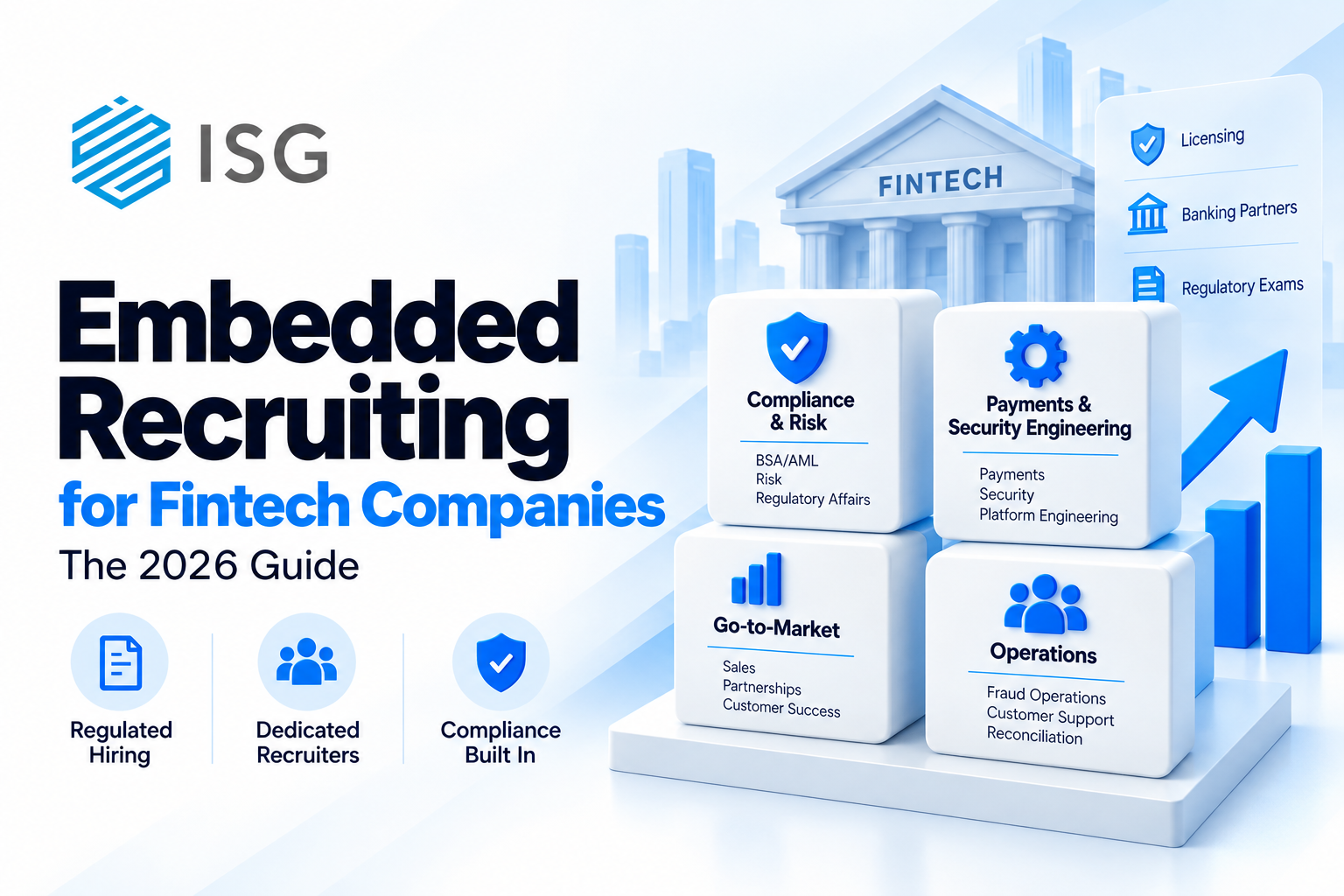
Embedded recruiting for fintech companies places dedicated recruiters inside the company, under the access controls of the company, with compliance written into every scorecard. Fintech hiring differs from other software hiring because licensing, banking partners, and regulatory exams set the hiring calendar.
Fintech companies hire four role families through the embedded model: compliance and risk, payments and security engineering, go-to-market, and operations. The fintech funding and licensing cycle opens roles in a fixed order, with the compliance seat before scale. We run every fintech engagement in five steps, and the full method is below.
What Makes Fintech Hiring Different?
Fintech hiring differs from other software hiring because regulation sets the calendar: licensing, banking partner onboarding, and examinations open roles on dates the company does not choose. A software company hires when the funding round closes. A fintech company hires when the funding round closes and when the license lands and when the sponsor bank signs.
The three regulatory triggers are given below:
A money transmitter license, lending license, or broker-dealer registration lands, and the license conditions name the roles the company has to staff.
A sponsor bank or banking-as-a-service partner signs, and the due diligence of the partner names the compliance program the company has to run.
A regulatory examination gets scheduled, and the exam scope names the controls the company has to evidence.
Each trigger opens roles with a deadline attached. Recruiting capacity has to exist before the trigger fires, because the trigger does not wait for a search to start.
Which Compliance Requirements Shape Fintech Hiring?
Five compliance requirements shape who a fintech company hires and how the hire gets made. The five are given below:
Background checks and fingerprinting for roles that touch customer funds or licensed activity, completed before the start date.
Individual licensing for certain roles, such as mortgage loan originators or registered representatives, which narrows the candidate pool to licensed holders.
A BSA/AML program with a named compliance officer, which most sponsor banks require before launch.
SOC 2 and PCI DSS controls, which set the security engineering scope.
Vendor due diligence, which covers the recruiting partner as a vendor with access to candidate data.
The fifth requirement applies to us. An embedded recruiter inside a fintech company operates as a vetted vendor, with data handling agreed before day one.
How Does Embedded Recruiting Work Inside a Fintech Company?
Embedded recruiting works inside a fintech company by placing a dedicated full-cycle recruiter in the team within 48 hours, under the access controls of the company, running every search with compliance in the scorecard. The recruiter uses the ATS, email, and calendar of the company. The recruiter joins the hiring manager meetings. The recruiter carries six to ten weighted requisitions, sized against the role list.
Three things change from a standard software engagement, given below:
Every scorecard carries a regulatory competency line, written at intake.
Background-check sequencing gets planned into the offer stage, so the start date holds.
Recruiter data access gets scoped under the vendor policy of the company, with least-privilege permissions in the ATS.
The rest of the engagement runs the same way every engagement runs: weekly pipeline reviews, monthly reporting on four metrics, and seats that scale month to month.
How Does the Recruiter Operate Under Fintech Access Controls?
The embedded recruiter operates under the same access controls as a fintech employee, with candidate data handled inside company systems and never exported. Resumes, notes, and offer details live in the company ATS. Communication runs on company email. Access ends when the engagement ends.
Sponsor banks and auditors ask for vendor access records during due diligence. An embedded recruiter working inside company systems produces a clean record. The company answers the vendor question with one line: the recruiter worked inside our controls.
What Happens When a Banking Partner or License Lands?
A signed banking partner or a granted license opens a defined role list with a defined deadline, and the embedded recruiter runs the list as one program. The partner agreement names the compliance program. The license names the required officers. The role list writes itself from the documents.
We read the agreement at intake. Every named requirement becomes a scorecard line. Every deadline becomes an offer date on the backward schedule. The hiring plan follows the legal document, not the other way around.
What Does a Fintech Intake Cover?
A fintech intake covers the standard four items plus two regulatory items: the license or partner requirement behind the role, and the background-check path to the start date. The standard four are the scorecard, the compensation band, the interview loop, and the feedback window.
The two regulatory items are given below:
The requirement source: which clause in the license, the partner agreement, or the exam scope created the role.
The clearance path: which checks the hire passes, how long each check runs, and which date the start date depends on.
Intake runs on day one for every role on the list. The two regulatory items get written before sourcing, because both change which candidates qualify.
Which Roles Do Fintech Companies Hire Through the Embedded Model?
Fintech companies hire four role families through the embedded model: compliance and risk, payments and security engineering, go-to-market, and operations. The role families, their first openings, and their triggers are mapped below:
| Role family | First roles opened | Trigger | Scorecard addition |
|---|---|---|---|
| Compliance and risk |
BSA/AML officer, compliance manager, risk analyst | Sponsor bank signing or license grant | Program ownership and examination experience |
| Payments and security engineering |
Payments engineer, security engineer, backend engineer | Product launch or SOC 2 scope | PCI DSS and card network experience |
| Go-to-market | Account executive, partnerships lead, customer success | Launch and first revenue | Regulated-sale experience and disclosure discipline |
| Operations | Fraud operations, customer support, reconciliation | Transaction volume | Dispute handling and ledger literacy |
The table sets the order inside a hiring plan. Compliance opens first because the banking partner requires the program before launch. Engineering runs in parallel. Go-to-market and operations follow transaction volume.
How Are Compliance and Risk Roles Recruited?
Compliance and risk roles get recruited from three pools: banks, regulators, and other fintech companies, with examination experience as the deciding scorecard line. Bank candidates know the program and the exam. Regulator candidates know the exam from the other side. Fintech candidates know the speed.
The scorecard tests one thing above the rest. The candidate names a program the candidate owned through an examination and the findings that came back. A compliance officer who has never sat through an exam learns on the license of the employer. The embedded recruiter sources for the exam line first and the title second.
How Are Payments and Security Engineers Recruited?
Payments and security engineers get recruited against the highest individual-contributor bands in software, and the band has to be set before sourcing starts. Security engineers earn the highest individual-contributor compensation in every market we track, with a median of $204,000 in 2026. Payments engineers with card network experience sit in a narrow pool.
The engineering compensation bands behind fintech offers carry the full set by role and stage.
The pool is narrow and the competition is wide. Every bank, every payments company, and every fintech company sources from the same security engineers. Speed decides the hire more often than the band does.
What Does a Fintech Engineering Scorecard Add?
A fintech engineering scorecard adds three lines to a standard engineering scorecard: control ownership, audit evidence, and incident history. Control ownership asks which SOC 2 or PCI controls the candidate owned. Audit evidence asks what the candidate produced for an auditor.
Incident history asks how the candidate handled a security event with regulatory reporting attached. Three lines separate a fintech engineer from a software engineer with the same title.
How Are Go-to-Market and Operations Roles Recruited?
Go-to-market and operations roles get recruited against transaction volume, with regulated-sale discipline on the revenue side and ledger literacy on the operations side. An account executive at a fintech company sells a licensed product under disclosure rules. A fraud operations analyst reads a ledger before reading a ticket.
The candidate pools differ from the compliance pools. Revenue candidates come from payments companies, lending platforms, and banking software vendors. Operations candidates come from card issuers, processors, and bank operations teams. The scorecard tests the regulated layer in both families, because a strong SaaS seller without disclosure discipline creates a compliance finding on the first call.
How Does the Fintech Funding and Licensing Cycle Shape Hiring?
The fintech funding and licensing cycle opens roles in a fixed order, and the compliance seat opens before the scale seats. The order is given below:
Seed: founders, first engineers, and a fractional or first compliance lead ahead of the sponsor bank conversation.
Series A: the full-time compliance officer, the security engineer, and the first go-to-market seats, timed to the license or partner signing.
Series B: risk, fraud operations, partnerships, and the engineering team build, timed to transaction volume.
Growth: second-market licensing, new product lines, and the leadership layer across every family.
Each stage has a trigger and a role list. The 12-month hiring plan that maps triggers to quarters holds the fintech list against the licensing calendar. Capacity gets bought one quarter before the trigger, never one quarter after.
What Does Second-Market Licensing Change?
Second-market licensing repeats the Series A role list for every new state or country, with the compliance seat expanding before the revenue seats. A new state license brings new reporting, new exam scope, and often a new licensed-role requirement. A new country brings a new regulator and a new banking partner.
The embedded seat absorbs the repeat. The scorecards from the first market carry over with the regulatory lines updated. Sourcing starts from the registries of the new market. The hiring plan treats each new license as a trigger with a dated role list.
How Do We Run a Fintech Engagement at ISG Partners?
We run a fintech engagement in five steps: read the regulatory documents, scope vendor access, write compliance into every scorecard, schedule backward from the license date, and report on four metrics. The five steps are given below:
Read the documents. The sponsor bank agreement, the license conditions, and the exam scope become the role list.
Scope vendor access. The recruiter gets least-privilege ATS access under the company vendor policy, with data handling agreed in writing.
Write compliance into every scorecard. Each role carries a regulatory competency line, from the BSA officer to the account executive.
Schedule backward. License dates and partner launch dates set the offer deadlines, with background-check time built in.
Report on four metrics. Time-to-fill, cost per hire, offer acceptance, and 90-day retention, reported monthly with a weekly pipeline review.
Our recruiters work from a network of 300,000+ professionals. Atlanta is our home base, inside one of the largest payments processing concentrations in the country. Fintech sits inside the software and technology base that makes up most of our engagements.
Why Does Offer Speed Decide Fintech Hires?
Offer speed decides fintech hires because candidates with regulatory experience receive several offers in the same window, and the slowest offer loses. A compliance officer with exam experience hears from banks and fintech companies in the same month. A security engineer with PCI scope hears from everyone.
Every decline gets a reason code in our engagements. Reading decline codes on regulated-role searches shows speed as the leading code on compliance and security searches. The repair is structural: the band set at intake, the loop capped in rounds, the background check started at the verbal offer.
How Does the Background Check Fit the Offer Stage?
The background check fits the offer stage in three moves: start at the verbal offer, condition the written offer, and set the start date after the check clears. A check started after signature adds the full run time to the start date. A check started at the verbal offer runs while the candidate serves notice.
The three moves are given below:
Verbal offer accepted, and the candidate authorizes the check the same day.
Written offer issued, conditional on the check, with the band and the start window stated.
Start date confirmed once the check clears, inside the window the written offer named.
The sequence protects the license deadline. A role that has to be staffed by a regulatory date gets a start date the check has already cleared.
How Does Fintech Hiring Differ From SaaS Hiring?
Fintech hiring differs from SaaS hiring in three ways: the compliance seat opens first, background checks sit inside the offer stage, and the role list comes from legal documents rather than the product roadmap. The two verticals share the funding cycle and the engineering bands. The regulatory layer sits on top.
Embedded recruiting shaped to the SaaS funding cycle covers the shared base. The fintech engagement adds the three layers above and runs the rest the same way.
What Breaks Fintech Hiring?
Four mistakes break fintech hiring, and each one treats a regulated company like an unregulated one. The four are given below:
The compliance officer gets hired after the sponsor bank asks for one, instead of before the conversation starts.
Scorecards get copied from a software company, with no regulatory competency line.
Background checks start after the offer is accepted, and the start date slips past the license deadline.
A head of compliance title gets given to a candidate with no examination history, and the first exam finds the gap.
Each mistake shows up in the same place: the examination, the audit, or the partner review. The hiring plan is the cheapest place to fix all four.
Hire to the License, Not to the Roadmap
Embedded recruiting for fintech companies places a dedicated recruiter inside the company, under company controls, with compliance written into every scorecard. The regulatory calendar sets every deadline. Read the documents first. Open the compliance seat before the bank asks. Start the background check at the verbal offer.
We run every ISG Partners fintech engagement with dedicated full-cycle recruiters deployed within 48 hours. Engagements run from a single senior search through full team builds and executive search. Seats scale month to month as the licensing calendar moves.
How a dedicated recruiter runs inside a regulated company shows the engagement model end to end. Bring the sponsor bank agreement and the license timeline to a discovery call, and we write the role list together.
Frequently Asked Questions
Do embedded recruiters need their own background checks at a fintech company?
Embedded recruiters pass the vendor onboarding of the company, which includes background checks where the company policy requires them. Access gets granted after onboarding, never before.
Can one embedded recruiter cover compliance and engineering searches?
One recruiter covers both families up to the six-to-ten weighted requisition band, and a second seat opens past the band. Compliance and security searches count as heavy weight.
How early does a fintech company hire the first compliance officer?
The first compliance officer gets hired before the sponsor bank conversation starts, because the bank asks for the program on the first call. A fractional lead covers seed, and a full-time officer lands at Series A.
Do fintech go-to-market roles need regulatory experience?
Fintech go-to-market roles need regulated-sale experience: disclosure discipline, licensed-product handling, and partner-bank etiquette. The scorecard tests the three directly.
Does embedded recruiting cover licensed roles such as loan originators?
Embedded recruiting covers licensed roles, with the license verified at screen and the state registration sequenced before the start date. The licensed pool is narrow, so sourcing starts from the registries.