
Engineering Compensation Guide 2026: Salaries by Level, Stage, and Specialty
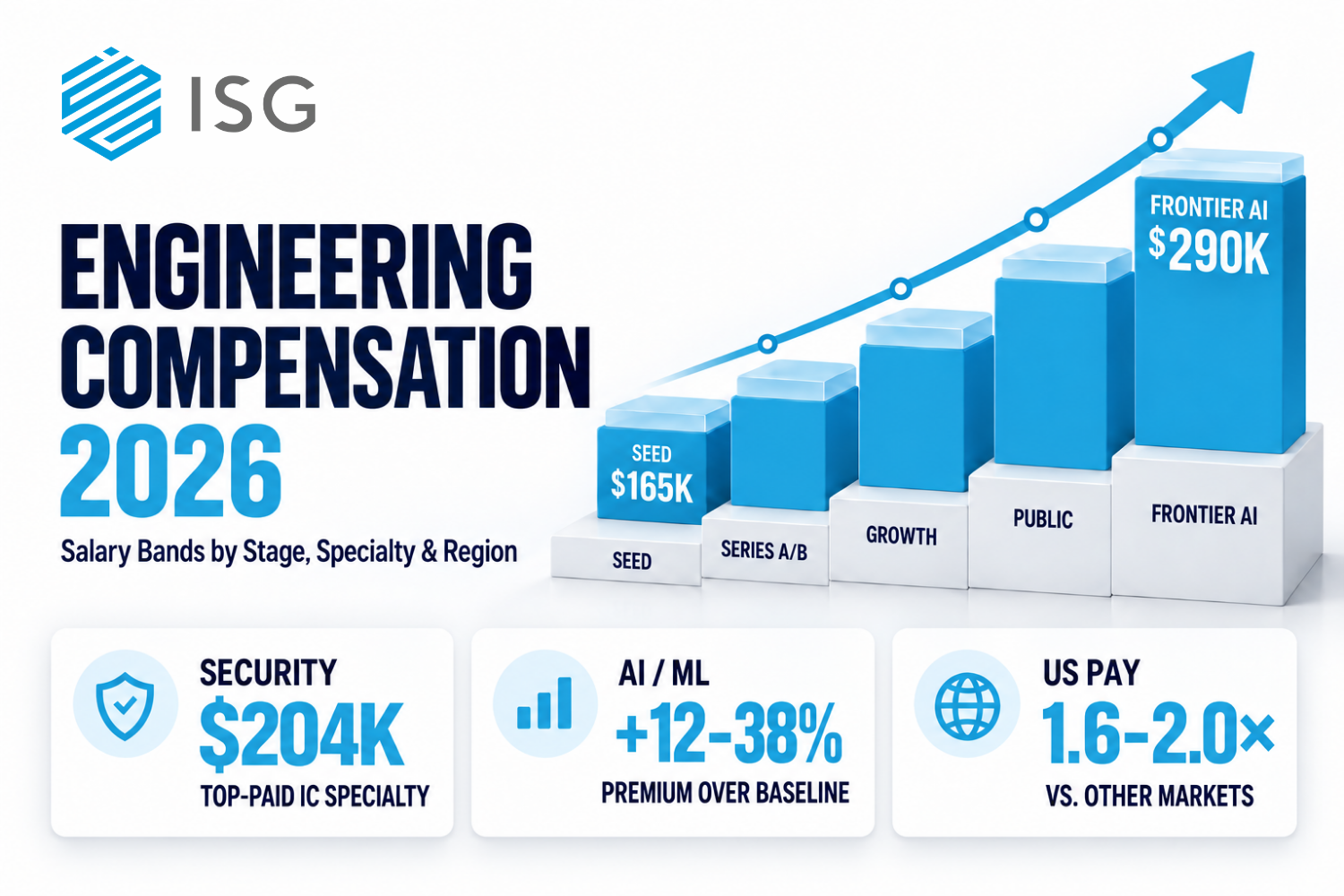
Engineering compensation in 2026 runs on three variables: company stage, specialty, and region. The US software engineer median sits at $192,120, and the median hides a spread running from $165,000 at seed-stage startups to $290,000 at frontier AI labs. Security engineering pays the highest of any individual contributor specialty in every market we track, at $204,000.
AI and machine learning roles carry a 12 to 38 percent premium over baseline engineering pay. US engineers earn 1.6 to 2.0 times their counterparts in other markets. Bands built on last year's data lose offers in the 2026 market, and we watch the losses happen. The full structure is below.
What Is the Average Software Engineer Salary in 2026?
The median US software engineer earns $192,120 in cash compensation in 2026, according to our Engineering Compensation Intelligence research. One number, honestly reported, and nearly useless on its own.
Medians flatten the three variables that decide any individual offer: the stage of the company paying, the specialty being paid for, and the region setting the baseline. Two engineers with identical titles earn figures six figures apart for structural reasons, not performance reasons.
Companies misuse the median in one direction. A band anchored to the market median, applied to a security engineer at a growth-stage company in a US hub, produces an offer the candidate reads as an insult. The full 2026 Engineering Compensation Intelligence report breaks the data apart properly. The guide below explains how to read the breaks.
How Does Engineering Compensation Change by Company Stage?
Company stage moves engineering cash compensation from $165,000 at seed to $290,000 at frontier AI labs, the widest single spread in the market. The stage ladder and the logic behind each rung are mapped below:
| Company stage | Cash positioning | What sets the number |
|---|---|---|
| Seed | $165,000 anchor | Equity carries the offer, cash preserves runway |
| Series A to B | Climbing toward market | Cash competitiveness rises with each round |
| Growth stage | At or near market | Cash competes directly, equity still meaningful |
| Public and enterprise | Market rate, structured | Refreshers, bonuses, and predictable ladders |
| Frontier AI labs | $290,000 top of spread | Scarcity pricing for specialized talent |
Stage decides the cash-versus-equity conversation before any candidate enters the room. Equity benchmarks by role and stage cover the other half of the seed-stage offer, where option grants do the work cash defers.
Why Do Frontier Labs Pay the Most?
Frontier labs sit at the top of the spread because the candidate pool for their work is the thinnest in technology. Scarcity sets the price.
A small population of engineers holds the experience these companies need, every lab knows the same names, and cash became the fastest differentiator. The $290,000 anchor describes cash alone, before equity and before the premiums specialized roles stack on top.
How Do Startups Compete Below the Top of Market?
Startups win engineers below top-of-market cash through equity weight, scope, and speed, never by pretending the gap is small. A seed-stage offer competes on ownership percentage, on problems a big company hands to committees, and on offer processes that close in days.
Honesty completes the pitch. Candidates comparing a $165,000 startup offer against a lab offer deserve the real equity math, presented plainly. The startup that names the gap and prices the upside wins more of these conversations than the startup that argues the gap away.
Which Engineering Specialties Pay the Most in 2026?
Security engineering pays the highest of any individual contributor specialty in every market we track, at $204,000, ahead of the AI roles taking the headlines. The finding surprises nearly everyone. AI commands the attention.
Security commands the consistent premium, everywhere, at every stage. Specialty pricing belongs inside the band architecture from day one, because the market prices specialties without asking permission.
What Drives the Security Engineering Premium?
The security premium comes from asymmetric risk: one hire prevents losses measured in company-ending terms, and every board now knows the arithmetic. Demand grew faster than the talent pipeline in every region at once.
Supply stayed thin because the specialty demands years of adjacent experience before the title fits. Companies stopped negotiating hard against the premium once breach costs entered board conversations, and the premium settled into the structure.
How Large Is the AI and Machine Learning Premium?
AI and machine learning roles carry a 12 to 38 percent premium over baseline engineering compensation, widening with seniority and research depth. The bottom of the range covers production ML engineering.
The top covers research-adjacent work at companies pricing against the frontier labs. Recruiting inside the premium band has rules of its own, and our machine learning engineer recruiting playbook covers the search mechanics behind the numbers.
What Do Research Scientists Earn?
Research scientists earn a $265,000 median in 2026, reaching $560,000 at the 90th percentile. The 90th percentile figure explains most confusion about AI pay: the headline numbers in the press describe the top of a steep curve, not the middle. Companies hiring research talent budget against the curve position they can win, not against the stories.
How Does Engineering Pay Differ by Region?
US engineers earn 1.6 to 2.0 times their counterparts in other markets, and the gap holds across levels and specialties. Inside Europe, the UK pays 18 to 25 percent above Germany for engineering roles, and the gap widens to 22 to 27 percent for AI and machine learning positions. Regional strategy follows directly.
A company hiring across markets sets deliberate geographic bands or watches internal equity collapse the first time two teammates compare notes. Remote hiring compressed some regional gaps and eliminated none of them, and companies pretending geography stopped mattering build bands the market corrects for them.
How Do Remote Bands Work Across Regions?
Remote compensation runs on one written decision: anchor every remote hire to a single reference market, or pay each hire against the local market. Both approaches work. Mixing them breaks internal equity within a quarter.
The anchor approach simplifies planning and costs more in lower-cost regions. The local approach saves budget and demands airtight banding discipline. Companies drift into trouble by deciding per offer, under deadline pressure, with the candidate watching. Write the policy before the first remote requisition opens.
How Do You Build Engineering Compensation Bands?
Engineering bands get built on four decisions: level architecture, geographic strategy, specialty premiums, and refresh cadence. Level architecture defines the rungs and the width of each rung, so adjacent levels overlap enough to reward growth without promotion inflation.
Geographic strategy names which markets anchor which bands, in writing, before offers go out. Specialty premiums get built into the bands rather than improvised at the offer stage, because improvised premiums become internal-equity problems wearing a signing bonus.
The strategy behind all four decisions is a hiring decision, not an HR formality, and why compensation bands decide hiring outcomes makes the full argument.
How Often Do Engineering Bands Need Refreshing?
Engineering bands need refreshing on a set cadence, because the 2026 market moves faster than annual survey cycles. A band set in January defends an offer in September against data two markets old.
The premium specialties move fastest, the frontier-adjacent roles move faster still, and the refresh discipline costs a fraction of one lost finalist. Current data at the offer stage is the cheapest competitive advantage in engineering hiring.
What Breaks Engineering Offers?
Four failures break engineering offers: stale bands, level mismatch, equity opacity, and ignored specialty premiums. Stale bands lose finalists to companies quoting the current market. Level mismatch offers a strong candidate the right money at the wrong title, and the title costs the yes.
Equity opacity presents option grants without strike, preferences, or dilution context, and sophisticated engineers read opacity as a warning. Ignored premiums price a security engineer like a generalist and lose the search before the offer, because the candidate's inbox already told them the market.
Every failure traces to the same root: the company negotiated against last year while the candidate lived in the current one. Scaling teams feel the failures hardest, and scaling engineering hiring without burning out the team covers the volume side of the same problem.
Frequently Asked Questions
What is the average software engineer salary in 2026?
The median US software engineer earns $192,120 in cash compensation. Stage, specialty, and region move individual offers far above or below the median.
Which engineering specialty pays the most?
Security engineering pays the highest individual contributor premium in every market, at $204,000. AI roles take the headlines, and security takes the consistent top position.
How much more do US engineers earn than other markets?
US engineers earn 1.6 to 2.0 times their counterparts in other markets. The multiple holds across levels, specialties, and company stages.
How large is the AI engineering pay premium?
AI and machine learning roles pay 12 to 38 percent above baseline engineering compensation. Research scientists reach a $265,000 median and $560,000 at the 90th percentile.
How do startups compete with big tech engineering pay?
Startups compete through equity weight, problem scope, and offer speed, priced honestly against the cash gap. Naming the gap wins more finalists than arguing the gap away.
Key Takeaways: The Median Is Not the Market
Engineering compensation in 2026 runs $165,000 to $290,000 by stage, pays security its highest premium, prices AI 12 to 38 percent up, and punishes stale bands at the offer stage. Read the spread, not the median. Build the bands before the search. Refresh the data before the offer.
We recruit engineers inside client teams at ISG Partners with current compensation data behind every offer, from a single senior search through full team builds.
Our Engineering Compensation Intelligence research is the same data our recruiters carry into offer conversations, refreshed against the market our clients hire in, not the market last year's survey remembers. Bring an open engineering role to a discovery call, and we price the offer against the real spread together.