
How Many Interview Rounds Before You Lose the Candidate?
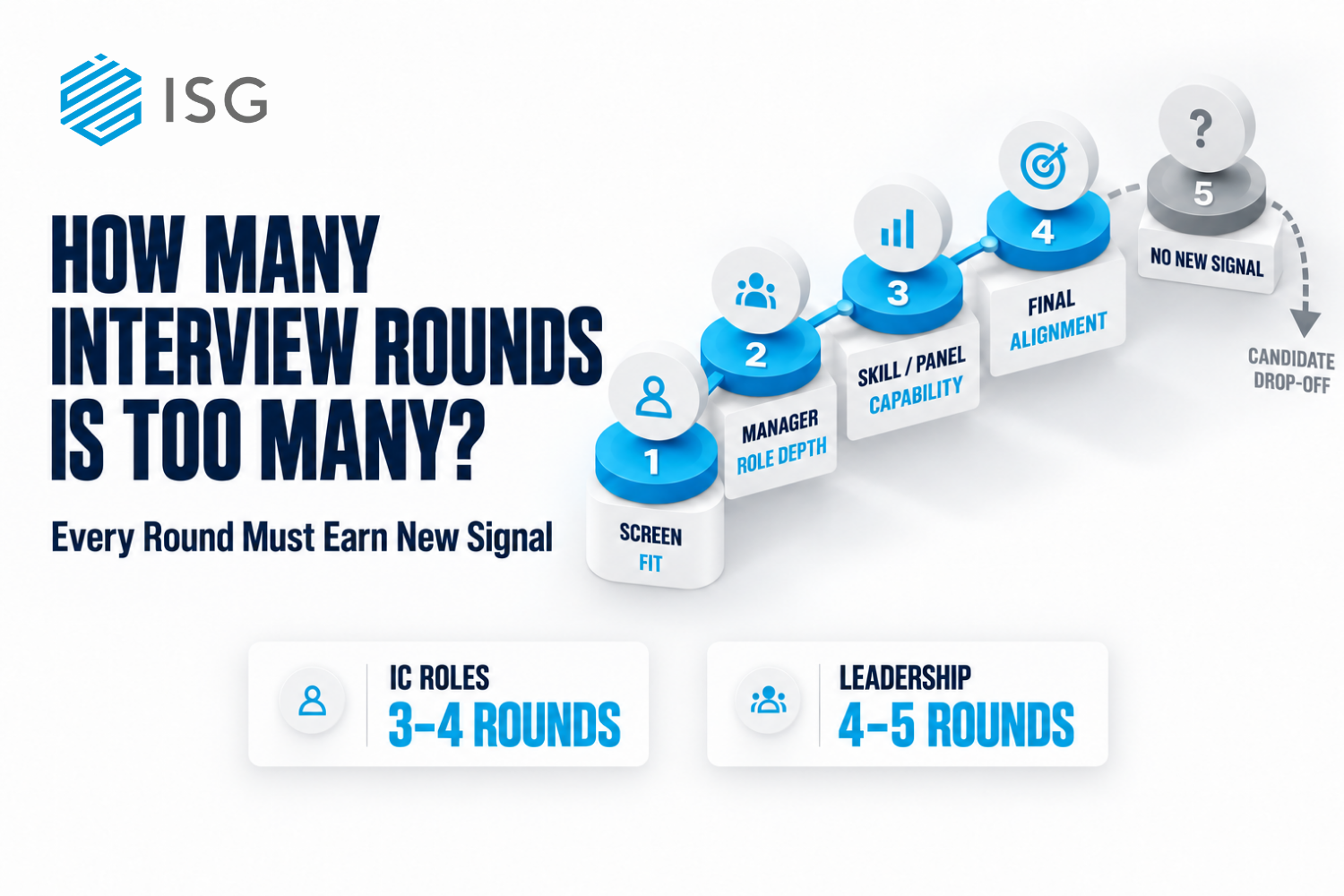
Interview rounds lose candidates when the rounds stop earning new signal. Most loops cross that line around round four. Three to four structured conversations cover most individual contributor roles. Leadership searches justify four to five rounds. Every extra round multiplies exit opportunities without adding evidence.
Candidates drop out of long interview processes because each stage is a two-way gate. Calendar length loses as many finalists as round count. The interview loop is the ungoverned middle of the hiring funnel. We design loops inside client engagements at ISG Partners, and the design system is below.
How Many Interview Rounds Does It Take to Lose a Candidate?
A candidate is lost the moment a round asks for time without earning new signal. Round count is the visible variable. Signal is the real one. Candidates read purpose the way interviewers read resumes. A purposeful five-round executive loop holds candidates.
A padded three-round process loses them. Somewhere in an over-built loop, the interview stops measuring the candidate. The loop starts measuring their patience instead. The best candidates decline to be measured on patience.
Three variables govern the middle of the funnel. The first is how many rounds run. The second is what each round earns. The third is how many calendar days the loop consumes. Intake governs the entry of the funnel. Offer strategy governs the exit. The loop between them mostly grows by accident.
What Is the Right Number of Interview Rounds?
The right number of interview rounds equals the number of distinct questions the hire decision needs answered. Round counts follow question lists, never tradition. A loop earns a new round only by naming a new question, in writing. The bands below hold across most searches we run.
How Many Rounds for Individual Contributor Roles?
Three to four interview rounds cover most individual contributor roles. Each round answers one question no earlier round touched. The standard sequence maps below:
| Interview stage | The question the stage answers | Signal earned |
|---|---|---|
| Recruiter screen | Does basic mutual fit exist | Motivation, logistics, expectations |
| Hiring manager interview | Can the candidate succeed in the role | Role depth, working style, standards |
| Technical or panel round | Does capability survive evidence | Demonstrated skill, collaboration read |
| Final round | Does alignment hold at decision level | Judgment, mutual close begins |
Four stages produce four distinct answers with zero overlap. Loops fail the overlap test constantly. Two interviewers probing the same competency produce one signal and two exit opportunities. The written question list is the loop's constitution. Rounds answer to the list, never the reverse.
How Many Rounds Do Executive and Leadership Searches Need?
Leadership searches justify four to five rounds, and executive searches justify more conversations in fewer calendar weeks. Seniority widens the stakeholder set. The question list legitimately grows: board alignment, cross-functional fit, strategic depth.
The count grows with the questions. The calendar must not grow with the count. An executive candidate tolerates six conversations inside three weeks. The same candidate walks away from four conversations spread across two months.
Elapsed time signals indecision at the exact level where decisiveness is the product. Compression at the executive level is a scheduling discipline. Stakeholder calendars get blocked the day the search opens, not the week a finalist appears.
Why Do Candidates Drop Out of Long Interview Processes?
Candidates drop out of long interview processes because every round is a gate that swings both ways. The company evaluates the candidate at each stage. The candidate evaluates the company right back. Interviewer preparation, feedback speed, and process coherence all read as previews of the job.
Interview fatigue compounds quietly: scheduling friction, repeated questions, unpaid hours. Strong candidates feel the fatigue first, because strong candidates hold parallel offers. A faster loop is always one inbox away.
Silence between rounds finishes what fatigue starts. A candidate waiting eight days for feedback fills the silence with conclusions. How process damage surfaces at the offer stage shows where the conclusions land. Ghosting runs both directions in long loops. Companies go quiet on candidates. Candidates return the courtesy by accepting elsewhere without a note.
Where Does Candidate Drop-Off Concentrate?
Drop-off concentrates at two points: right after take-home assignments and right before final rounds. Invested hours peak at both points. Parallel offers mature at both points. The strongest loops guard the two transitions with dates.
Every stage handoff becomes a promise with a deadline attached. Kept promises hold candidates through the vulnerable windows. Speed through both windows costs preparation, not corners.
What Does Each Interview Stage Need to Earn?
Each interview stage needs to earn one signal no earlier stage produced. The signal gets named before the round exists. The audit takes twenty minutes. List every round in the current loop. Write the unique question each round answers. Delete every round whose question already has an answer.
Duplicated rounds are theater with calendar cost. Theater reads as disrespect to a candidate spending vacation days on the process. Criteria discipline holds the audit together. Interview scorecards that calibrate every round turn each stage's question into comparable evidence. The loop then produces a decision instead of a pile of impressions.
When Do Take-Home Assignments Help or Hurt?
Take-home assignments help under strict rules and hurt everywhere else. An assignment is a round that spends the candidate's personal hours. Personal hours raise the earning bar. Senior, employed candidates decline multi-day unpaid projects at the highest rate.
Those candidates are the exact profile most searches want. Paid assignments change the equation entirely. Companies serious about senior work product increasingly pay for the hours.
What Are the Take-Home Assignment Rules?
Four rules keep assignments useful: capped scope, stated criteria, returned feedback, and round replacement. Scope stays under a respectful ceiling, measured in hours. Evaluation criteria get stated before the candidate starts.
Real feedback returns regardless of outcome. The assignment replaces a round instead of adding one. An assignment that breaks the rules filters for desperation, not capability.
How Do You Compress the Interview Loop Without Losing Signal?
Loop compression cuts calendar days, not evidence. Rounds and days are different levers. The calendar lever moves first. Five rounds inside eight days beats three rounds across five weeks. Elapsed time is where parallel offers win. Three tactics do the compression.
Batching stacks panel conversations into single days. Pre-booked interviewer slots kill scheduling drift before drift adds silent weeks. A feedback window with a date turns every transition into a kept promise. Decide-by dates complete the system.
Every search gets a target offer date at intake. The date disciplines every calendar decision after it. Stage aging makes the whole loop visible. Candidates sitting past the agreed window mark exactly where the loop is stuck. Where hiring timeline drag lives covers the drag beyond the loop itself.
Who Owns the Interview Loop?
The interview loop needs one named owner, because ungoverned loops grow rounds nobody decided to add. Intake is where the loop gets designed. Stage count, stage questions, interviewer assignments, and feedback windows all get set before the first candidate enters.
The intake meeting that defines the loop locks the design while changes are still cheap. The owner then defends the design. Every "one more conversation" request routes through the owner. The request answers the new-question test or dies without a written answer. Our recruiters coach candidates before every round and debrief after each one.
The debrief gives the loop a second set of eyes. A stage that earned nothing gets flagged while the fix costs a conversation instead of a finalist. Ownership also ends debates about process length. One person holds the answer. The answer lives in writing.
What Breaks Interview Loops?
Four patterns break interview loops: round inflation, consensus addiction, improvised stages, and the under-interviewing coin flip. Round inflation is grief wearing process clothes. One bad hire adds a permanent stage that punishes every future candidate.
Consensus addiction invites everyone to interview and no one to decide. Decision comfort replaces decision quality. Improvised stages run without named questions and produce impressions instead of evidence. The opposite failure deserves equal honesty.
One-round hiring is a coin flip with a start date. We tell clients to add rounds as often as we tell clients to cut them. The loop is right when the question list and the round list match, in both directions. Each broken pattern shares one root: nobody owned the loop.
Frequently Asked Questions
How many interview rounds is normal?
Three to four rounds cover most individual contributor roles, and four to five cover leadership searches. The count follows the list of distinct questions the decision needs.
How many interview rounds is too many?
Any round past the point where stages earn new signal is too many. Name the unique question a round answers, or cut the round.
How long between interview rounds is acceptable?
Days, not weeks, with a feedback date promised at every stage transition. Elapsed time loses more finalists than round count does.
Do take-home assignments help hiring?
Assignments help when scope stays capped in hours, feedback returns, and the assignment replaces a round. Multi-day unpaid projects lose the strongest candidates first.
Why do candidates ghost mid-process?
Candidates ghost when silence, repeated questions, or scheduling drift signal the company stopped valuing their time. A parallel offer finishes what the silence started.
Key Takeaways: Design the Loop or the Loop Designs Itself
Interview loops hold candidates when purposeful rounds run inside a compressed calendar, each stage earning a signal no earlier stage produced. Audit the questions. Cut the theater. Date every transition. Own the middle of the funnel, because nobody else does.
We design interview loops inside every ISG Partners engagement, from a single senior search through executive search. Stage questions get set at intake. Candidates get coached before every round and debriefed after each one.
The loop stays defended against drift for the life of the search. Interview coordination inside our engagements shows where loop design sits in the process. Bring your current interview stages to a discovery call, and we run the new-question test together.