
When to Hire Your First Head of People (and What Signals Beat Headcount)
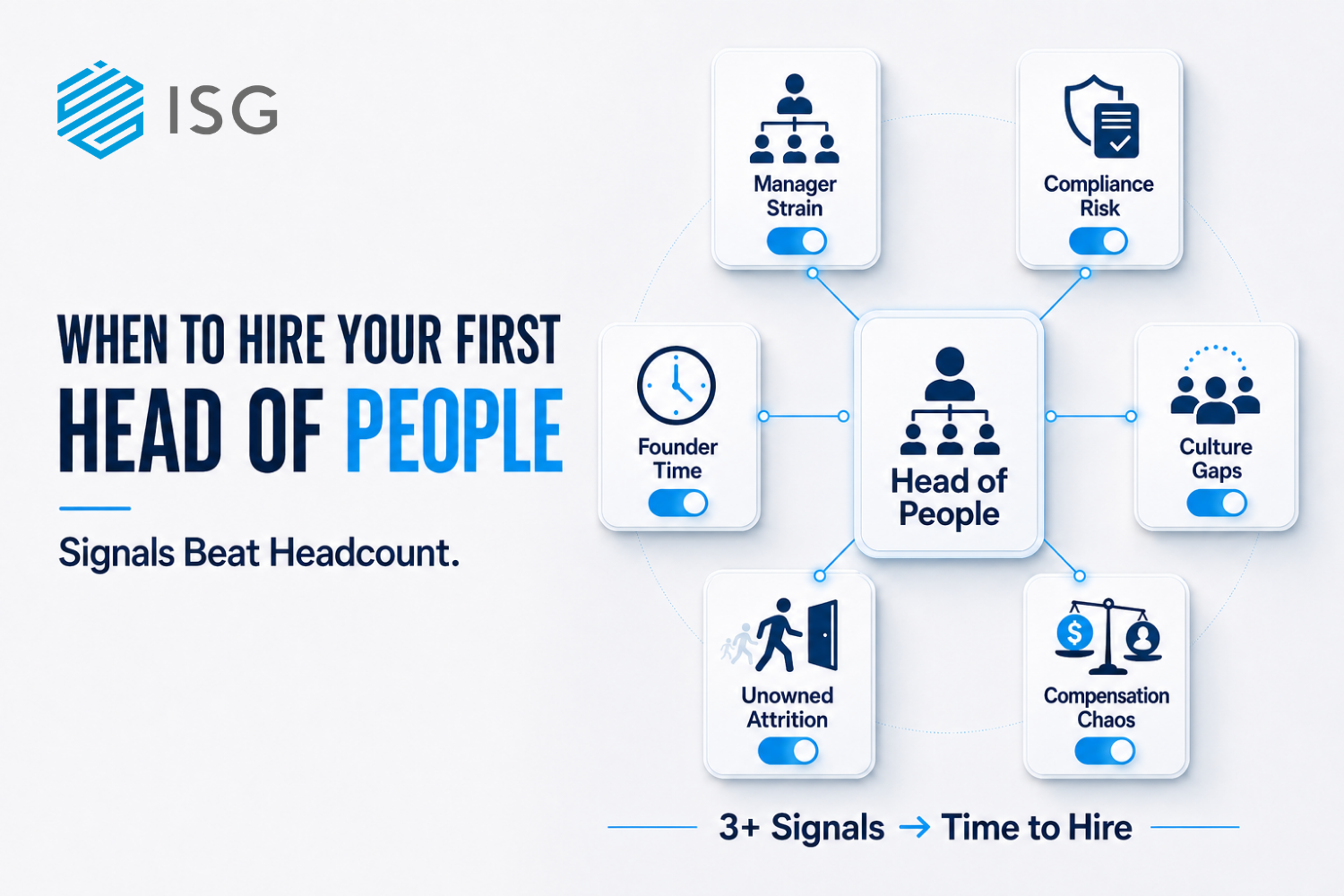
The first Head of People gets hired on signals, not on headcount, because the popular headcount rules disagree with each other by a factor of two. Six signals fire regardless of company size: a struggling manager layer, a crossed compliance surface, founder hours consumed by people operations, breaking culture transmission, unowned attrition, and compensation chaos.
One conflation causes most mis-hires in the seat: founders buy a Head of People to fix a recruiting problem, and the two jobs differ completely. Recruiting capacity fills seats. A Head of People builds the system employees live inside after the seats fill. We sit on the recruiting side of that line at ISG Partners, and the honest map of both sides is below.
When Do Startups Need a Head of People?
Startups need a Head of People when the people load outgrows improvisation, and the load arrives at different headcounts for different companies. The popular rules of thumb prove the point by contradicting each other: the common triggers sit a factor of two apart, which is the tell that headcount was never the variable.
Growth rate, geographic spread, manager ratio, and hiring intensity load the people function, and the load fires the signals. A signals-based read beats every number, because the signals travel across company shapes while the numbers only describe averages nobody is.
Why Does Headcount Fail as the Trigger?
Headcount fails as the trigger because two companies at the same size carry completely different people loads. Picture two 40-person companies. One sits stable in a single office, fully hired, with an experienced manager layer. The other is doubling inside a year, hiring across three states, and promoting first-time managers monthly.
The first company runs fine on founder attention and good instincts. The second is already late. Growth rate multiplies the load, geography multiplies the compliance surface, and new managers multiply the coaching demand. Count the load, never the heads, and the timing answers itself.
How Fast Does the People Load Compound?
The people load compounds because unaddressed signals feed each other. Compensation chaos feeds unfairness, unfairness feeds regretted exits, and exits feed the founder hours already stretched thin. Untrained managers mishandle small problems into big ones, and every big one lands on the executive calendar.
The compounding explains a regret we hear constantly from the founder side of our searches: the hire was due two quarters earlier. Signals read early cost a search. Signals read late cost a year of quiet damage.
Which Signals Say the First People Hire Is Due?
Six signals mark the moment, and any three firing together settles the question. Read the six quarterly, in writing, the same way the board reads the numbers. The signals to check are listed below:
The manager layer struggles. First-time managers handle people problems with no training, no feedback system, and no one to ask. Every people issue in the company now routes through the least experienced layer in the company.
The compliance surface crosses a line. Employment spreads across states or countries, contractors convert to employees, and the first hard terminations get handled by instinct. Improvisation stops being cheap at exactly the moment the surface grows.
Founder hours disappear into people operations. Compensation questions, policy improvisation, and interpersonal disputes consume executive weeks. The most expensive people in the company run an unbuilt function part-time.
Culture stops transmitting by osmosis. Early employees absorbed the values from the room. New employees join teams the founders rarely see, and onboarding differs by department. What made the company work is no longer being taught.
Attrition arrives with no owner. Regretted exits happen, patterns go undiagnosed, and nobody owns the question of why. Exit signal without an owner is expensive data thrown away.
Compensation turns into accumulated exceptions. Every offer got negotiated individually, no bands exist, and internal unfairness is now one spreadsheet audit from public. The chaos compounds with every hire made without a system.
Is Hiring Pain a People Problem or a Recruiting Problem?
Hiring pain is usually a recruiting capacity problem, and buying a Head of People to solve hiring pain mis-hires the role. The conflation is the most common failure in the seat. Open roles pile up, the founder feels people pain, and the company hires a People leader to fix the pipeline.
The new leader becomes a full-time recruiter with a VP title, the systems work never starts, and both jobs get done badly. The two functions divide cleanly, and the division is mapped below:
| Area | Recruiting capacity owns | Head of People owns |
|---|---|---|
| Pipeline and searches | Sourcing, screening, closing every open role | Nothing day to day |
| Compensation | Pricing offers against the market | The philosophy, the bands, the fairness |
| Managers | Nothing | Training, feedback systems, development |
| Onboarding | Handing off the closed candidate | The system the new hire lands inside |
| Compliance | Nothing | Policy, employment surface, risk |
| Retention | The 90-day check-in window | Diagnosis and systems past day 90 |
The pattern in the table repeats across every row: recruiting fills seats, and the People function builds what surrounds the seats. Companies feeling pipeline pain need capacity, and the recruiting model options for startups map the choices at that stage.
Companies watching engineers run interviews all week instead of shipping feel the same pain from inside, and why hiring pain burns out teams without recruiting capacity covers that version. Neither pain is a People-leader vacancy. Both are capacity gaps wearing one. The mis-hire bills twice. The company pays the leadership salary and still loses the year of systems the seat existed to build.
What Comes First: Recruiting Capacity or the People Leader?
Recruiting capacity typically comes first, because seats get filled before systems get built, and the honest boundary runs in both directions. A company with fifteen open roles and no People function needs the roles filled now and the function built on the signals' schedule.
Capacity solves the first problem inside days, and our fit criteria for adding recruiting capacity show exactly which hiring patterns the capacity model serves. The reverse boundary carries equal weight: recruiting capacity never substitutes for the People function once the signals fire.
A recruiter fills seats brilliantly and builds no manager training, no compliance posture, and no performance system, and pretending otherwise stalls the company politely.
The two hires also split one document between them: the hiring plan the People leader inherits gets executed by recruiting capacity and systematized by the People function, and the plan works best when both owners exist. The two moves also share one engagement cleanly: capacity fills the open seats while the People search runs beside them.
What Does the First Head of People Look Like?
The first Head of People is a systems builder with generalist range, comfortable creating structure where none exists. The profile matters as much as the timing.
Builder or Administrator?
Builders create the function, and administrators run a function somebody else created, and the first hire must be the builder. The classic mis-hire imports a policy administrator from a large company into a startup with no policies, and the administrator waits for structure that never arrives.
The builder writes the first compensation philosophy, designs the first manager training, and creates the onboarding system from a blank page, then hires the specialists later. Generalist range beats specialist depth for the first seat, ambiguity tolerance beats process mastery, and the interview tests for evidence of building rather than evidence of maintaining.
Two interview asks surface the difference fast. Describe a function built from nothing, and show the artifact: the band structure, the training deck, the onboarding page. Builders bring artifacts. Administrators bring org charts.
What Do You Put in Place Before the Hire?
Four assets belong in place before the People leader arrives, and founders own all four regardless of timing. Written compensation bands come first, because every negotiated exception before the hire becomes cleanup after, and compensation bands founders set before HR exists cover the discipline.
A documented hiring process comes second, so the standard survives the handoff. A basic onboarding checklist comes third, one page, used identically by every team. Written values come fourth, because culture that lives only in founder heads transmits to nobody.
The four assets cost a founder a week and give the future People leader a foundation instead of an archaeology project. The assets also sharpen the search itself, because a candidate reacts to a real foundation differently than to a blank slate promise.
Frequently Asked Questions
At what headcount do you hire a Head of People?
Signals beat headcount: the popular rules disagree by a factor of two. Three of the six signals firing together settles the timing at any size.
What does a Head of People do versus a recruiter?
Recruiting capacity fills seats, and a Head of People builds the systems around the seats. Compensation philosophy, manager development, compliance, and retention diagnosis sit with the People function.
What is the first HR hire at a startup?
A generalist Head of People who builds systems from a blank page. Specialist HR administrators come later, after the function exists to administer.
Do startups need HR before 50 employees?
Some do and some never did, because the load decides, not the count. Fast growth, multi-state hiring, and new managers fire the signals early.
What comes first, a recruiter or a Head of People?
Recruiting capacity usually comes first, because open seats demand filling before systems demand building. The People hire follows the signals, never the hiring pain.
Key Takeaways: Read the Signals, Split the Jobs, Build the Foundation
The first Head of People gets hired on signals, profiled as a builder, and never bought to fix a recruiting problem. Three signals firing settles the timing. The division-of-labor table settles the conflation. Four founder-owned assets settle the foundation.
We sit on the recruiting side of the line at ISG Partners, filling the seats while the signals mature, and we say plainly when the People hire is due, because capacity was never a substitute for the function.
The first Head of People search is a leadership search we run inside the same engagement, from the open roles of today through the executive seat the signals eventually demand. Bring the signal checklist to a discovery call, and we read the timing together.