
Customer Success Manager Compensation: How to Structure CSM Pay (2026)
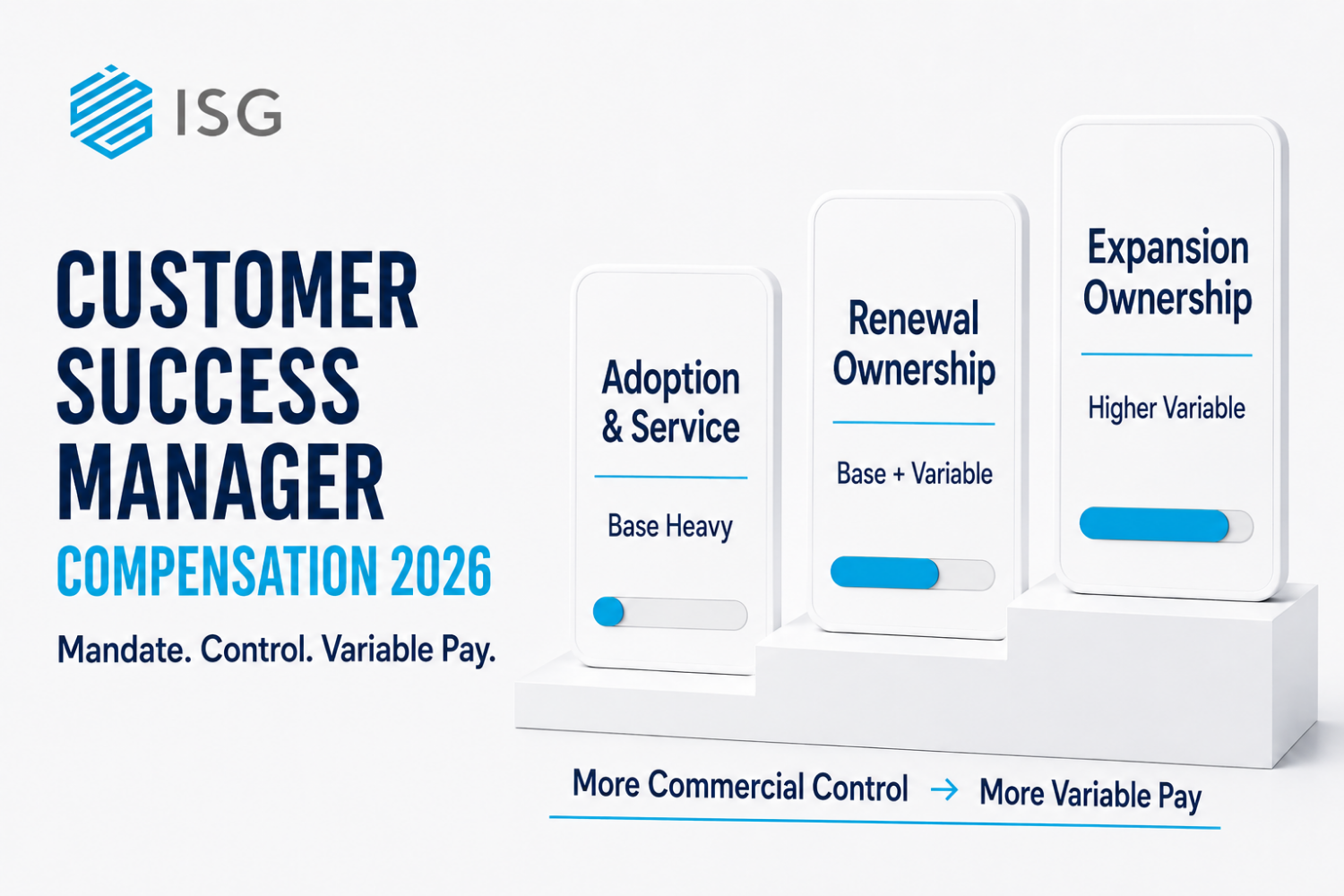
CSM compensation has no single right split, because customer success is not a single role. Three mandates exist inside the same title: adoption-focused service, renewal ownership, and expansion ownership, and the pay structure derives from the mandate rather than from a market debate. The control principle prices the seat: the more commercial outcome the CSM owns, the more variable the plan carries.
Quota questions, variable basis questions, and the fairness problem across customer books all resolve through the same mandate-first method. We place customer success talent every week at ISG Partners, and the structure below is the one that survives both the offer conversation and the first renewal cycle.
What Goes Into CSM Compensation?
CSM compensation contains the standard four elements: base salary, variable pay, targets, and upside mechanics, with one design decision in front of all four. The decision is the mandate. A CSM driving adoption with no commercial ownership, a CSM signing renewals, and a CSM selling expansion carry the same title and three different jobs.
The market debates a single correct split as if a single role exists, and the debate never ends because the premise is wrong. Write the mandate down first: which outcomes the seat owns, which outcomes the seat influences, and where the commercial signature sits. Every number in the plan follows from the answer, and plans built before the answer fight themselves quarterly.
What Are the Three CSM Mandates?
Three mandates cover the customer success market, and the full structure map is below:
| Mandate | What the CSM owns | Split logic | Variable pays on | Quota answer |
|---|---|---|---|---|
| Adoption and service | Onboarding, health, advocacy | Base-heavy, near a base-only structure | Team bonus on retention goals | Goals, never a quota |
| Renewal ownership | The renewal signature | Base-weighted, meaningful variable | Renewal rate on the owned book | Quota on renewals owned |
| Expansion ownership | Upsell and cross-sell revenue | Closer-adjacent, heavier variable | Expansion revenue closed | Quota on expansion closed |
Most comp arguments dissolve against the table. A company asking what split fits a CSM is really asking which mandate the seat carries, and the mandate answer settles the split, the basis, and the quota debate in one pass. Mixed mandates exist, and mixed mandates price as blends of the adjacent rows, weighted toward the outcome that pays the variable.
Mandates also drift. Companies grow, renewal signatures migrate between teams, and a plan reviewed annually against the written mandate stays honest while a set-and-forget plan quietly mismatches the job.
What Is the Right CSM Base to Variable Split?
The CSM split prices along the control spectrum: the more commercial outcome the seat owns, the more variable the plan carries. Our placement structures anchor the spectrum's endpoints. Closers hold 50/50 from AE through CRO, because closers control deals to the finish. SDR plans run 65/35 base-weighted, because pipeline roles hand off before the decisive moment.
RevOps prices base-only, because the role owns the system rather than the number. The CSM seat moves along the same line by mandate: a service CSM prices near the base-only end, a renewal owner carries a base-weighted structure with real variable, and an expansion owner approaches closer territory.
The method places the split, and current market data prices the anchor: CSM pay bands inside our 2026 GTM data carry the live base and OTE figures by mandate and stage. Book model bends the split too. High-touch enterprise books support individual variable cleanly, while pooled SMB coverage fits team-based variable, because pooled outcomes belong to nobody alone.
Do CSMs Carry a Quota?
The quota question is a mandate question wearing a comp question's clothes: quota follows commercial ownership, and never arrives without the ownership. A CSM who signs renewals carries a renewal quota honestly, because the seat controls the outcome the number measures.
A CSM who influences renewals while sales signs them carries goals and a team bonus, never a personal quota, because a quota on an outcome the seat lacks authority over is risk transfer with a dashboard.
The failure pattern repeats across the market: commercial numbers assigned to service mandates, followed by attrition in the exact seat where customer relationships compound. Assign the authority first or skip the quota entirely.
What Does CSM Variable Pay On?
CSM variable pays on the outcome the mandate assigns: renewal rate for renewal owners, expansion revenue for expansion owners, and shared retention goals for service mandates. Basis discipline protects the plan. Net revenue retention works as a team-level basis, because the number blends outcomes no single CSM controls.
Health scores and adoption metrics fail as pay bases, because proxies get gamed the moment proxies pay, and a green dashboard over a churning account helps nobody. The rule mirrors the pipeline version: pay the owned outcome, measure quality on everything else, and keep the paid metric one the CSM moves directly.
How Do You Keep Variable Fair Across Books?
Variable pay on renewals is only as fair as the book of business behind the number, and book assignment decides the fairness before the year starts. Two CSMs with identical skill inherit different odds: one book arrives healthy and referenceable, the other arrives churning from decisions made years earlier.
Flat targets across uneven books pay the territory rather than the work. Three fixes hold. Grade renewal risk at assignment and set book-adjusted targets. Rebalance books on a stated cycle rather than by exception. Where books resist grading, shift the variable to team level, so the uneven odds spread instead of concentrating.
A CSM who trusts the fairness of the number stays through the hard book. A CSM who reads the number as a lottery leaves with the relationships. Publish the grading logic to the team. Fairness believed is fairness working.
When Do You Shift a CSM From Flat Base to Variable?
Variable enters the CSM plan when three conditions land together: commercial ownership moves to the seat, the book becomes forecastable, and the measurement runs clean. Ownership comes first, because variable without authority repeats the risk-transfer failure at a new address.
Forecastability comes second: a book still churning from old decisions turns variable pay into weather. Measurement closes the set, because disputed renewal data burns more trust than variable ever builds.
Companies moving the renewal signature from sales to customer success stage the comp shift with the mandate shift, in writing, with a guaranteed transition period while the first owned cycle completes.
We structure these transitions inside how our engagements run from search through offer, and the staged version closes candidates the overnight version scares away. The shift runs in reverse too: a mandate that loses commercial ownership releases the variable, stated with the same clarity.
How Do CSM Plans Fit the Revenue Org?
CSM plans price next to the sales plans, with the expansion boundary agreed in writing before either plan launches. One question decides more than any split: who owns expansion revenue, customer success or sales. Two comp plans paying two teams for the same dollar guarantee a turf war with the customer in the middle, and the war costs renewals.
Draw the line by motion: expansion inside the existing footprint to one owner, new-department or new-entity growth to the other, named plainly in both plans. Customers feel the line faster than the org chart shows the line. The cash structures then build together.
How the closer plan derives from one anchor covers the sales side, the base-weighted SDR pay structure covers the pipeline side, and the CSM plan completes the set with one coherent control logic across the org. Companies hiring the full post-sales function alongside sales price everything in one pass, and CS hiring inside the SaaS three-track build shows where the seats land in the wider wave.
What Breaks CSM Compensation Plans?
Five failures break CSM plans: splits copied from sales, quotas without mandates, variable on gameable proxies, book-blind targets, and mid-year rewrites. The copied split fails on control, because an expansion closer's plan on a service mandate transfers risk to the seat least able to carry the risk.
Quota-without-mandate produces resignation letters with excellent documentation. Proxy pay produces green dashboards over red accounts. Book-blind targets pay geography instead of work.
Mid-year rewrites cost more trust than any correction recovers, and customer-facing trust compounds or collapses faster than anywhere else in the org, because the CSM's confidence in the company reaches the customer's ear weekly.
Frequently Asked Questions
What is a good CSM base to variable split?
The mandate decides the split: base-heavy for service mandates, base-weighted for renewal owners, closer-adjacent for expansion owners. Our 2026 GTM data carries the live bands by mandate.
Do CSMs get commission?
CSMs earn commission on commercial outcomes the seat owns: renewals signed or expansion closed. Service mandates earn team bonuses on retention goals instead.
Do CSMs carry a quota?
Quota follows commercial ownership: renewal owners and expansion owners carry quotas on the owned outcome. Service mandates carry goals, because quota without authority is risk transfer.
What metrics drive CSM variable pay?
Renewal rate on the owned book and expansion revenue closed are the honest bases. Net revenue retention works at team level, and health scores never pay.
What is CSM OTE in 2026?
CSM pay moves by mandate, stage, and region, so the honest answer is current placement data. Our 2026 GTM report carries the live base and OTE bands.
Key Takeaways: Write the Mandate, Price the Control, Protect the Fairness
A CSM plan derives in order: mandate first, split from control, variable on the owned outcome, targets adjusted to the book. The market's split debate ends the moment the mandate gets written down, and the plan that prices the mandate honestly keeps the seat filled through the renewal cycles that matter. One page of mandate beats ten pages of plan.
We place customer success talent across all three mandates at ISG Partners, priced against our published 2026 GTM data and closed with plain mechanics. The same one-pass discipline covers the CSM seat, the sales org beside the seat, and the leadership above both, inside one engagement from a single search through executive search. Bring the mandate conversation to a discovery call, and we price the seat against the market together.