
Embedded Recruiting vs In-House Talent Acquisition: Requisition Mix Decides the Model
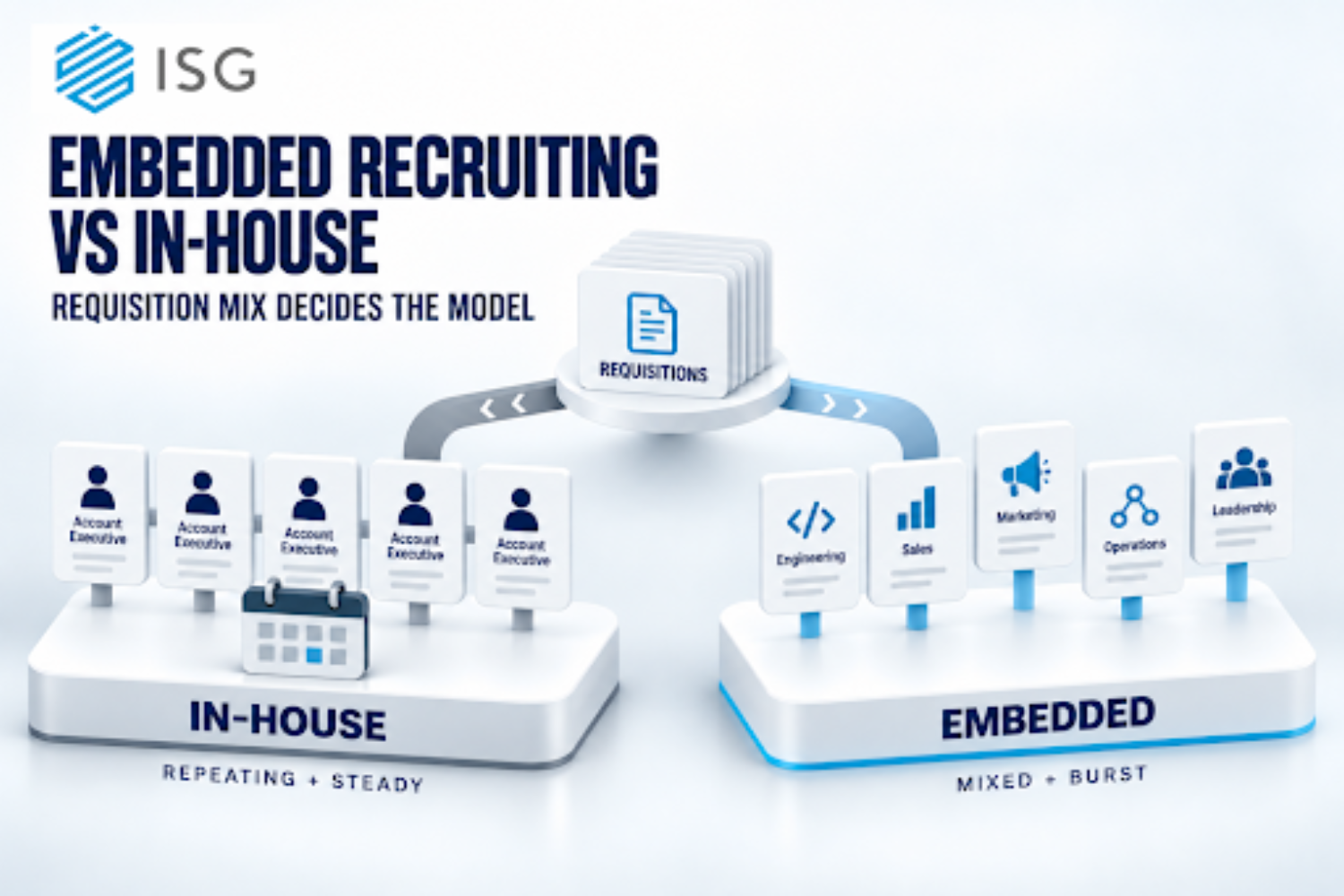
Embedded recruiting places a dedicated recruiter inside your hiring process, and in-house talent acquisition adds that recruiter to your payroll. Requisition mix separates the two models, not annual hire count. An in-house recruiter produces hires months after the decision lands, and an embedded recruiter produces inside days.
Both models fail the same way when nobody inside the company owns hiring. Most companies run both in sequence rather than choosing one permanently. ISG Partners runs the embedded side of that sequence through our dedicated recruiter model for growth-stage hiring plans.
What Separates Embedded Recruiting From In-House Hiring?
Embedded recruiting supplies a dedicated recruiter who works inside your existing hiring process, and in-house talent acquisition employs that recruiter directly.
Both recruiters work in your applicant tracking system. Both join your hiring meetings. Both represent your brand to every candidate they contact. Greenhouse, Lever, and Workday stay in place under either model. Your hiring managers keep every decision.
One difference matters structurally. An in-house recruiter sits on your org chart permanently. An embedded recruiter deploys for the length of an engagement and steps down when the plan changes.
Cost framing misleads in both directions. A salary looks cheaper than a monthly fee across a full year of steady hiring. A monthly fee looks cheaper than idle payroll across a quiet quarter. Neither comparison holds without the hiring pattern underneath. The choice turns on the shape of your hiring, not the shape of your budget.
How Does Internal Mobility Differ?
In-house talent acquisition describes a recruiting team on your payroll, and internal mobility describes filling roles from your existing workforce.
The two terms share vocabulary and answer different questions. Internal mobility moves current employees into open roles through promotion and transfer. In-house talent acquisition sources candidates from outside the company. Buyers comparing recruiting models want the second definition. Nothing below addresses internal mobility.
What Does an In-House Recruiter Own?
An in-house talent acquisition team owns employer brand, long-horizon pipeline, and the institutional memory behind every hiring decision the company has made.
Four advantages sit with permanent headcount.
Institutional memory compounds: A recruiter inside your business for several years knows which past hires succeeded and which ones failed. That knowledge shapes every calibration conversation and every scorecard. Hiring managers stop re-explaining the role. Candidates hear a consistent story across every conversation.
Employer brand ownership stays permanent: Your in-house recruiter represents the company in the market indefinitely, not for the length of an engagement.
Priority setting runs direct: No commercial conversation sits between your hiring manager and your recruiter.
Long-horizon pipeline work continues through quiet quarters: Nurture cycles that run for years sit outside any engagement window.
None of these four transfer to an external model, and no honest comparison claims otherwise.
What Does Embedded Recruiting Cover Instead?
Embedded recruiting covers requisition volume above the internal ceiling and role types an in-house generalist has never sourced.
Every recruiter reaches a throughput ceiling. Job descriptions, hiring manager coaching, scheduling, and reporting erode the hours left for sourcing. The practical ceiling sits well below the theoretical one.
Role type sets a second limit. A generalist who has filled go-to-market roles for years holds no network in a specialist technical market. Calibration then takes weeks the plan never had.
Geography sets a third limit. Local market knowledge never transfers with a job description.
Timing sets the fourth. ISG Partners deploys a dedicated recruiter within 48 hours of kickoff, and most clients see first candidates in two to three days. Our breakdown of how embedded recruiting works inside an existing hiring process covers the mechanics in full.
How Does Requisition Mix Decide the Model?
Requisition mix decides the model because one role repeated many times and many different roles demand different recruiting capacity.
Most comparisons answer with an annual hire count. The counts published across the category disagree with each other by a wide margin, and the disagreement has a cause. Hire count, requisition count, and concurrent open roles measure three different things.
Role diversity sets the ceiling, not role volume. A repeating requisition compounds: one calibration, one outreach sequence, one pipeline, filled many times over. A mixed requisition list restarts that work at every role.
The difference shows up in the work itself. A repeating requisition reuses the same screening questions, the same competitor list, and the same objection handling. A mixed list forces new market mapping, new hiring manager alignment, and new outreach at every opening.
Shape across the year matters as much as mix. A plan spread evenly across four quarters and the same plan concentrated in one quarter produce opposite answers at identical annual totals.
We size engagements at six to ten concurrent open roles per recruiter. Our analysis of recruiter capacity across concurrent open roles shows how that band moves with role diversity.
The table below maps both models against the dimensions buyers compare.
| Dimension | In-House Talent Acquisition | Embedded Recruiting |
|---|---|---|
| Requisition mix | Repeating profiles at volume | Mixed profiles across functions |
| Requisition shape | Level across four quarters | Concentrated in bursts |
| Employment status | Permanent employee on payroll | Dedicated recruiter, month to month |
| Cost shape | Fixed through hiring pauses | Flat monthly across the engagement |
| Time to capacity | Months to hire, months to ramp | Deployed within 48 hours |
| Systems and process | Your ATS, your process, your tools | Your ATS, your process, your tools |
| Reporting | Internal, set by your talent leader | Monthly reporting, 30/60/90 check-ins |
| Long-term focus | Employer brand and internal mobility | Filling the current plan |
Why Does a New In-House Recruiter Take Months?
Hiring an in-house recruiter starts a search that competes with every open role for the recruiting capacity the company already lacks.
The recursion sits at the center of the decision. A company short on capacity resolves the shortage by running a search. That search consumes the capacity that went missing in the first place.
The recruiter search competes on the same terms as every other role. Strong recruiters field multiple offers. Compensation, brand, and process speed decide the outcome, exactly as they do for the engineering and sales roles already sitting open.
Two delays stack. Sourcing and closing a strong recruiter takes months. Reaching full output takes months more. The roles that prompted the hire stay open through both stages.
The tool stack arrives empty. Sourcing seats, sequencing software, and candidate data get procured separately. A new recruiter joins with none of them in place.
One counterweight holds. The delay runs once, and permanent capacity remains afterward. Plans that stay level for four quarters take that delay comfortably. Plans that spike lose the quarter.
Who Owns Recruiting Under Each Model?
Both models fail the same way when nobody inside the company owns hiring.
The failure pattern stays identical across models. Intake meetings never happen. Interview feedback never returns. Requisitions age regardless of who sources against them.
An embedded recruiter surfaces that failure faster and reports the pattern clearly. Surfacing a problem never repairs the problem.
An in-house recruiter meets the same wall quietly and takes the blame for the outcome.
One named person needs authority over the requisition list. That person approves intake, chases feedback, and closes stale roles. Every model performs better underneath that authority, and no model substitutes for the authority itself.
Answer the ownership question first. Compare models second.
How Does the Handover to In-House Work?
Embedded recruiting hands over to in-house talent acquisition when the internal hire lands, and the handover decides whether the capability stays.
The common sequence runs in one order, and the two models never compete inside it. Embedded capacity holds the burst. The in-house hire lands and ramps against a working pipeline. Embedded capacity then steps down or covers the roles outside the internal skill set.
Overlap matters during that window. A new in-house recruiter who inherits live pipelines starts producing faster than one who starts from an empty applicant tracking system. The embedded engagement builds the pipelines the internal hire inherits.
Capability transfers when the engagement ran inside your systems and your process, because pipelines, calibration notes, and outreach sequences remain in your tools. Capability leaves when the work ran on a provider platform you never see.
ISG Partners runs every engagement inside your ATS for that reason. Our guide to the reporting cadence that keeps a recruiting partner accountable covers the management side of the same handover.
The model spans a single senior search through sustained hiring across several functions at once.
When Does Neither Recruiting Model Fit?
A hiring plan with a small number of unrelated roles across a year fits neither model.
Four situations rule both models out.
Low volume with unrelated roles: Permanent capacity sits idle between searches, and an engagement never reaches efficient scale. A single contingency search costs less.
Unapproved headcount: Roles without sign-off never become searches. Wait for the approval, then resource the capacity.
No internal owner: A broken process stays broken under new capacity. Fix ownership before buying anything, from anyone.
A plan that changes monthly: Requisition lists that reshuffle every few weeks defeat both models. Lock the plan for a quarter, then resource against the locked version.
Where Does Your Requisition Mix Sit?
Requisition mix and requisition shape decide the model, and annual hire count decides nothing on its own.
Three points settle the decision. Mix outranks count. Ownership precedes model choice. Sequence beats permanent choice.
Count your concurrent open roles, then check how many share a profile. Level plans with repeating profiles point toward permanent headcount. Mixed plans and quarterly bursts point toward an engagement.
ISG Partners maps that pattern on a discovery call and states plainly which side of the line your plan sits on. Start with the hiring patterns that fit an embedded engagement, then book a call to run your own mix against the band.
Common Questions About Embedded Recruiting
What is the difference between an embedded recruiter and an in-house recruiter?
An embedded recruiter works inside your hiring process on a month-to-month engagement. An in-house recruiter joins your payroll permanently. Both work in your systems and represent your brand to candidates.
How many open roles justify an in-house recruiter?
Concurrent open roles matter more than annual hires. Repeating profiles at a level pace point toward permanent headcount. Mixed profiles across several functions point toward an engagement instead.
How long does hiring an in-house recruiter take?
Sourcing and closing a strong recruiter takes months, and reaching full output takes months more. Open roles stay open through both stages, which sets the real cost of the delay.
Does hiring knowledge stay with the company after an embedded engagement ends?
Knowledge stays when the engagement ran inside your own systems. Pipelines, calibration notes, and outreach sequences remain in your tools. Knowledge leaves when the work ran on a provider platform.
Who manages an embedded recruiter?
One named person inside your company owns the requisition list. That person approves intake and returns interview feedback. Embedded recruiters report into that owner rather than around them.