
How to Hire Security Engineers: Role Definition Before Sourcing
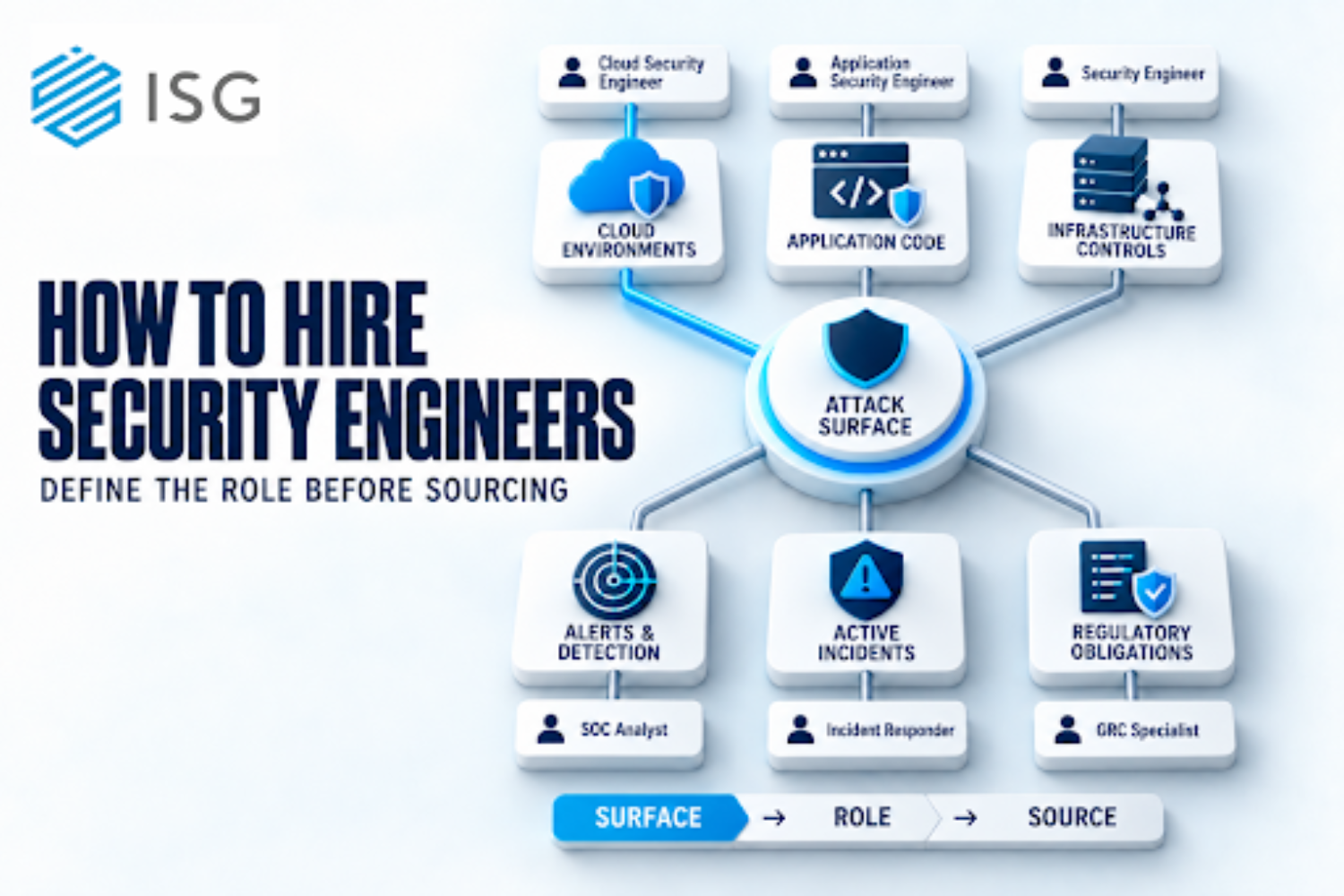
A security requisition that names a job title rather than an attack surface produces a search nobody runs well. The shortage sits at senior specialist level, while entry-level applications arrive faster than any team reviews them. Verification decides the outcome, and most companies hiring a first security engineer lack anyone internal qualified to verify.
Adjacent technical fields supply candidates the security market never surfaces. Security searches run long because the downside of a wrong hire stays unbounded. ISG Partners fills security roles through recruiters who source inside specialist technical markets, so weigh the recommendations below accordingly.
Which Security Role Does the Requisition Need?
A security requisition names an attack surface before a job title, because the surface decides the role. The request from a hiring manager usually reads the same way. We need a security person. That request names a budget, not a search.
Security job titles overlap heavily and carry different meanings at different companies. A security engineer at one company runs detection tooling. A security engineer at the next company reviews application code. Attack surfaces never overlap that way. Every surface has exactly one owner.
Six questions convert a headcount request into a search:
Which surface does the hire own?
Who covers that surface today?
What degrades while nobody covers it?
Which tools sit on the surface?
Who does the hire report to?
Which decisions does the hire make alone?
Answer all six and the title falls out. Answer none and the search runs on a keyword.
The table below maps each surface to the role that owns it, and to the cost of naming the wrong one.
| Attack surface owned | Role that owns it | What breaks when the requisition names the wrong role |
|---|---|---|
| Alerts and detection | SOC analyst | Detection coverage degrades and alerts age unreviewed |
| Infrastructure controls | Security engineer | Controls drift and configurations decay quietly |
| Cloud environments | Cloud security engineer | Misconfiguration exposure grows with every deployment |
| Application code | Application security engineer | Vulnerabilities ship alongside releases |
| System design | Security architect | Design flaws compound across every later build |
| Offensive testing | Penetration tester | Gaps stay unknown until an outsider finds them |
| Active incidents | Incident responder | Containment slows and damage widens |
| Regulatory obligations | GRC specialist | Audit findings and reporting gaps accumulate |
Where the Security Shortage Actually Sits
The security talent shortage sits at senior specialist level, while entry-level applications arrive in volume no team reviews.
Two descriptions of the same market sit side by side on every search results page. Employers describe roles nobody qualified applies to. Candidates describe postings with hundreds of applicants and no reply. Both descriptions hold at the same time.
The supply is not thin. The distribution is uneven.
Almost every security requisition filters at several years of security experience. One requisition applying that filter costs nothing. Every requisition applying the filter at once converts a distribution problem into a scarcity problem. The pool above the filter stays small, the pool below the filter grows, and neither pool ever meets the other.
The scarcity then gets reported as market conditions. Market conditions describe a decision the market did not make.
Two consequences follow. The senior pool costs more and moves slower than the plan assumes. The junior pool sits unscreened, and screening a pool that size takes work nobody budgeted.
Specialty depth widens the gap further. Cloud security and AI security carry the thinnest senior pools in the market, and compensation follows the scarcity. Security engineering holds the highest individual contributor position in every market we measure, ahead of the specialties taking the headlines. Our 2026 engineering compensation data on the security premium covers the figures by level and region.
Who Verifies Security Capability?
A hiring manager without a security background never evaluates security capability reliably, and most companies hiring a first security engineer face exactly that gap.
Every guide in this category recommends practical assessment over resume review. None of them names who designs the assessment or who grades the answer.
The gap compounds at the first hire. A company with no security function has nobody internal qualified to judge a security answer. The interview then measures confidence rather than capability, and confidence interviews well.
Three sources of borrowed verification work in practice:
A trusted practitioner outside the company, retained for two hours across the final panel.
A technical peer from an adjacent discipline, briefed to judge reasoning rather than domain depth.
A structured incident walkthrough, which surfaces process quality without requiring the interviewer to know the answer.
The incident walkthrough travels furthest. Ask the candidate to walk through one security event they investigated. How they gathered evidence. How they contained the threat. How they restored operations. How they reported the event upward. Judgment quality shows across those four steps even when the interviewer lacks the domain.
Scoring stays the harder half. Fixed criteria keep every panel member reading the same answer the same way. A hiring scorecard built before the first screen sets those criteria in advance.
One failure mode justifies all of the above. Technically strong security hires who never translate risk into business terms fail inside the first year. No credential predicts that failure.
What Do Certifications Predict?
Certifications price the offer and never predict the hire. Credentials operate as an initial filter inside HR, which moves compensation upward for the people holding them. Moving compensation is a market fact rather than a capability signal.
Filtering on credentials buys a smaller pool at a higher price. The credential proves study. The work proves capability.
Read credentials as one signal beside demonstrated work and situational judgment, then weight the second two higher.
How Do Adjacent Fields Feed Security Roles?
Security candidates arrive from network engineering, system administration, infrastructure operations, and software development more often than from the security market itself.
Four conversions repeat across our searches:
Network engineering into detection and infrastructure security.
System administration into identity and endpoint work.
Software development into application security.
Infrastructure operations into cloud security.
What transfers is systems reasoning, production familiarity, and comfort working from incomplete information. Those three carry most of the daily job.
What never transfers free is adversarial thinking and threat modeling. Both get taught inside a competent team. Neither arrives with the candidate.
One requirement blocks every candidate in these pools. The security-experience filter named in the section above removes them before a human reads the application. Removing that filter from a single requisition opens a pool the posting never reached.
Candidates already inside security behave differently. Specialists at that level never answer postings. Relationship sourcing and community presence reach them, and both take longer than a job board.
Why Do Security Searches Run Long?
Security searches run long because one wrong hire creates unbounded loss, and interview processes expand to price that risk.
Every source in this category complains about search duration. None of them connects the duration to the risk driving it.
Asymmetric downside explains the expansion. A wrong engineering hire costs a quarter of output. A wrong security hire costs an unmonitored surface for as long as nobody notices, and nobody noticing is the failure itself.
Panels grow. Rounds multiply. Approval chains lengthen. Every one of those decisions reads as rational in isolation.
The aggregate reads as irrational. Finalists accept competing offers while a fourth round gets scheduled, and the search restarts at zero with the surface still unowned. Our analysis of how many interview rounds a search survives covers where added rounds stop paying for themselves.
The fix is not fewer safeguards. The fix is a decided process before the search opens. Approved band. Locked panel. Named verifier. No gaps between rounds.
ISG Partners deploys a dedicated recruiter within 48 hours of kickoff, and most clients see first candidates in two to three days. Speed at the front of a search buys the room a careful panel needs at the end.
What Does an Open Security Role Expose?
An unfilled security role leaves a surface unmonitored, which makes vacancy an exposure question rather than a productivity question.
Vacancy cost across every other function gets counted in lost output. A seat sits empty and work slows.
Security inverts the count. The surface named in the requisition has no owner for the full length of the search, and the risk continues whether or not anyone watches.
The comparison that matters runs between a slow search and an unowned surface. Recruiting spend against salary answers a different question.
When Is Hiring Not the Answer?
Four situations resolve without a security hire, and opening a requisition inside any of them wastes a quarter.
Each one arrives disguised as a hiring problem.
The requisition names a title, not a surface. Fix the requisition first. A search never starts properly before the surface gets named.
Nobody internal verifies capability. Borrow verification before sourcing. A search ending in an unevaluable finalist ends nowhere.
The need is scoped work rather than a role. A compliance audit finishes. A penetration test finishes. Neither justifies permanent capacity, and neither fits an embedded engagement.
Nobody owns security internally. A hire reporting to nobody fails in security the same way the hire fails in every other function.
Where Does Your Security Requisition Sit?
Naming the surface, the owner, and the verifier converts a security headcount request into a search that closes.
Three moves decide the outcome. Surface before title. Verification before sourcing. A decided process before the first screen.
The same discipline applies to one senior security search and to sustained hiring across several security surfaces at once.
ISG Partners runs specialist searches inside your own ATS and reports time-to-fill, cost per hire, offer acceptance, and 90-day retention every month. Start with when an embedded engagement fits a specialist search, then book a discovery call and we name the surface together. Bring the requisition as written, because the gaps show up fast.
Common Questions About Security Hiring
Which security role does a first security hire cover?
A first security hire covers the surface carrying the most exposure today. Infrastructure controls or cloud environments in most companies. Name the surface first, then match the title to the surface.
Why do security searches take months to fill?
Panels expand to price the risk of a wrong hire, and every added round adds calendar time. Finalists accept other offers during the gaps between rounds rather than during the rounds themselves.
What do certifications predict about a security hire?
Certifications predict the price of the offer, not the quality of the hire. Credentials operate as an HR filter, which raises compensation for holders and shrinks the pool available to the search.
Where do security candidates come from outside security?
Network engineering, system administration, infrastructure operations, and software development all convert. Systems reasoning transfers intact. Adversarial thinking and threat modeling get taught after the hire rather than before.
Who verifies security capability when the hiring manager lacks a security background?
A practitioner retained for the final panel, a technical peer judging reasoning, or a structured incident walkthrough scored against fixed criteria. All three work without security depth on the panel.