
Seed Stage Hiring Sequence: The First 10 Hires, Derived Instead of Copied
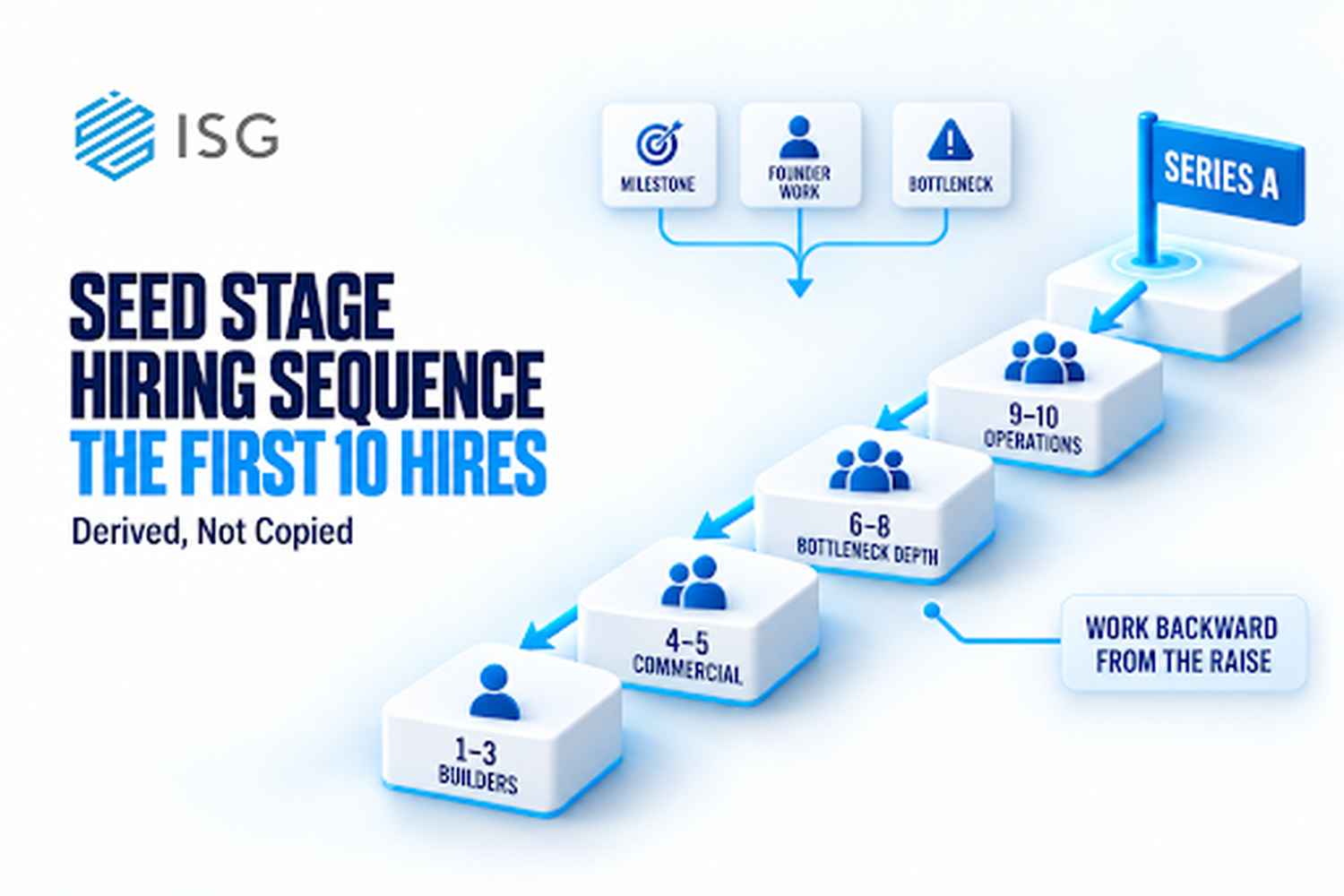
The seed stage hiring sequence gets derived from your Series A milestones, never copied from a published list. Three questions produce the order: what must be true at the next raise, what work do founders uniquely own, and what breaks first at the current pace. Founders hire builders first in most product companies, and the reasons matter more than the pattern.
Generalists beat specialists across the first ten because early work refuses to stay inside a title. Seed compensation runs cash-light and equity-heavy, priced honestly against the gap. Several roles never belong at seed at all. We work the funded end of this stage at ISG Partners, and the derivation system is below.
What Is the Right Seed Stage Hiring Sequence?
The right seed stage hiring sequence is an output of your milestones, not a template copied from another company. Published first-ten lists disagree at the edges and agree at the center, and both facts carry the same lesson.
The center holds because most product companies share early physics: something gets built, then sold, then supported. The edges disagree because every company runs different milestones, founders, and bottlenecks.
Copying a list imports someone else's milestones into your plan. Deriving the sequence from your own raise keeps every seat accountable to the only deadline that matters at seed: the metrics the next round gets priced on.
Which Three Questions Derive the Sequence?
Three questions derive the seed hiring sequence: what must be true at the Series A, what work do founders uniquely own, and what breaks first at the current pace. The first question sets the destination. The second question protects the work no hire replaces.
The third question sets the order of everything else. Run the three against your plan and the sequence writes itself, one seat at a time. Skip them and the sequence gets written by whoever complained loudest in the last planning meeting.
How Do Series A Milestones Set the Seed Plan?
Series A milestones set the seed plan because every seed hire exists to make the next raise true. Write the raise story first: the revenue, product, and proof points the round gets priced on. Work backward from the story to the seats.
A seat that moves a milestone gets funded. A seat that moves comfort waits. The backward discipline also prices the plan against runway, because every seat converts directly into months of cash. A hire that shortens runway without shortening the distance to the milestone is a luxury wearing a job title.
The Series A GTM sequence that follows picks up where the seed plan lands, which is exactly why the seed plan aims at that handoff.
Who Do Founders Hire First?
Founders hire builders first in most product companies, because the milestone story starts with something real to sell. The common shape across the first ten, once derived, is mapped below. Read the trap column as carefully as the role column:
| Hire band | The work that justifies the seats | The trap at this band |
|---|---|---|
| Hires 1 to 3: founding builders | Product owned end to end, shipped fast | Hiring specialists before the product knows what the product is |
| Hires 4 to 5: first commercial motion | Scaling demand the founders already proved | Hiring sales to find the motion instead of scale the motion |
| Hires 6 to 8: deepen the bottleneck | Depth wherever the pace breaks first | Copying another company's bottleneck instead of reading yours |
| Hires 9 to 10: first operations leverage | Admin, numbers, and logistics off founder plates | Building an ops layer before the ops exist |
The bands hold across most product companies. The seats inside each band come from your derivation, never from the table alone. A deep-tech company pulls technical depth forward. A B2B company with proven demand pulls the commercial band forward. The three questions decide, every time.
When Does the First Sales Hire Land?
The first sales hire lands when a founder-run sales motion works and needs scale, never before. Early selling is learning wearing a revenue costume. Founders talking to customers learn what the product is, what the objection is, and what the price survives.
Delegating those conversations delegates the learning, and the learning is the asset the Series A gets priced on. The release test governs the timing: hire when the founder is the bottleneck on work someone else does at equal quality.
Selling a proven motion passes the test. Discovering the motion never does. One title flag belongs here: a VP of Sales at seed buys a manager for a team of zero, and the seat fails for structural reasons before personal ones.
How Do Generalists Beat Specialists in the First 10?
Generalists beat specialists across the first ten hires because seed-stage work refuses to stay inside a title. The first engineer touches infrastructure, product decisions, and customer calls in the same week. The first commercial hire runs outreach, closes, onboards, and feeds the roadmap.
Range is the qualification, and the requisition describes the work instead of borrowing a big-company title. Titles get attached last, sized to the ladder the company grows into later.
The specialist cliff arrives on schedule: once a function stabilizes and the pace breaks on depth, the specialist seat earns funding through the same three questions. Specialists hired before the cliff solve problems the company has not reached yet, at salaries the runway feels immediately.
How Does Seed Compensation Work Across the First 10?
Seed compensation runs cash below market and equity above market, priced honestly against the gap. Our engineering research anchors the cash side: seed-stage engineering compensation sits near $165,000 while frontier employers pay far above the figure, and the gap never negotiates away.
Winning offers name the gap and price the upside. Ownership, scope, and speed carry the pitch, and how equity grants scale by role and stage governs the grant side of the same conversation. Grants step down by hire number and step up by scope, and the honest offer shows the candidate both curves.
Candidates comparing a seed offer against a public-company package deserve the real math, presented plainly, because the ones who join anyway are the ones the stage needs.
Who Does Not Belong at Seed?
Four seats never belong at seed: VP titles, a full-time recruiter, quarterly-work specialists, and an operations layer. VP titles buy managers for teams of zero, per the flag above.
A full-time recruiter fails the readiness math: seed hiring volume sits far below a seat of sustained load, and the six signals behind a first recruiter hire fire at zero for nearly every seed company.
Quarterly-work specialists solve scoped problems: a compliance audit, a security review, a brand refresh. Scoped work gets bought as scoped work and finishes. An operations layer at seed manages processes that do not exist yet, and the layer hardens before the company knows which processes deserve hardening. Every one of the four returns later, at the stage that funds them honestly.
How Do Seed Companies Resource Hiring Without a Recruiter?
Seed companies resource hiring through founder-led search first, one bought search second, and engaged capacity only at a funded burst. Founder-led search fits most of the first ten, because networks, investors, and referrals reach the early pool better than any posting.
One senior seat outside the network sometimes justifies a single bought search, priced at contingency benchmarks of 15 to 25 percent of first-year salary, and one search at that price beats a standing engagement below volume. Which recruiting model fits each funding stage maps the full ladder.
Honesty belongs here in plain words: most seed rounds sit below our engagement, and the plan above works without us. The exception is the funded burst, where a round lands with several roles opening at once, and how a dedicated recruiter runs a funded hiring burst shows the model that flexes back down after. We name the line on discovery calls, in both directions.
Key Takeaways: Derive the Sequence, Then Defend the Sequence
The seed hiring sequence comes from three questions run against your own Series A milestones, with founders keeping the learning work and every seat priced in runway. Write the raise story first. Fund the seats that move the story. Let the four wrong seats wait for their stage.
We work the funded end of seed at ISG Partners: a dedicated recruiter deployed within 48 hours when a round opens several roles at once, first candidates in two to three days for most clients, month to month in both directions, from one senior search through the burst and back down.
Bring the raise story to a discovery call, and we derive the sequence against the milestones together. The answer for most seed companies is founder-led hiring, and we say so when the derivation says so.
Frequently Asked Questions
Who should a startup hire first?
Most product companies hire a founding builder first, because the raise story starts with something real. The derivation questions override the pattern when your milestones differ.
How many hires does a seed round support?
The runway math answers per company: every seat converts into months of cash against the milestone distance. Counting seats before pricing runway reverses the equation.
Does a VP of Sales belong at seed?
A VP of Sales at seed manages a team of zero and fails structurally. Founders prove the motion, then the first sales hire scales the proven motion.
How much equity do the first 10 hires get?
Grants step down by hire number and step up by scope, governed by role-and-stage benchmarks. The honest offer shows both curves beside the cash gap.
When does a seed startup need a recruiter?
Almost never as headcount, and only at a funded burst as engaged capacity. The readiness signals fire at zero for nearly every seed company.