
Why Data Center Projects Stall on Hiring: The Timeline Nobody Sequences
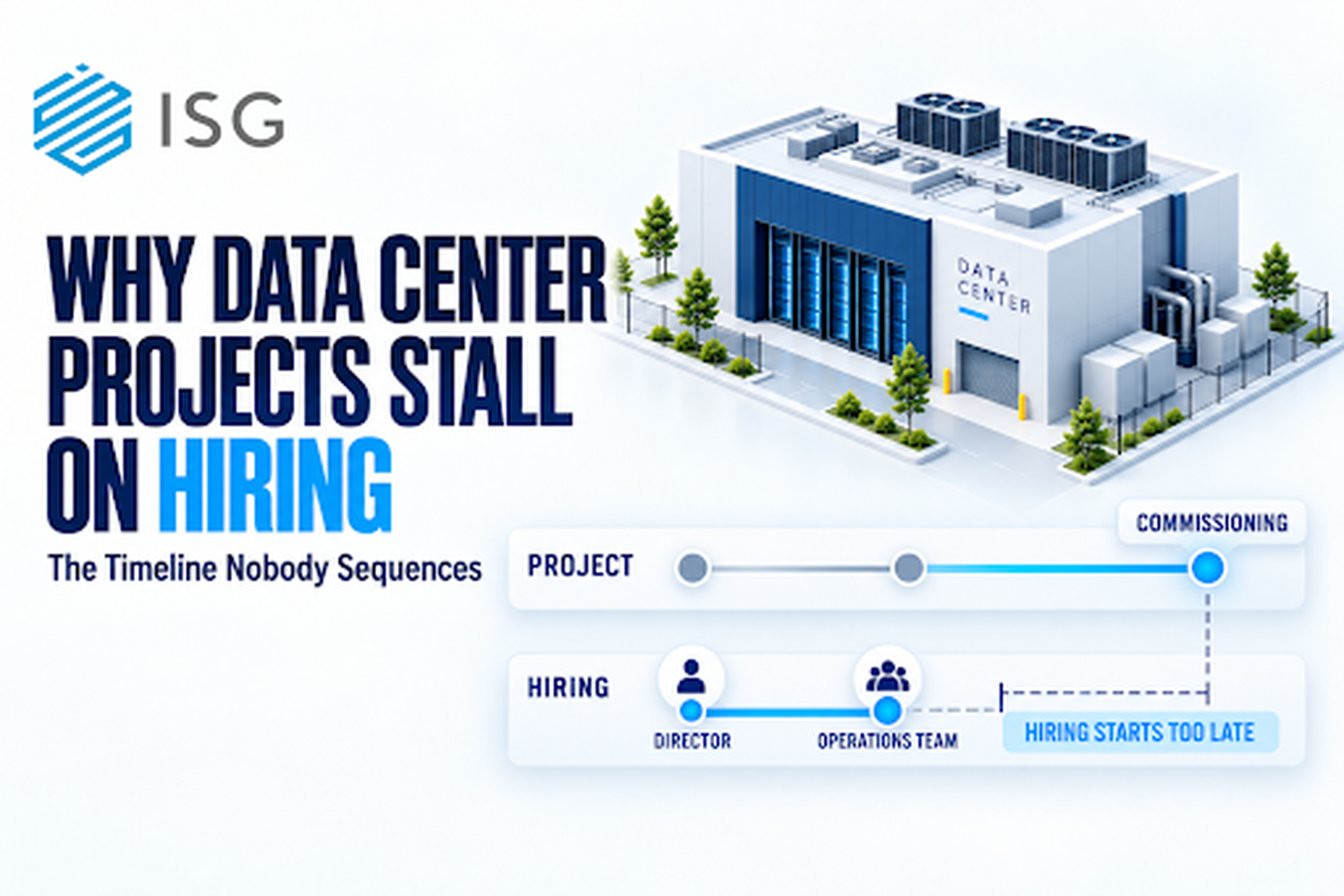
Data center projects stall on hiring because two clocks run unsequenced: commissioning dates get fixed years ahead, and operations hiring starts when the building looks nearly done. The talent shortage sits in a thin senior layer, concentrated worst in the newest markets. Critical-facilities searches run as heavy requisitions, so the late start meets the long search and the building finishes before the team exists.
Requisition lists understate the real seat count, because around-the-clock coverage multiplies every post. Every new build then staffs from the same regional pool, which stalls existing facilities through churn.
Workforce planning prevents the stall with a backward schedule. We run that schedule inside client engagements at ISG Partners, and the full sequence is below.
Why Do Data Center Projects Stall on Hiring?
Data center projects stall on hiring because operations recruiting starts at a construction milestone instead of a commissioning date. The commissioning date sits fixed in contracts years ahead. The hiring start floats, keyed to how finished the building looks.
A nearly finished building triggers the requisitions, and the requisitions then meet the market reality: senior critical-facilities searches run for months, in thin pools, often with relocation attached.
The two clocks never got sequenced, so the building finishes before the team exists. The stall reads as a talent shortage in the postmortem. The stall started in the project plan. Sequencing fixes what sourcing alone never fixes.
Where Does the Data Center Talent Shortage Sit?
The data center talent shortage sits in a thin senior operations layer, not in a missing workforce. Facility technicians, electricians, and mechanical trades exist in volume across adjacent industries.
Senior critical-facilities operators, the people who run live environments where downtime carries contract penalties, form the thin layer.
Experience in live critical environments takes years to build and transfers from a short list of prior settings. Every operator quotes the shortage as market conditions. The market condition is a distribution: deep pools of convertible adjacent talent, and a shallow pool of proven seniors that every project bids against at once.
Why Are Emerging Metros the Thinnest Talent Markets?
Capacity growth concentrates where land and power run cheap, and cheap land sits exactly where experienced operators never worked. Established hubs hold the talent depth. Emerging metros hold the construction cranes.
The inversion forces a decision on every project: import experienced leadership with relocation attached, or develop local talent on a timeline the commissioning date rarely allows. Compensation prices the decision.
Northern Virginia pays a 7 to 10 percent premium over Phoenix and Columbus for the same critical-facilities roles. Dublin sits 15 to 19 percent below Northern Virginia. A Director of Critical Facilities carries a $198,000 median in Northern Virginia, reaching $285,000 at the 90th percentile.
Metro-level data center compensation intelligence maps the full structure by market. Projects budgeting local-market pay for imported leadership discover the gap at the offer stage, which is the expensive place to discover anything.
How Does the Hiring Timeline Mismatch the Construction Timeline?
The hiring timeline mismatches the construction timeline because searches get scheduled by building progress and sized by hope. Construction runs on a published schedule with named milestones. Hiring runs on a feeling that the building looks close.
Critical-facilities roles are heavy requisitions by every measure: scarce specialty, senior stakes, and relocation in the emerging metros. Heavy searches consume months.
A search opened at substantial completion delivers a team somewhere after energization, and the facility runs its first months understaffed or borrowed. The backward schedule below replaces the feeling with a sequence:
| Project milestone | Hiring action | Search reality |
|---|---|---|
| Commissioning date fixed | Staffing plan written, seats counted | The date anchors everything backward |
| Multiple quarters out | Director search opens | Heaviest search, longest runway, relocation likely |
| Director landed | Leadership builds the team plan | Shift structure and ladder decided by the owner |
| Quarters before energization | Senior operator searches run | Thin pool, every project bidding at once |
| Construction closing out | Technician cohort hired and training | Adjacent conversions ramp inside the team |
| Energization | Full team operating | Coverage live from day one |
The table reads simple. The discipline is starting the first row years out instead of quarters out. Projects that write the staffing plan the week the date gets fixed never meet the stall.
When Does Project Staffing Start?
Project staffing starts the day the commissioning date gets fixed, with the Director search first. Leadership-first sequencing does the heavy lifting. The Director owns the shift structure, the hiring ladder, and the culture of the operations floor.
Every later hire lands better with the Director already in seat. Compensation structure supports the same order: a Director earns 2.7 to 2.8 times a Technician in every metro we measure, which describes a ladder built from the top. A project hiring technicians first buys bodies without a builder. A project hiring the Director first buys the person who fills every other seat.
Why Do Requisition Lists Understate Data Center Seats?
Requisition lists understate data center seats because one around-the-clock post multiplies into several hires. A facility running day and night needs three shifts to cover one post through a single day. Relief for weekends, vacations, sickness, and training rotations stacks on top. One line on the requisition list becomes a cohort in the staffing plan.
Underestimating the multiple leaves shifts uncovered, and uncovered shifts in critical environments convert directly into risk. Weight compounds the count. Every senior critical-facilities role qualifies as a heavy requisition, and how heavy requisitions change recruiter capacity shows the math: heavy searches count double in seat sizing, so a data center staffing plan loads recruiting capacity faster than the raw list suggests.
How Does the Poaching Loop Stall Existing Facilities?
Every new build staffs from the same regional pool, so hiring for the next facility stalls the facilities already running. The senior layer is thin and local. A new campus opening across the metro sources from the operators keeping current sites live. Every departure removes proven coverage from a critical environment.
Churn then spreads: backfilling the departed operator opens another search in the same thin pool, and the loop turns again. Retention becomes project strategy under those conditions.
Current market compensation, published ladders, and real progression keep operators from answering the recruiter across the street. The comp intelligence above is the currency of that defense, because operators know their market price before the counteroffer conversation starts.
How Does Workforce Planning Prevent the Stall?
Workforce planning prevents the stall with four moves: a backward schedule, a metro talent audit, adjacent conversion pipelines, and capacity that flexes by phase. The backward schedule anchors every search to the commissioning date, per the table above.
The metro talent audit runs before the site decision finalizes, because pool depth belongs in the site math beside land and power. Adjacent pipelines widen the thin layer deliberately. Capacity flexing matters because project hiring runs in phases: leadership search, senior cohort, technician cohort, then steady-state.
Capacity that moves with project phases covers the elastic side. The embedded model across data center build phases covers how a dedicated recruiter runs the sequence inside your systems.
Which Adjacent Industries Feed Data Center Teams?
Four adjacent industries feed data center operations reliably: military and naval power systems, hospital critical facilities, industrial plant operations, and telecom infrastructure.
Each background carries the transferable core: live-environment discipline, procedure adherence, and calm inside failure conditions. Facility-specific systems get taught inside a competent team.
The conversion pipeline demands one thing most requisitions block: removing the data-center-experience filter from technician and mid-level postings. The filter guards a thin pool while a deep one waits outside the door. Projects that build the conversion pipeline early stop bidding against every neighbor for the same seniors.
When Is Hiring Not the Stall?
Power queues, equipment lead times, and permitting stall more data center projects than hiring does, and hiring takes the late blame. Honest diagnosis runs one test. A hired team waiting on an unfinished building marks a construction stall. A finished building waiting on an unhired team marks the hiring stall covered here.
Confusing the two wastes the fix. One scope note belongs beside the test: commissioning itself is scoped contract work performed by specialist commissioning teams, and scoped work fits neither permanent headcount nor an embedded engagement. The operations team that runs the facility afterward is the search worth sequencing.
Key Takeaways: Sequence the Clocks
Data center projects stall when the fixed commissioning clock meets an unsequenced hiring clock, and the backward schedule closes the gap. Anchor every search to the commissioning date. Weight the seats for coverage and difficulty. Defend the pool you already employ.
We run the backward schedule inside ISG Partners engagements. A dedicated recruiter deploys within 48 hours and sources inside specialist critical-facilities markets. Monthly reporting covers time-to-fill, cost per hire, offer acceptance, and 90-day retention.
Engagements span a single Director search through full facility team builds. The engagement process from kickoff to reporting shows the structure. Bring the commissioning date to a discovery call, and we build the staffing schedule backward from the date together.
Frequently Asked Questions
Why does staffing delay data center projects?
Hiring starts at construction milestones while commissioning dates sit fixed, and heavy searches run for months. The late start meets the long search at energization.
When does hiring start for a new data center?
Hiring starts the day the commissioning date gets fixed, Director search first. Leadership landed early fills every later seat faster.
Which data center roles are hardest to fill?
Senior critical-facilities operators and Directors form the thinnest pool in every market. Adjacent industries supply convertible technicians in volume.
How does metro location change the search?
Emerging metros hold the projects and lack the operators, forcing an import-or-develop decision. Northern Virginia pays 7 to 10 percent over Phoenix and Columbus.
Do candidates from outside data centers convert?
Military power systems, hospital facilities, plant operations, and telecom convert reliably. Live-environment discipline transfers. Facility systems get taught after the hire.