
When to Hire Your First In-House Recruiter: Six Signals That Decide the Timing
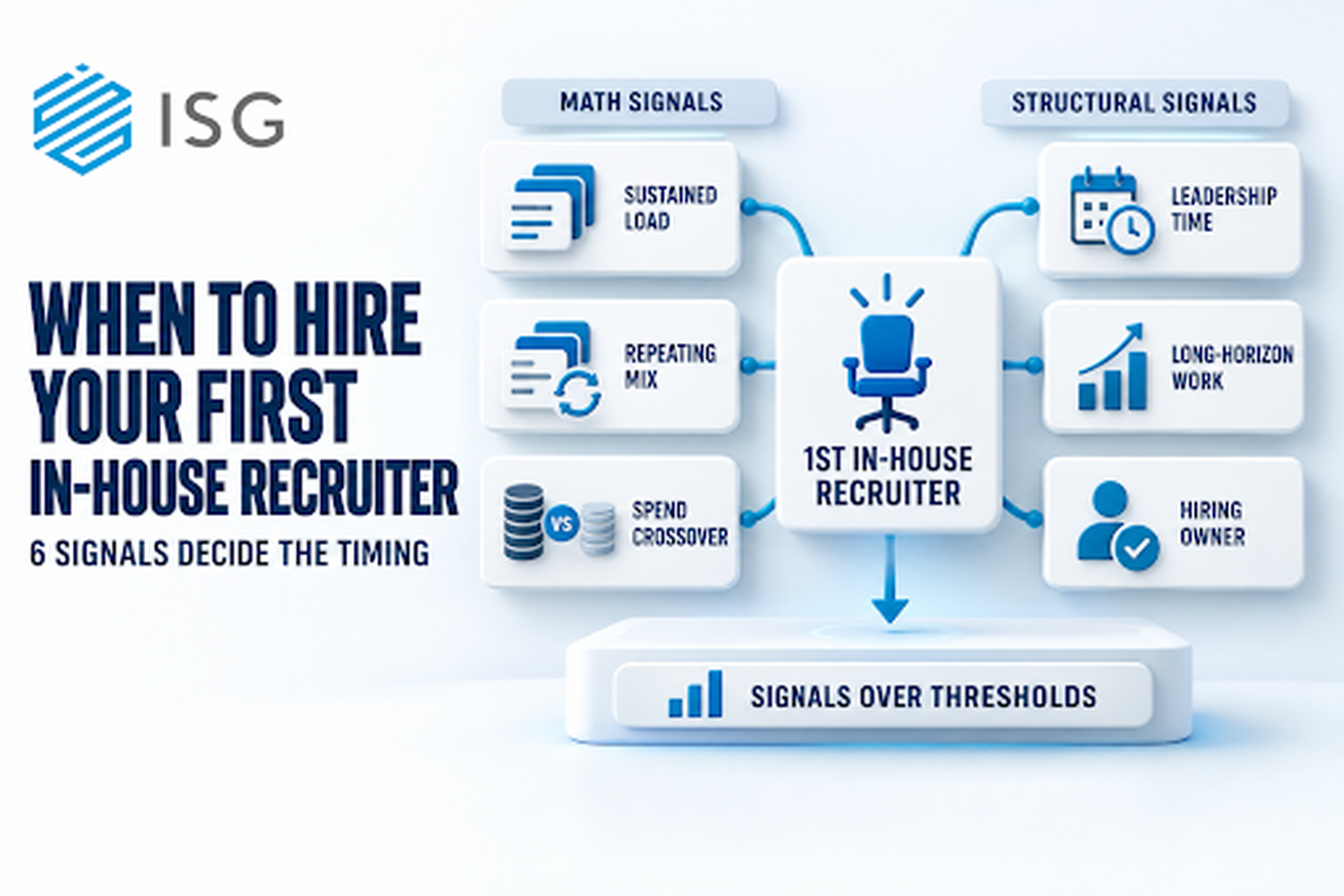
The first in-house recruiter joins when six readiness signals fire, never at an annual hire count. Published hire-count thresholds mislead because count, shape, and mix measure three different things. Three math signals test the plan: sustained concurrent load, repeating-profile share, and spend crossover. Three structural signals test the company: leadership time drain, unowned long-horizon work, and a named hiring owner already in place.
A full-cycle recruiter comes before a talent acquisition manager in almost every plan. Timing works against the future peak, because ramp consumes months before output arrives. We run the embedded side of the same sequence at ISG Partners, and the six signals are below.
When Does a Company Need Its First In-House Recruiter?
A company needs its first in-house recruiter when the hiring plan sustains a full seat and the structure supports the seat. Readiness lives in six signals. Annual hire counts appear in almost every published answer, and the published counts disagree with each other widely.
The disagreement has a cause. Hire count, requisition shape, and role mix measure three different things. Requisition mix inside the model comparison shows why mix outranks count in the model decision. Timing follows the same logic. Test the six signals against your own plan, and the answer stops depending on whose threshold you read.
Why Do Annual Hire-Count Thresholds Mislead?
Annual hire-count thresholds mislead because a year total hides the shape and the mix that decide recruiter workload. Twenty hires spread evenly across four quarters fill a seat comfortably. Twenty hires concentrated into one funding-round quarter drown a seat and then starve the seat. Same count, opposite answers. Mix cuts the same way.
Twenty hires of one repeating profile compound: one calibration, one pipeline, filled again and again. Twenty different roles restart the work at every opening. The honest unit is concurrent weighted load, and weighted requisition math behind seat sizing covers the counting method. A recruiter seat holds six to ten concurrent weighted roles. Readiness starts where the plan sustains that number.
What Are the Six Signals of In-House Readiness?
Six signals decide readiness: three test the math of the plan, and three test the structure of the company. Each signal has a test a founder runs in minutes. The full set maps below:
| Signal | The test | The signal fires when |
|---|---|---|
| Sustained concurrent load | Weighted open roles per quarter, next four quarters | Load holds at or above six roles in most quarters |
| Repeating-profile share | Share of planned roles matching a repeated profile | Repeating roles dominate the plan |
| Spend crossover | Expected placements priced at agency fees vs one internal seat | External fees pass the fully loaded seat cost |
| Leadership time drain | Weekly leadership hours spent sourcing and screening | Hiring consumes output priced far above recruiting work |
| Unowned long-horizon work | Employer brand and nurture pipelines, owner named or not | Nobody owns work that compounds across years |
| Hiring owner in place | One named person approving intake and chasing feedback | The owner exists before the seat gets funded |
Two or three signals firing starts the conversation. Five or six firing means the seat is late. Zero firing means the plan belongs on flexible capacity for now.
Which Math Signals Justify the Seat?
Three math signals justify the seat: sustained load, repeating mix, and spend crossover. Sustained load is the anchor test. Map the next four quarters from the 12-month plan that maps roles to quarters, weight the heavy searches, and read the quarterly peaks. A seat justified by one loud quarter sits idle for three quiet ones.
Repeating mix is the compounding test. Payroll pays off where pattern recognition compounds, and pattern recognition compounds on repeated profiles. Spend crossover is the finance test. Price the expected placements at contingency benchmarks of 15 to 25 percent of first-year salary.
Compare the total against one fully loaded internal seat, on your own numbers. Fees passing the seat cost make the finance case. Fees below the seat cost mean the fixed seat subsidizes quiet quarters.
Which Structural Signals Justify the Seat?
Three structural signals justify the seat: leadership time drain, unowned long-horizon work, and a hiring owner already in place. Leadership drain is the expensive signal. Founder and executive hours spent sourcing and screening carry the price of the work displaced.
The displaced work is product, revenue, and fundraising. Long-horizon work is the quiet signal. Employer brand, candidate nurture, and talent community presence compound across years, and compounding work belongs to permanent headcount.
No engagement window holds a five-year nurture cycle. The owner signal is the prerequisite. One named person approves intake, chases interview feedback, and closes stale requisitions. A recruiter hired into an ownerless process inherits the blame for the process. Fund the owner first, then the seat.
Who Comes First: a Recruiter or a Talent Acquisition Manager?
A full-cycle recruiter comes before a talent acquisition manager in almost every first-hire plan. The first seat does the work: sourcing, screening, coordination, and offers, end to end. A talent acquisition manager owns strategy, employer brand, and a team of recruiters.
Strategy without execution capacity produces documents. A management layer over zero recruiters manages nothing. Titles mislead here the way they mislead everywhere, so define the seat by the work of the first quarter and attach the title afterward.
When Does a Talent Acquisition Manager Come First?
A talent acquisition manager comes first only when a multi-seat function is already funded. A plan opening several recruiter seats inside the same year justifies hiring the builder of the function before the function. The manager then designs the process, hires the recruiters, and owns the outcome. Every other plan starts with hands.
How Does Timing Work Around Recruiter Ramp?
Recruiter timing runs against the future peak, because months separate the decision from the output. The search for a strong recruiter takes months, and full productivity takes months more. A seat opened when the pain arrives produces after the pain peaks.
Read the plan two quarters ahead and hire against the load coming, not the load present. The recursion inside the search deserves one more sentence: hiring a recruiter consumes the exact capacity the company already lacks, and the model comparison linked above covers the mechanics.
Ramp shortens against a live pipeline. A first recruiter inheriting warm pipelines, calibrated scorecards, and moving candidates produces in weeks. A first recruiter inheriting an empty tracking system rebuilds the function from zero while the requisitions age.
How Does Embedded Recruiting Fit Around the First Internal Hire?
Embedded recruiting holds the hiring plan before the internal seat, hands over live pipelines at ramp, and covers the specialist edges after. The sequence runs in one order. Embedded capacity carries the burst while the recruiter search runs.
The internal hire lands and ramps inside working pipelines instead of an empty system. Embedded capacity then steps down, or narrows to the searches outside the internal skill set. The engagement structure around a first internal hire shows how the handover runs inside your own systems. One honest line belongs here.
The internal hire replaces part of what we sell, and the advice stays the same. Companies with sustained, repeating, level plans belong on payroll capacity, and we say so on discovery calls weekly.
The engagement model spans a single senior search through full team builds, which is exactly why the timing question relaxes. Elastic capacity makes an imperfect timing call cheap. A permanent seat makes the same call expensive.
When Is Hiring an Internal Recruiter the Wrong Move?
Four timing situations make the internal hire wrong: spike-shaped plans, unlocked headcount, a missing owner, and load below one seat. Spike-shaped plans burst and quiet. A permanent seat sized for the burst idles through the quiet, and holding hiring capacity flexible through plan changes covers the elastic alternative.
Unlocked headcount means roles without sign-off, and roles without sign-off never become searches. Lock the plan, then resource the plan. A missing owner repeats the structural warning above: capacity added to a broken process breaks faster.
Load below one seat band means the math signal never fired, and a seat below capacity is a subsidy wearing a job title. Waiting is a decision too, and sometimes waiting is the right one.
Key Takeaways: Signals Over Thresholds
The first in-house recruiter joins when sustained load, repeating mix, and spend crossover meet a named owner, funded long-horizon work, and protected leadership time. Test the six signals, not a borrowed threshold. Hire against the future peak. Sequence the models instead of choosing one forever.
We run the embedded side of that sequence at ISG Partners. Dedicated recruiters deploy within 48 hours. First candidates arrive in two to three days for most clients. Engagements run month to month, in both directions, from one senior search through sustained team builds.
Bring your hiring plan to a discovery call, and we run the six signals against the plan together. The answer sometimes points at payroll, and we name that answer plainly when the signals say so.
Frequently Asked Questions
How many open roles justify a first in-house recruiter?
Sustained concurrent load at or above six weighted roles per quarter justifies the seat. Annual totals mislead. Read the quarterly peaks, weighted for difficulty.
Does a recruiter or a talent acquisition manager come first?
A full-cycle recruiter comes first in almost every plan. A talent acquisition manager comes first only when a funded multi-seat function needs a builder.
How long until a first in-house recruiter produces hires?
Months pass between the decision and full output: the search runs, then ramp runs. Warm pipelines shorten the ramp. Empty systems stretch the ramp.
Do outside recruiting partners still fit after the internal hire?
Outside capacity narrows to specialist searches, surge quarters, and confidential work. The internal seat owns the repeating profiles where pattern recognition compounds.
When does seasonal or spike hiring justify an internal recruiter?
Spike hiring rarely justifies a permanent seat, because the seat idles between spikes. Elastic capacity matches spike-shaped plans. Payroll matches level plans.